
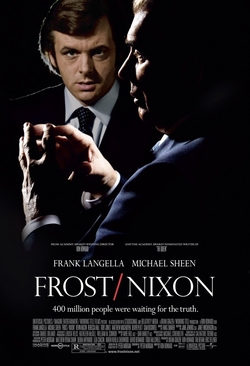
Behind the film
- Year
- 2008
- Director
- Ron Howard
- Writers
- Peter Morgan
- Runtime
- 2h 2m
- Genres
- Biographical, Drama
- Production
- Working Title Films, Imagine Entertainment, StudioCanal
- Country
- France, United States, United Kingdom
- Cast
- Frank Langella, Kevin Bacon, Toby Jones, Oliver Platt, Michael Sheen, Sam Rockwell, Matthew Macfadyen, Rebecca Hall
About the film
Contains story spoilers.
Frost/Nixon begins with a resignation that leaves a question hanging over American public life. Richard Nixon departs the presidency in 1974, and British television host David Frost watches from Australia, struck by the size of the audience. President Ford's subsequent pardon removes the prospect of a criminal trial. Frost sees an interview as both an event people would watch and a route back into American television, where his own career has faded. Producer John Birt doubts that a presenter associated with entertainment can get the answers viewers expect. For researcher James Reston Jr., who later joins the project, the interviews ought to provide the confrontation that the courts will never deliver. Frost starts with a commercial instinct; the people around him bring demands that make an ordinary celebrity conversation impossible.
Nixon's representative, Swifty Lazar, negotiates a substantial payment, and Frost commits himself before securing a network to carry the programme. Nixon needs money and hopes a friendly interviewer will give him room to recover his reputation. Frost meets Caroline Cushing on his flight to California and brings her into the unfamiliar world of presidential aides and guarded hospitality. At San Clemente, Nixon is cordial, curious about his guest and conscious that the proposed conversation is a contest. Frost hands over a deposit that he can barely afford. When American broadcasters decline the project, he seeks investors and sponsors himself. Friends and personal funds become part of the gamble, while a patchwork of local stations offers a possible audience. The question of who will pay sits beside the question of who will control the interview.
By 1977, Birt, Reston and Bob Zelnick are preparing research from their hotel base while Frost is frequently out trying to keep the venture financially alive. Their contract divides the conversations into four areas, including Nixon's record, foreign affairs, Vietnam and Watergate. The preparation does not translate into control once the cameras roll. Nixon can turn a short question into an anecdote that consumes the available time, choosing his pace and moving attention toward achievements he wants remembered. Frost lets answers run, and his team watches its carefully assembled challenges disappear into polite exchanges. A sponsor withdraws. Away from the set, Frost keeps up a sociable front, including a birthday dinner, while Nixon is shown alone at his piano. Each man is relying on television to change the direction of a career, but Nixon appears to understand this particular performance better.
The film makes its turning point a late-night telephone call from an intoxicated Nixon. He talks about their modest beginnings, resentment of social elites and the need to win. This private conversation is Peter Morgan's invention, not an authenticated exchange between the historical men. Within the drama it strips away Frost's comfortable manner: he can no longer assume charm and a famous guest will be enough. Facing trouble with his existing television work as well as the interview project, he finally studies the evidence with sustained attention. Reston goes to Washington to pursue an unpublished transcript that the team believes can establish Nixon's earlier knowledge of the cover-up. The researchers now have a specific sequence to challenge, and Frost has to turn their preparation into questions that Nixon cannot simply talk past.
In the final session, Frost presses Nixon on the transcript and on the powers he claimed as president. Nixon's assertion that a presidential action cannot be illegal brings the dispute into the open. Aide Jack Brennan calls a break as the exchange becomes dangerous for his employer, but the resumed conversation produces an admission that Nixon let the American people down. The team celebrates the breakthrough; the film also stays with the former president after the public performance has ended. Frost visits him again before leaving and brings a farewell gift of shoes, recalling Nixon's earlier interest in his footwear. The broadcasts restore Frost's fortunes and repay his backers, while Nixon never returns to elected office. Morgan's adaptation of his own play builds that outcome around a dramatized personal duel, rather than presenting every scene as a documentary record.
Ron Howard's approach to the actors helps explain why the exchanges can hold the screen without constant changes of setting. Michael Sheen and Frank Langella had already played Frost and Nixon on stage. Langella described eighteen months of developing a shared sense of rhythm across productions; for the film, he could reduce a gesture to something as small as a raised eyebrow because the camera was close. Even the subtle makeup took two and a half hours. Howard let the actors take their time and found the useful moments in editing. He also avoided film rehearsals to keep performances fresh, allowing camera operators to discover movement before collecting necessary extra shots. For the invented phone call, he placed the two sets side by side and filmed both actors simultaneously, with two cameras on each. Neither performance depended on receiving lines from an off-camera stand-in. The method preserves the sense of two people listening and responding even while the finished scene keeps them physically apart.