
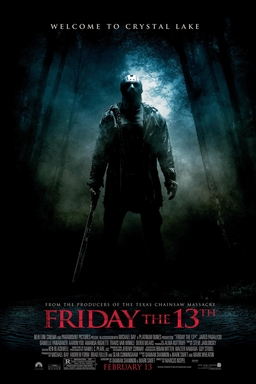
Behind the film
- Year
- 2009
- Director
- Marcus Nispel
- Writers
- Damian Shannon, Mark Swift
- Genres
- Horror, Slasher
- Production
- Paramount Pictures, New Line Cinema, Platinum Dunes
- Country
- United States
- Cast
- Derek Mears, Nana Visitor, Jared Padalecki, Danielle Panabaker, Amanda Righetti, Travis Van Winkle, Julianna Guill, Aaron Yoo
About the film
Contains story spoilers, including the ending.
Friday the 13th brings Clay Miller to Crystal Lake looking for his missing sister, Whitney. Jared Padalecki plays Clay in Marcus Nispel's 2009 horror film, with Amanda Righetti as Whitney and Derek Mears as Jason Voorhees. Clay keeps searching despite warnings from local people and the police. The abandoned cabins and woods offer few answers, until he meets Jenna, played by Danielle Panabaker. She has come to the lake with friends for a weekend at a house belonging to Trent's parents. Trent, played by Travis Van Winkle, hopes the trip will bring him closer to her. Jenna instead helps the stranger asking about his sister. Clay's personal search draws him into the group's holiday, while the surrounding woods belong to a man armed with a machete. Neither the visitors' plans nor Clay's determination account for the danger of entering Jason's territory.
Whitney has survived an earlier camping trip in which Jason killed her companions. He keeps her because she resembles his mother, whose beheading he witnessed as a child. Six weeks later, Clay and Jenna see him carrying a body at the old camp. They hurry back to warn the others, but Jason attacks the house and kills the police officer who arrives to help. Trent dies after reaching the road. Clay and Jenna return to the camp, where Clay finds Whitney chained inside Jason's underground home. He frees her, but Jenna is killed as they try to escape. Cornered in a barn, Whitney pretends to be Jason's mother, giving the siblings a chance to fight back. They subdue him with a chain, and Whitney drives his own machete into his chest. After daybreak, brother and sister throw his body into the lake. Their escape seems complete until Jason bursts through the dock and grabs Whitney. Finding his sister has brought Clay to the place where Jason can reach them both again.
Crystal Lake and its underground passages belong to a new version of the story, assembled from parts of the early films. Producers Brad Fuller and Andrew Form described borrowing favourite deaths and story ideas rather than following one earlier instalment from beginning to end. They wanted a contemporary setting, with clothes and cars belonging to the young people of the time. The lake itself remained essential. Form also described Jason's underground system as a place where he lives and operates, giving the killer a home beneath the visitors' holiday surroundings. Fuller resisted making the whole film an explanation of Jason's childhood. He wanted to keep the character frightening without asking the audience to feel sorry for him. That leaves Clay's search and the friends' weekend to carry the human activity around Jason's attacks.
Mears approached Jason as someone able to survive in the woods and plan what he does there. He read about survivalists and child development, and thought of the character partly through John Rambo in First Blood. His account stresses a killer who thinks ahead and sets people up. The costume gave that idea a worn, practical shape. Two jackets were joined together, combining a textured hunting-style collar with the longer body of a military jacket. Beneath a thin, damaged shirt, Scott Stoddard's chest prosthetic allowed muscle movement to remain visible. Mears described a slight spinal curve and a hump, as well as the deformed head. A false eye was attached to his face rather than the mask, so it would stay in place when the mask moved. These details also affected the work: with one eye covered, Mears had to judge his steps carefully during action scenes because his depth perception had changed.
Stoddard's work extended from Jason's body to the damage inflicted on the other characters. In an Interview magazine feature, he demonstrated injury makeup on Van Winkle, recreating wounds for a photograph away from the film set. The demonstration is useful to distinguish from Trent's actual death in the story. Stoddard had spent three months on location in Texas and described the makeup department's close contact with actors during a film full of violent deaths. Designing Jason's face was a particularly guarded part of the assignment, requiring roughly four hours in the makeup chair. Stoddard wanted the face to carry some sympathy as well as fright. Fuller, however, said he did not want audiences to feel sorry for Jason. His concern was the way the story might explain the killer and make his violence seem sympathetic.
The woods and lake were also a practical construction problem. Nispel told Student Filmmakers that Texas had to stand in for New Jersey, with the team working out how to supply the camp and lake the story needed. Returning to Austin brought back many crew members he already knew. Daniel Pearl photographed the film, and Nispel described a pace of roughly forty to fifty setups a day. He usually limited actors to three takes, hoping to keep their performances immediate. Effects were another calculation within that schedule. Blood on costumes could require a change before filming continued, so some was added digitally later. Nispel preferred most of an effects scene to be physically present, reserving computer work for a small part of the dangerous moment. The method joined practical performances to adjustments that could be made after shooting.
Nispel also wanted room for humour among the young characters. Speaking to ComingSoon, he distinguished the film's tone from sustained dread and said the levity should come from the kids. Aaron Yoo and Arlen Escarpeta supplied much of that lighter behaviour. The forest and underground spaces guided his visual approach, rather than a decision to repeat the appearance of his earlier work. Sound could misdirect the audience too. Nispel said he wanted the familiar vocal motif associated with Jason to accompany false alarms, leaving the real attacks unannounced. The aim was to keep recognition from becoming a dependable warning. A familiar sound could make someone brace for a scare without telling them when Jason would actually strike.