
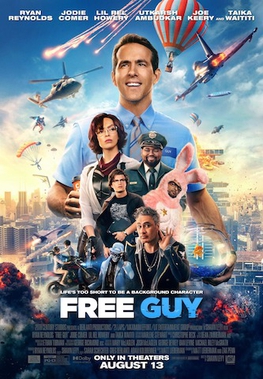
Behind the film
- Year
- 2021
- Director
- Shawn Levy
- Writers
- Zak Penn, Matt Lieberman
- Runtime
- 1h 55m
- Genres
- Action, Comedy, Fantasy, Science fiction
- Production
- 20th Century Studios, 21 Laps Entertainment, Berlanti Productions
- Country
- United States
- Cast
- Ryan Reynolds, Taika Waititi, Lil Rel Howery, Joe Keery, Camille Kostek, Jodie Comer, Utkarsh Ambudkar, Channing Tatum
About the film
Contains story spoilers, including the ending.
Free Guy gives its hero a familiar job inside a deeply unfamiliar reality. Ryan Reynolds plays Guy, a bank teller who discovers that his world is an open-world video game and that he has been a background character in it. Shawn Levy directs the 2021 film from a screenplay by Matt Lieberman and Zak Penn. The discovery gives Guy an opportunity to rewrite his part in a place where the rules were established by someone else. It also comes with a deadline: the world he knows is threatened, and the people who designed it have the power to wipe away lives that seem real from inside.
Free City rewards its players for causing chaos. Guy and his best friend Buddy, played by Lil Rel Howery, are among the residents whose daily lives take place beneath that mayhem. Guy's encounter with Molotov Girl opens a different possibility: he can participate actively while choosing to help people. Jodie Comer plays both the in-game adventurer and Millie, the woman controlling her. Outside the game, Millie believes its owner Antwan stole code created by her and Keys. Taika Waititi plays Antwan, with Joe Keery as Keys and Utkarsh Ambudkar as Mouser. Guy's growing popularity makes his good deeds a business problem for a company preparing another violent game. Antwan orders his programmers to remove him. The cheerful character's attempt to choose his own purpose therefore becomes entangled with Millie's effort to reclaim what she helped create, each threatening the company's control from a different direction.
Guy's sunglasses reveal the interface hidden from ordinary residents, and his helpful actions make him a sensation among players. A server reset interrupts his awakening, but a kiss from Molotov Girl restores his memories. He remembers seeing the hidden island containing Life Itself, Millie and Keys' original creation, reflected in his apartment's blinds. The attempt to reach it becomes a race against Antwan, who attacks the physical servers with an axe as Free City collapses. Millie bargains away her claim to the commercial game in exchange for the original code and the surviving world. The recovered creation becomes Free Life. Guy remains there rather than entering the human world, and Buddy returns after seeming to vanish with the destruction. The romance also changes direction: Guy helps Millie recognise that Keys programmed into him the qualities of the woman Keys loved. She leaves the game to find her creative partner, while Guy's own future opens beyond his old routine.
That routine was a structural tool as well as a running joke. Lieberman and Penn told The Ringer that repeated actions make changes in a character visible: the setting can repeat while the person responds differently. The early screenplay had a cynical Guy who was already dissatisfied. Reynolds pushed towards an innocent character who liked his life, allowing his discovery to take him further. Penn also strengthened the story outside Free City, treating Millie as an important point of entry for the audience and developing her history with Keys. Guy's realisation that he lives in a game moved later in the narrative. These revisions make awareness something the story builds towards, rather than a fact its hero immediately understands. The evolving screenplay also tied the in-game romance to a relationship outside it, giving Millie's investigation an emotional outcome as well as a dispute over ownership.
Cinematographer George Richmond gave the two worlds different visual rules. Free City was photographed in large format with spherical lenses, aiming for broad views, straight vertical lines and comparatively little distortion. The real-world scenes used anamorphic lenses and more active camera movement. Handheld work and deliberately imperfect motion distinguish that environment from the game's more controlled camera platforms. A robot arm was used for some movements whose abrupt stops could suggest a game's point of view. Colour follows a related division: the game is warmer, more saturated and more contrasty, while the outside world is flatter and cooler. Richmond also reduced colour differences between office lighting and daylight in the company scenes. The distinction means the film can move between Millie at a computer and Guy inside its constructed reality while giving each place its own texture, rather than relying entirely on dialogue to explain the change.
Production designer Ethan Tobman extended that distinction into Guy's home. The creative team established separate rule books for the real and game worlds so that camera use, colour and design would agree about where a scene belonged. Guy's apartment was built around the idea of a resident whose developers had not fully finished him. It contains pencils without a sharpener, a calendar missing Tuesdays and colour-matched books without written spines. Such details make his limited existence part of the room, beyond the dialogue explaining his status. The climax's oversized counterpart, Dude, needed another combination of physical and digital work. Aaron Reed supplied the enormous body, with Reynolds and Reed involved in the action alongside the stunt and effects departments. The team's roundtable account describes collaboration across those departments, keeping actors in the scenes where possible while planning the moments that required other performers or effects.
Lieberman identified the sunglasses discovery as an essential scene that survived every draft. The audience has to accept that one change in Guy's perception reveals a world that has been surrounding him all along. He also singled out a heart-to-heart with Buddy, where the characters question what their lives and programming mean. Those two moments connect the film's large visual idea to a friendship already present in the script. Lieberman said that relationship grew during filming, while Levy helped balance the comedy, action and affection. The concept becomes understandable through Guy's changing choices and the people he cares about, even for someone unfamiliar with open-world games.