
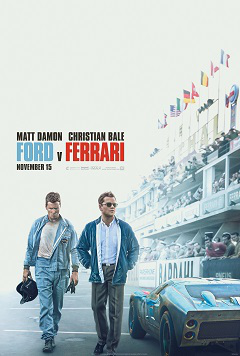
Behind the film
- Year
- 2019
- Director
- James Mangold
- Writers
- Jez Butterworth, John-Henry Butterworth, James Mangold, Jason Keller
- Runtime
- 2h 32m
- Genres
- Biographical, Drama, Action, Sport
- Production
- Chernin Entertainment, 20th Century Studios, Walt Disney Studios Motion Pictures
- Country
- United States, France
- Cast
- Matt Damon, Christian Bale, Jon Bernthal, Caitríona Balfe, Noah Jupe, Josh Lucas, Tracy Letts, Remo Girone
About the film
Contains story spoilers.
Ford v Ferrari begins with a business failure that becomes a public contest. Ford vice president Lee Iacocca proposes buying Ferrari, whose racing team dominates Le Mans; Enzo Ferrari rejects the arrangement, and Henry Ford II answers by ordering his company to beat Ferrari at its own event. That decision brings in Carroll Shelby, a former Le Mans winner who has turned from driving to building cars after heart trouble ended his racing career. Shelby can sell a vision to executives, but a race car cannot be produced by a boardroom vote. The film's central tension forms between Ford's corporate scale and the people who must make a machine survive a day and night at speed.
Shelby chooses Ken Miles, a British driver and mechanic with a precise sense of how a car behaves. Miles can identify what is wrong with the GT40 through testing, then explain it in terms engineers can use; he is also impatient with public relations and executive etiquette. The film shows the pair developing the car in a hangar, with Miles pushing its limits and Shelby translating his findings into a program Ford will fund. Their friendship runs on trust and argument. Shelby knows Miles's ability is essential, but he also understands that the company can remove both of them if they cannot show progress in a form management accepts.
At the Mustang launch, Miles gives Ford executive Leo Beebe a brutally honest assessment of the car, making himself a liability in Beebe's eyes. Shelby is told to leave Miles off the Le Mans team. The first Ford effort fails to finish, and Miles listens to the race on the radio, hearing the weaknesses he warned about. Ford demands an explanation from Shelby, who points to the GT40's raw speed as proof that the project frightened Ferrari even before it became reliable. He persuades Henry Ford II to continue, with direct authority over the work. Testing the GT40 Mk II brings immediate danger: brake fade leads to a crash and fire, forcing the team to treat the stopping system as a race-long problem rather than a minor repair.
When Beebe takes control of Ford's racing division, Shelby has to maneuver around the executive structure to get Miles another chance. He gives Ford II a ride in the GT40 and makes a wager: if Miles wins Daytona, he gets to drive at Le Mans; if not, Ford takes Shelby American. At Daytona, Beebe's team fields a rival car with a NASCAR pit crew, while Shelby lets Miles exceed the engine's stated limit. Miles wins, earning the seat. At Le Mans, a faulty door forces an early pit stop, but Miles recovers and sets a punishing pace. Later, when the brakes fade during a duel with Ferrari driver Lorenzo Bandini, the crew replaces the entire assembly. Ferrari protests; the rules allow it, and Miles returns to the track.
As the race wears on, mechanical strain and driver skill determine which cars remain. Miles battles Bandini until the Ferrari drops out, leaving Ford in the leading positions. Beebe asks Shelby to slow Miles so that three Fords can cross together for a company photograph. Shelby passes the choice to Miles rather than pretending it is a racing decision. Miles gives up his lead on the last lap and crosses alongside McLaren's Ford, shared with Chris Amon, only to learn that the dead-heat rule awards the win to the car that covered more distance from its starting position. McLaren and Amon started farther back, so Miles is officially second. The film's final scenes return to the quiet bond between the two men and Miles's son Peter, grounding the race's spectacle in a personal loss.
The finish reflects the real 1966 Le Mans photo finish and the ruling that denied Miles first place, but the film shapes the surrounding conflict into a focused drama. Its Leo Beebe is a persistent antagonist, and dialogue and timing of Ford's order are presented for the story; they should not be treated as a documentary record of every conversation or motive. The leading cars were shared by two-driver teams: Miles and Denny Hulme drove the No. 1 Ford, while Bruce McLaren and Chris Amon shared the No. 2 car that was declared the winner because it had started farther back. The film gives most of its attention to Miles and McLaren, which makes the result feel like a personal reversal, though both cars had a second driver. The ending moves beyond the race to Miles's fatal test of an experimental Ford at Riverside two months later, then shows Shelby bringing Peter the wrench his father once threw at him. The race scenes keep returning to cockpit views, pit work and the crowded track, putting mechanical strain close to the drivers' faces. In the quieter office sequence, Henry Ford's turned-away posture and eventual turn toward Shelby make power visible through blocking rather than an argument. That restrained visual rhythm balances the motion and noise of the circuit.