
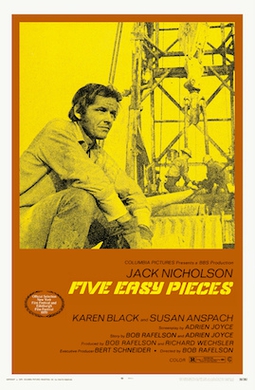
Behind the film
- Year
- 1970
- Director
- Bob Rafelson
- Writers
- Carole Eastman, Bob Rafelson
- Genres
- Drama, Road movie
- Production
- Raybert Productions
- Country
- United States
- Cast
- Jack Nicholson, Karen Black, Fannie Flagg, Sally Struthers, Lois Smith, Billy "Green" Bush, Susan Anspach, Ralph Waite
About the film
Contains story spoilers, including the ending.
Five Easy Pieces follows Bobby Dupea between the California oil fields and the musical family he has left behind. Jack Nicholson plays Bobby, a trained classical pianist now spending his free time bowling and drinking with his friend Elton. Karen Black plays Rayette, his waitress girlfriend. Her pregnancy brings a responsibility he is unwilling to face. A visit to his sister Partita in Los Angeles gives him another reason to leave: their father has suffered two strokes. Bobby agrees to return to the family home on Puget Sound, reluctantly taking Rayette with him. The trip brings his present relationship into contact with the privileged upbringing he has kept apart from it. His first response is to put Rayette in a motel and visit the house alone.
At the house, Bobby meets Catherine Van Ost, a pianist engaged to his brother Carl. Catherine is attracted to him, and asks him to play. His performance of Chopin's Prelude in E minor moves her, but he dismisses the feeling she hears in it. The exchange makes music another way for him to refuse an intimacy he has just offered. They nevertheless become lovers. When Rayette arrives at the house, Bobby's attempt to separate the two parts of his life fails. He defends her when a family guest mocks her, yet that defence does not undo his embarrassment about bringing her there. His anger also finds a less defensible target when he discovers his father's nurse massaging Partita and starts a fight he loses. Catherine refuses his invitation to leave with him. She recognises that his desire to escape gives her little reason to expect a loving relationship. Being able to play the family's music has not made Bobby able to settle among them, or to offer Catherine a secure alternative.
Bobby's anger also surfaces during the journey north, when a diner will not make the substitutions he wants. He tries to obtain plain toast by ordering a chicken salad sandwich without its filling. The argument ends with him sweeping the table's contents onto the floor. His cleverness gets him no closer to what he wanted; the outburst simply ends the conversation. The later talk with his father gives him no such opponent. The old man cannot answer as Bobby tries to explain his wandering and apologises for the distance between them. Bobby admits that he moves to get away from situations that become difficult when he stays. The final stop makes that confession painfully concrete. While Rayette goes for coffee at a gas station, he abandons her, his car and his belongings to take a truck heading north. The departure offers no destination where he will finally belong. It leaves Rayette behind with the consequences of another escape.
The distance between Bobby's two homes runs through their ordinary pleasures. In Bakersfield, there are bars, bowling alleys and country songs; at the Dupea house, family conversation and classical performance assume an education Rayette has never shared. Neither setting is simply a disguise that can be stripped away to reveal an entirely different man. Bobby has attachments in both, even as he resents their demands. Partita still belongs to the musical household and cares for their father, while her brother keeps putting distance between himself and the people who know him. His hilltop confession briefly lets him say how much that distance hurts. Nicholson wrote the scene on the set, after director Bob Rafelson pressed him to let Bobby cry. The quiet around the unresponsive father gives the admission room that Bobby's arguments elsewhere do not allow. He can speak, but he cannot obtain an answering reassurance.
Rafelson developed Bobby with screenwriter Carole Eastman after struggling through three partial scripts about a similar central character in different places. Their conversations brought his interests in music into a workable story, while Eastman wrote and Rafelson searched for locations. He spent three weeks working in the oil fields himself. He also described using their machinery to shape the conversation between Bobby and Elton about Rayette's pregnancy. Behind Nicholson, he placed a clutter of wells; for Elton's reverse angle, he moved two miles away and used a nearly empty field with a single machine. Rafelson associated those backgrounds with Bobby's confusion and Elton's more direct temperament. He kept most exterior shots still, allowing cuts between separately chosen views to organise the geography. The apparent continuity of the conversation therefore joins spaces selected for the men speaking in them. The equipment around Bobby gives his unease a visible setting before he returns to the family house.
Rayette's introduction came from a smaller discovery during filming. Rafelson was preparing the scene in which Bobby returns from the oil fields. Black was sitting in the sink putting on lipstick. He decided to film her there. The gesture gives Rayette a physical ease in their home before Bobby's dissatisfaction and the journey begin to dominate their relationship. Rafelson used Black's position rather than asking her to match the image he had prepared. His account makes her entrance a contribution from the actor to the character's everyday behaviour.