
Behind the film
- Year
- 1982
- Director
- Werner Herzog
- Writers
- Werner Herzog
- Genres
- Drama, Adventure
- Production
- ZDF
- Country
- Germany, Peru
- Cast
- Klaus Kinski, Claudia Cardinale, José Lewgoy, Grande Otelo, Jean-Claude Dreyfus, Peter Berling, Milton Nascimento, Veriano Luchetti
About the film
Contains story spoilers, including the ending.
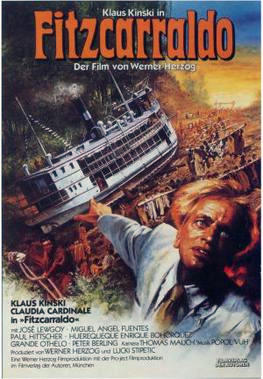
Fitzcarraldo’s first destination is an opera performance he has almost missed. Klaus Kinski plays Brian Sweeney Fitzgerald, arriving in Manaus with Molly after a long river journey, dishevelled and without tickets. An usher lets them enter, and the performance gives an immediate shape to the obsession that will carry them into the jungle. Claudia Cardinale’s Molly supports a man who wants other people to hear what he hears in Caruso’s voice. Back in his modest surroundings, Fitzcarraldo plays records for children and promises a small pig its own box in his future opera house. His attempts to interest the rubber barons meet a very different response: they have little patience for his music. Werner Herzog sets his outsized ambition beside these small, awkward encounters. Opera is something Fitzcarraldo wants to share, even when his listeners see no reason to fund the building he imagines. The gramophone later travels into the expedition, carrying that private passion where a concert audience is the last thing anyone expects. The opening opera sequence was staged by fellow filmmaker Werner Schroeter.
The scheme turns music into a business problem. Fitzcarraldo wants to join the rubber barons so he can afford an opera house in Iquitos, but access to rubber territory depends on the rivers. With the savings of Molly, a brothel owner, he buys a neglected steamer and an undeveloped plantation. Rapids on the Ucayali block the route. He proposes travelling up the Pachitea and moving the vessel across land where the rivers approach each other. On a map, the plan offers a way around the obstruction. In the jungle, that line becomes a mountain with a steamer at its foot. The practical task is enormous because the ship has to remain a ship: the means of reaching the plantation must also be ready to work on the water beyond it. Fitzcarraldo commits Molly’s money and his crew to an idea whose commercial usefulness depends on first achieving something that seems almost impossible.
Most of the crew abandon the expedition before the crossing, leaving the captain, engineer and cook. Indigenous people help bring the steamer over the mountain, but their reasons for doing so differ from Fitzcarraldo’s. The hauling eventually succeeds through months of labour and a system of pulleys. After the celebration, their chief releases the mooring, sending the vessel into the rapids. Fitzcarraldo survives the passage but loses his rubber scheme. He learns that his helpers intended the ship as an offering to the spirits of the river. The same work has therefore served two plans that were never truly the same. Returning to Iquitos, he sells the steamer back to its previous owner and arranges a performance before the sale takes effect. A visiting opera company performs on its deck as it passes the town. The opera house remains unbuilt, yet opera reaches the place he wanted it to reach. The ending gives him a public performance rather than the permanent institution and rubber fortune he set out to obtain.
The ship’s passage over land is also an actual event recorded by the film. Herzog told interviewer Huw Spanner that moving a real boat over a real mountain did not mean he was pursuing realism. He wanted the physical event to become fantasy, something with the scale and force of opera. That explains why the engineering feat belongs so closely to Fitzcarraldo’s musical desire. The vessel is an object with weight, machinery and an ordinary purpose, yet its movement across the hillside makes it seem to have entered a different order of possibility. Herzog wanted the audience to be able to trust what their eyes showed them while responding to a much larger metaphor. The achievement has to be physically there for its apparent impossibility to register. The film can turn an improbable ambition into a concrete image without requiring its hero to achieve the profitable future he expects to find on the other side.
The making of Fitzcarraldo involved a major restart that changed the people carrying that ambition. Producer Walter Saxer recalled that Jason Robards became ill after weeks of filming and left the production. Insurance money allowed the team to begin again with Kinski. Saxer also described a change in the role of the cook. Huerequeque Enrique Bohórquez, whom he knew from the earlier Aguirre production, took the part after another actor struggled with the plan to film in English. Saxer remembered Bohórquez as a newcomer to acting whose presence became one of the finished film’s strengths. These casting changes sit behind a story built around dependence on other people’s skills. Fitzcarraldo can imagine the crossing, but the cook, engineer, captain and people doing the hauling make the expedition possible. The production’s own need to start again with a different leading actor gives a concrete measure of how much the film relied on the people inside its immense landscape.