
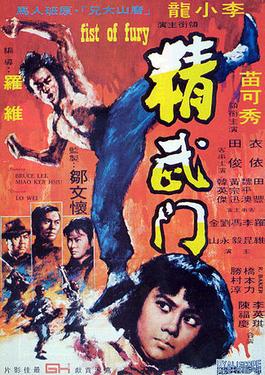
Behind the film
- Year
- 1972
- Director
- Lo Wei
- Writers
- Lo Wei, Bruce Lee
- Genres
- Action, Drama, Romance, Martial arts
- Production
- Orange Sky Golden Harvest
- Country
- Hong Kong
- Cast
- Bruce Lee, Nora Miao, Lo Wei, Jackie Chan, Corey Yuen, James Tien, Robert Baker, Maria Yi
About the film
Contains story spoilers, including the ending.
Fist of Fury stars Bruce Lee as Chen Zhen, a student returning to a Shanghai martial arts school after the death of his teacher. Lo Wei directs the 1972 film, with Nora Miao among the cast. Chen discovers that his instructor was murdered and sets out to confront a rival Japanese school. The investigation opens into a larger criminal operation, while his opponents include Chinese and Japanese assassins and a formidable Russian fighter. His loyalty to the dead teacher brings him into conflict with people who possess power well beyond the training hall.
Chen had hoped to marry Yuan Li'er when he returned to Jingwu. Instead, he finds Huo Yuanjia dead and the school facing open humiliation. Visitors from the Japanese dojo deliver an insulting sign and challenge the students to defend themselves. Senior student Fan Junxia tries to hold Chen back, but Chen goes to the rival dojo alone and defeats its fighters. Retaliation follows at Jingwu, where the damage makes his personal victory dangerous for everyone else. His fellow students plan to help him leave Shanghai. Before he can escape, he overhears the cook and caretaker and learns that Huo was poisoned. The discovery turns his anger into a direct hunt for the people behind the killing. Yuan finds him hiding near his teacher's grave. Their reunion briefly returns the story to the marriage and shared life that his arrival had promised, while the threats against the school continue to grow.
The insults in the film take a physical form: signs that Chen can break, return or force his opponents to confront. In Paize Keulemans's Columbia University teaching unit, this relationship between writing and Lee's body becomes a way of reading the film's nationalism. The derogatory placard at the school attacks the Chinese students as a group. A park notice places Chinese visitors alongside dogs as people or creatures to be excluded. Chen answers these written restrictions with fighting and destruction. Keulemans places those scenes within the foreign-controlled spaces of Shanghai, where the setting itself carries questions about who can move freely and expect justice. He also connects the film's Shanghai to the Hong Kong in which it was made under British rule. That is a scholarly reading of the film's locations and confrontations. On screen, a school dispute keeps leading Chen towards restrictions that extend far beyond the men he can defeat inside a dojo.
The fights give Chen control of a room while the story keeps reducing his control over events outside it. In the Criterion essay Water and Vessel, Jeff Chang describes the opening clash through its changing camera positions: circling movement, sudden shifts and views moving between overhead and waist height. Han Ying-chieh receives the fight-choreography credit. Chang also draws attention to Chen's comic disguises as a rickshaw driver, newspaper seller and telephone repairman. These interruptions let Lee play concealment and impersonation alongside the confrontations. The same essay reads Chen's isolation as part of the catastrophe. He will not share his plans even with the woman he loves, and his opponents answer attacks on individuals by attacking the school. The private avenger and the community he wants to defend are increasingly exposed to different consequences.
The physical action also includes work by a young Jackie Chan, appearing under the name Chan Yuen-lau. The Hong Kong Film Archive identifies him as a stunt double for Hashimoto Riki, who plays the Japanese villain. That places a future leading actor on the other side of Lee's confrontations, contributing to the falls and impacts around the star. Lee's speed is central to Sean Axmaker's TCM account of the film: quick movement and fluid combinations distinguish him from the opponents placed in his path.
Fist of Fury reunited Lee and Lo Wei after The Big Boss as the second film in Lee's Golden Harvest contract. Axmaker connects the story to Huo Yuanjia, the martial arts teacher whose reputation provided the film with its starting point. The screen story begins with a funeral and a return intended for marriage. Its conflict grows when the rival school taunts Huo's students. Chen's response makes defending his teacher's name inseparable from answering the attacks against the people left behind.
The ending stops Chen's movement rather than allowing it to deliver another victory. After the confrontation with the Russian fighter and the destruction around Jingwu, the police come to take him away. He charges towards the armed line, and the image freezes with Lee suspended in his leap as gunfire is heard. Dorothy Wai Sim Lau discusses this final image in Chinese Stardom in Participatory Cyberculture as an expression of Chen's resistance within semi-colonial Shanghai. The last gesture remains defiant, but the sound denies the possibility of simply carrying his earlier triumphs forward. The film leaves his body airborne at the moment when individual fighting ability has reached the limits imposed by armed authority.