
Behind the film
- Year
- 2017
- Director
- Carlos Saldanha
- Writers
- Munro Leaf, Tim Federle
- Runtime
- 1h 48m
- Genres
- Comedy, Adventure
- Production
- Blue Sky Studios, 20th Century Animation
- Country
- United States
About the film
Contains story spoilers.
Ferdinand grows up at Casa del Toro, a ranch where young bulls are trained to impress a matador. He would rather smell flowers than prove he can fight, and the other calves mock him for it. When a matador chooses Ferdinand’s father, Raf, for a match, Raf does not return. Ferdinand runs away and is taken in by Juan, a farmer, and Juan’s daughter Nina. On their flower farm, the bull becomes a large but gentle companion, protected from the system that treated his father’s death as an ordinary outcome. Years later, he follows Juan and Nina to a local flower festival after they decide he is too large to bring. A bee sting makes him panic, and his attempt to escape the crowded square destroys property and frightens the townspeople. Animal-control officers seize him before the family can explain, and he is returned to the ranch he escaped as a calf.
Back at Casa del Toro, Ferdinand finds familiar rivals and a set of new animals. Valiente still believes toughness is the only way to survive; Guapo is loud but freezes under pressure, while Bones is more practical. Lupe, a goat, appoints herself Ferdinand’s coach and tries to teach him to fight, though he is more interested in getting everyone out. Her role as a supposed calming companion is itself a joke: the goat is excitable, and she resents being treated as if calmness were her only purpose. The ranch’s horses perform with the confidence the bulls are expected to imitate, until a dance-off turns into a surprising first moment of cooperation. The bulls unite in their dance against the horses, and Ferdinand’s company begins to feel like a group rather than a collection of rivals. That matters when Guapo is sent toward the chop house after freezing during practice. With the bulls facing death whether they fight or fail, Ferdinand’s plan to get them out gains urgency.
Ferdinand starts to bond with the other bulls, but Valiente mocks them for wasting time with him, and they return to training. While trying to escape with Lupe and help from the hedgehogs Una, Dos and Cuatro, Ferdinand discovers the trophy room. It contains the horns of bulls killed in the arena, including Raf’s, and makes clear that being chosen is no promise of survival. Ferdinand returns to warn the others. Valiente rejects the warning and fights him, breaking one of his own horns. Moreno sends Valiente toward the chop house, while El Primero chooses Ferdinand for the arena because he mistakes the injury as a sign of aggression. Ferdinand and Lupe then help the others escape, rescuing Valiente and Guapo from the same system that Valiente had defended. With the other animals and a rabbit named Bunny, they steal a truck and head for Madrid.
The escape becomes a race to get the bulls out of reach before Moreno’s men catch them. At Atocha station, Ferdinand helps his friends board a train, then stays behind so they can get away. He and Lupe are captured and brought to Las Ventas, where El Primero prepares for the final match. Juan and Nina learn where Ferdinand is after a video of the escape reaches the news, and they rush to Madrid. In the arena, Lupe urges Ferdinand to survive. He first runs in panic and accidentally humiliates El Primero, who wounds him with a banderilla. Ferdinand is close to retaliating, but sees a crushed carnation beneath his hoof. It recalls the flower farm and Nina, giving him a reason to stop before anger turns him into the fighter everyone expects him to be.
Ferdinand sits down in the ring instead of attacking El Primero. The crowd calls for the matador to spare him, and El Primero lowers his sword. The bull survives the fight, and Juan and Nina reunite with him. Moreno later brings the other bulls, Lupe, the hedgehogs and Bunny to live at the farm. Saldanha said he began animating the film at its third act and worked backward, because he knew the book’s ending and wanted the feature’s added characters and events to lead clearly to Ferdinand sitting down. He also said the opening selection sequence was among the last scenes animated; the filmmakers simplified its layers so the young bulls’ world and Ferdinand’s refusal were clear. Saldanha also described Lupe as a “comfort goat” conceived to stay beside Ferdinand, then made her temperament the opposite of the calm label.
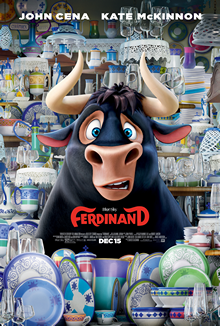
The earlier china-shop sequence gives that gentleness a different kind of test. Saldanha timed Ferdinand’s careful steps before the score existed, using Carmen to help establish a rhythm that grows increasingly precarious. The bull is trying to protect the plates and avoid hurting the shopkeeper, so his size creates danger even when his intentions are considerate. The team also visited Spain and studied Spanish painting to develop the film’s earthy oranges and reds. The choices give the flower farm, ranch and arena a shared visual setting while letting Ferdinand’s physical weight remain central to both the comedy and the threat of a fight.