
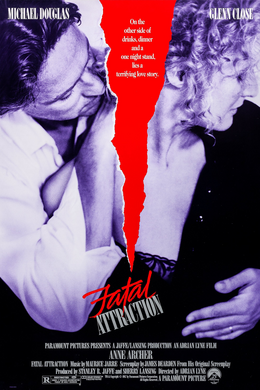
Behind the film
- Year
- 1987
- Director
- Adrian Lyne
- Writers
- James Dearden
- Genres
- Psychological thriller, Erotic thriller, Mystery, Drama
- Production
- Paramount Pictures
- Country
- United States
- Cast
- Michael Douglas, Glenn Close, Anne Archer, Ellen Foley, Fred Gwynne, Lois Smith, Stuart Pankin, Jane Krakowski
About the film
Contains story spoilers.
Fatal Attraction starts with Dan Gallagher treating adultery as a temporary escape from an otherwise comfortable life. Michael Douglas plays the married man, Glenn Close plays Alex Forrest and Anne Archer plays Beth, the wife whose apparent distance from the affair gradually disappears. Alex wants the encounter acknowledged as something with consequences. Dan wants it contained, and his attempts to withdraw keep drawing him back into her life. The film includes moments when her anger sits beside vulnerability: she reacts violently to his departure, harms herself, and insists that he recognise his responsibilities when she becomes pregnant. Those scenes complicate the movement toward the later physical threat without excusing what she does. Dan's secrecy also determines how long Beth remains outside the central conflict. The domestic world he hopes to preserve is already affected by choices she has not been allowed to understand. When Alex crosses into that world, the story's boundaries collapse: a private affair becomes a danger involving a wife, a child and the ordinary places where a family expects to be safe.
Alex's pursuit continues through calls, a visit to Dan's workplace and an encounter with Beth under the pretence of being interested in buying the Gallaghers' apartment. The family's move to Bedford does not end it. Alex damages Dan's car, follows him and kills Ellen's pet rabbit, leaving it boiling on the kitchen stove. Dan finally tells Beth about the affair and pregnancy. Alex then takes Ellen from school to an amusement park; Beth crashes her car while searching, although the girl is returned unharmed. Dan confronts Alex violently at her apartment, and the danger culminates at the family home. In the theatrical ending, Alex attacks Beth with a knife. Dan submerges her in the bath and believes she is dead, but she rises again, still armed, and Beth shoots her. The conclusion returns Dan to his marriage after a confrontation in which Beth has become an active participant.
Close approached Alex as a specific person in distress. In her Museum of the Moving Image conversation, she describes extensive preparation and a determination to keep the audience aware that the character was suffering. One practical result was the scene in which Alex sits on the floor switching a lamp on and off. Close says she suggested it during filming because she feared that Alex's humanity was disappearing. It was intended for late in the film, but the edit moved it earlier, into a place originally planned for an opera scene that was never shot. Close felt that this made Alex seem desperate too soon. Her recollection shows how a performance can change meaning without changing the action within a shot: placement determines when the audience receives the information. The lamp scene offers solitude and repetitive movement rather than another confrontation with Dan, but its position helps decide whether that solitude feels like the result of accumulated hurt or an early warning about the woman he has just met. Close also recalls specially constructed baths, including one with an acrylic side and another made deep enough to place a camera beneath the action.
The replacement ending was contentious within the production. Accounts preserved in Sherry Lansing's biography describe Close resisting the change from Alex's suicide to the bathroom attack. Michael Douglas supported the new version, while Close argued that it altered the character she had built. She eventually returned to film it. That disagreement concerns the story's direction as well as the mechanics of a final shock: suicide makes Alex's destructive impulse turn inward, whereas the released confrontation makes her an immediate threat whom Beth must stop. The two endings give the same affair markedly different final consequences.
The feature grew from James Dearden's British short Diversion, expanded with producers Sherry Lansing and Stanley R. Jaffe. Its development encountered resistance because Dan was considered an unsympathetic central character. Adrian Lyne eventually took over directing, while Dearden retained the screenplay credit. Filming used New York City and Westchester County locations, and production designer Mel Bourne consulted the actors when developing Dan's and Alex's apartment interiors. The Gallaghers' suburban house combined an exterior in Bedford with interiors filmed in Mount Kisco. Those details anchor the movement from city affair to threatened family home in recognisable domestic spaces. An alternate ending was filmed in which Alex kills herself and Dan faces suspicion, with a cassette providing evidence that can clear him. The suicide ending follows a different chain of events from the later bathtub climax and was later made available on home video. Its survival on home video makes the film's construction unusually visible: the same relationships and earlier opera references lead toward a different resolution, while the theatrical version closes around the restored family and Alex's death. Other locations included Central Park, Greenwich Village and Rye Playland, extending the story across public leisure spaces as well as private rooms.