
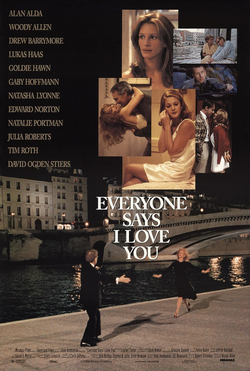
Behind the film
- Year
- 1996
- Director
- Woody Allen
- Writers
- Woody Allen
- Genres
- Romantic comedy, Musical
- Production
- Miramax, Jean Doumanian Productions
- Country
- United States
- Cast
- Woody Allen, Natalie Portman, Julia Roberts, Edward Norton, Goldie Hawn, David Ogden Stiers, Tim Roth, Natasha Lyonne
About the film
Contains story spoilers.
Holden's proposal goes wrong when Skylar swallows the ring hidden in her dessert. Her mother, Steffi, then introduces rehabilitated prisoner Charles Ferry to the family, and Skylar abandons Holden for him. The comfortable Manhattan setting was deliberate. Speaking to Richard Zoglin for TIME in 1996, Allen described wanting to share his affection for the Upper East Side, with children chauffeured to private schools and couples stepping out in evening dress. His musical idea dated back to making Annie Hall. An emotional model came from watching his parents dance at their sixty-fifth anniversary: their lack of training did not stop the occasion moving him. Drew Barrymore asked to have her singing dubbed, and Allen chose a nonprofessional voice for her.
Allen explained the singing more fully in his 2005 David Lean Lecture at BAFTA. He imagined the sort of people who sing in the shower or while walking along the street, doing their best without possessing wonderful trained voices. That was the point of using actors whose performances would carry feeling without requiring musical perfection. He took classic songs and worked them into the story, but their duration created an editing problem. Each number added several minutes of singing and dancing, and he unexpectedly found himself with a film running two and a half hours. Several numbers he liked had to go. When Mark Kermode suggested that the longer version might work, Allen disagreed about how long his musical could hold an audience. The songs therefore had to fit the pace of the whole film, however enjoyable individual sequences seemed to him.
Edward Norton's recollection gives that approach a practical shape. In his Fresh Air interview with Terry Gross, recorded in 2000 and rebroadcast in 2001, he said Allen had asked whether he sang during casting without explaining the plan. Only later did arranger Dick Hyman call about assessing his vocal range and reveal that they were making a musical. Norton remembered panicking. Allen insisted that the actors should not take voice lessons. The songs were recorded before filming so the performers could lip-sync or sing along to their own playback. Norton nevertheless prepared his tracks rather than attempt them cold, then feared he was being dismissed when Allen wanted to discuss the recordings. The problem was the reverse: Allen thought he sounded too accomplished, likening him to Perry Como, and asked for a less polished delivery. Norton returned to record the songs again. He singled out the jewelry-store number, My Baby Just Cares for Me, as funny within the film, while describing the embarrassment of hearing his singing detached from the scene. His account distinguishes an awkward-sounding performance from an unprepared recording session.
Hyman described a different kind of adjustment to Marc Myers in a JazzWax interview reprinted by All About Jazz. In the scene with a Sikh taxi driver returning from LaGuardia Airport, the driver suddenly sings Cuddle Up a Little Closer in Hindi. That seemingly spontaneous interruption needed several separate pieces of work. First the song had to be translated, and then Hyman needed someone to sing the translated version for dubbing. They found Sanjeev Ramabhadran, who was attending college in New York, and added the orchestration afterwards. Hyman's first instinct was to accompany the voice with a sitar-like instrument, gongs and percussion. Allen objected that this matched the image too literally. Hyman replaced it with a lush string backing in the manner of Andre Kostelanetz. He recalled that the combination became funnier with that change. The arrangement did not simply repeat what the audience could already see in the taxi: its exaggerated sweetness changed the relationship between the driver's appearance and the love song he was performing.
DJ helps her father Joe court Von by secretly overhearing her therapy and passing on her romantic wishes. Joe manufactures shared interests and chance meetings; Von leaves Greg for him. Skylar escapes Charles's robbery and returns to Holden. At her grandfather's funeral, corpses sing and dance in the chapel. Von, having exhausted her fantasies, returns to Greg. In his Cinemateca Portuguesa programme essay, Manuel Cintra Ferreira interprets Joe's courtship as a form of self-staging. Joe uses stolen psychological knowledge to become the character Von wants. Ferreira compares this invented romantic persona with a director creating characters for actors, who then present those characters to spectators. Under that reading, Joe's apparent compatibility depends on performing a fiction for a particular audience. The courtship is also a small model of the film's musical world, where people can step into a wish and briefly make it visible.
Ferreira also connects the move away from Manhattan with the film's willingness to expose its fantasy. He points to songs emerging unexpectedly, the hospital number's humour, the special effects helping Goldie Hawn's dance with Allen, and the Groucho Marx party mixing comedy with make-believe. At Christmas in Paris, Joe and Steffi reminisce, dance and kiss. She remains committed to Bob and encourages Joe to find a suitable partner. DJ's succession of romantic interests continues.