
Behind the film
- Year
- 1997
- Director
- Paul W.S. Anderson
- Writers
- Philip Eisner
- Genres
- Horror, Science fiction, Adventure, Speculative fiction
- Production
- Paramount Pictures
- Country
- United Kingdom, United States
- Cast
- Laurence Fishburne, Sam Neill, Kathleen Quinlan, Joely Richardson
About the film
Contains story spoilers.
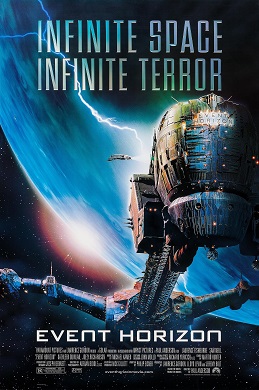
Event Horizon sends a rescue crew to a spacecraft that has returned carrying something its designer never anticipated. Set in 2047, the 1997 horror film follows Captain Miller, played by Laurence Fishburne, and Dr. William Weir, played by Sam Neill. Weir's gravity drive folds space for interstellar travel. Seven years after the ship vanished, its distress signal brings Miller's Lewis and Clark to Neptune, where the search for survivors uncovers a massacre. The crew also starts seeing people tied to their fears and regrets.
For director Paul W.S. Anderson, Philip Eisner's script offered the chance to make a darker film after Mortal Kombat. Speaking to Space.com, he recalled wanting something more visceral and enjoying the opportunity to create a world of spacecraft and space stations. His starting point for the Event Horizon's appearance came during a visit to Notre-Dame in Paris. Anderson already understood the story as a haunted house film; the cathedral gave him a structure to build that house around. Its towers became thruster pods turned on their sides, while stained-glass patterns informed the ship's ironwork. The medical bay's flared pillars drew on medieval supports built to carry stone, and the vessel's overall cross shape followed cathedral architecture. Anderson described translating those forms into steel. He also remembered the sets affecting the actors who spent their working days inside them. Joely Richardson was among those who told him they found the spaces oppressive. In his account, the lack of daylight and fresh air contributed to a feeling of confinement, which he thought suited the film. Anderson credited Neill and Fishburne with helping him develop his work with actors, and recalled the cast welcoming roles quite unlike their earlier screen work.
Cinematographer Adrian Biddle made that environment uncomfortable through its lighting as well as its shape. In American Cinematographer's contemporaneous production account, he explained using brown light from below, red flashes and an unpleasant fluorescent green. Anderson had shown him photographs of a band in a corridor whose wrongly balanced lighting had turned green; that accidental colour became a deliberate reference. The containment area brought further problems. Its entrance was a rotating tube, fifty feet long, with a narrow stationary walkway down the middle. The crew built a camera track into that walkway, while lighting rigs outside the tube shone through openings in its walls. Biddle also attached the camera to the floor for a move that turned the surrounding set upside down. In the next chamber, curved walls and water underfoot limited where the crew could stand. A crane could reach down through the open ceiling, and another camera position looked directly down onto the spinning sphere. Biddle treated the characters' traumatic visions as physical events rather than giving them a separate dreamlike appearance. He wanted viewers to decide whether they were seeing something real or something inside a character's mind. Anderson likewise wanted the nightmares to feel immediately present.
The camera's journey into the Lewis and Clark required a different kind of construction. Sue Rowe, a sequence supervisor at Cinesite during production, described the shot to vfxblog as the hardest she had tackled. It begins outside the miniature spacecraft, moves along its side and approaches the cockpit before continuing through the window into the live-action interior. Rowe had to combine several filmed elements into what appeared to be one continuous movement. The miniature became too soft when approached closely, so high-resolution photographs supplied detail around the live-action window. The set itself had no finished exterior beyond the windowpanes. Rowe recalled combining about twenty-five elements, then adjusting the movement's speed after visual effects supervisor Richard Yuricich and miniature cinematographer Dave Stewart requested changes. She spent three months on the shot; rendering it required other work at the facility to stop. Elsewhere, Rowe remembered artists scanning cabbage and raw steak to create the inside of Weir's empty eye sockets. For the Lewis and Clark's destruction, Stewart told her the miniature was packed with black-painted cornflakes so the explosion would throw burning debris into the air. Digital shockwaves added another layer to the photographed blast, mixing miniature destruction with computer-generated effects.
Weir eventually embraces the ship's evil presence and destroys the Lewis and Clark. Miller sacrifices himself by blowing apart the Event Horizon, sending its stern through the gravity drive while Starck, Cooper and Justin survive in stasis. A rescue party reaches them seventy-two days later. Starck sees Weir among the rescuers, then wakes screaming from that nightmare as Cooper tries to calm her. Their escape leaves her terrified. Looking back in a SYFY interview, Neill said people regularly mentioned Event Horizon to him despite its initial performance. He felt the film moved too quickly and wanted a more leisurely pace, with longer dark pauses before the next threat. He considered it too short when films felt overlong.