
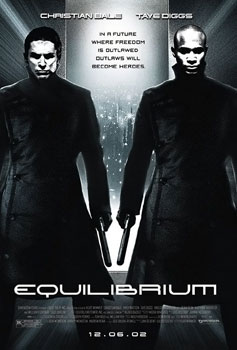
Behind the film
- Year
- 2002
- Director
- Kurt Wimmer
- Writers
- Kurt Wimmer
- Runtime
- 1h 47m
- Genres
- Action, Science fiction, Post-apocalyptic, Psychological thriller
- Production
- Dimension Films
- Country
- United States
- Cast
- Christian Bale, Emily Watson, Taye Diggs, Angus Macfadyen, Sean Bean, William Fichtner, Dominic Purcell, Francesco Cabras
About the film
Contains story spoilers.
Equilibrium is set in Libria, a city-state that treats emotion as the cause of war and enforces peace through compulsory Prozium. Art, books and music are outlawed as potential triggers, and Grammaton Clerics raid homes to destroy them and execute people accused of “Sense Offences.” John Preston is one of the regime’s most effective officers. The opening establishes his place in this system through his partnership with Errol Partridge, a fellow Cleric who secretly keeps a book of Yeats poems. Preston discovers the book and finds Partridge reading it in the Nether, beyond the city. Partridge accepts the risk of feeling; Preston kills him and returns to his work. The act is both an efficient execution and the first sign of the gap between obedience and understanding that the film will widen.
Preston’s own routine begins to break when he accidentally destroys his next Prozium dose. He is meant to replace it before another raid, but the day moves on without it. Music, light and small physical sensations start to register, and he hides replacement vials instead of taking them. On a raid against Sense Offenders, he finds a puppy among the seized material and keeps it from being killed. This is a turning point because his response is not an argument or a plan: he flinches at the violence and recognizes the animal as something vulnerable. The film makes feeling visible through these pauses, while the raids and gun-kata sequences continue at a brisk pace around him. His new partner, Andrew Brandt, notices that Preston’s behavior has changed and watches him closely.
Libria’s scale helps make the rules feel institutional rather than personal. The production uses Berlin’s monumental, austere architecture and long corridors to dwarf the people moving through them, while the black-and-white palette extends the city’s controlled appearance. Against that setting, the prohibited objects carry unusual weight: a poem is handled like evidence, a record becomes an encounter, and the puppy is an impossible exception to ordinary city life. The Gun-Kata, which combines firearms with formal martial-arts movement, gives the Clerics a recognizable physical language. Its stylized precision suits a society that has turned even violence into procedure.
Mary O’Brien, a resistance member Preston is assigned to interrogate, becomes another test of his new awareness. Rather than treating her as a file to process, he listens to her anger and begins to understand what the regime has removed from ordinary life. His investigation leads him to Jurgen, the Underground’s leader, who explains that the resistance wants to disrupt Prozium production and provoke an uprising. Preston agrees to work with the group while keeping his official role. His duties and loyalties now point in opposite directions: Brandt expects a disciplined colleague, DuPont wants him to identify the Underground, and Jurgen needs a Cleric who can reach the center of power. The film keeps these commitments unstable, making Preston’s ability to conceal emotion as important as his ability to fight.
Preston’s private change becomes harder to hide when Mary is sentenced to death. Jurgen warns him that intervening could expose the resistance, but Preston goes to the execution anyway. He fails to save her and breaks down in public, recalling that he once watched his own wife’s execution without feeling anything. Brandt arrests him and brings him to Vice-Counsel DuPont. Preston turns suspicion back on Brandt, buying time to return home. There he discovers that his son Robbie has already destroyed the hidden vials and stopped taking Prozium after their mother died. The discovery extends Preston’s rebellion beyond himself: the controlled household was never as emotionally sealed as the government assumes.
Jurgen’s plan gives Preston a way to reach Father, the leader whose recorded image dominates Libria’s screens. To regain the state’s trust, Preston appears to betray the Underground and deliver its leaders. The audience proves to be a trap: Brandt is still working with DuPont, and the resistance has been exposed. DuPont then reveals that the public Father died years earlier and that he has ruled in his place. The ruling circle does not take Prozium, preserving for itself the feelings it denies everyone else. Preston fights through the government headquarters, defeating Brandt in a sword battle before facing DuPont in the final gun-kata duel. DuPont asks whether the cost of emotion is worth paying; Preston answers by recalling Partridge’s defiance and kills him.
Preston destroys the command center that broadcasts Father’s propaganda, while the Underground attacks the facilities that produce Prozium. The closing images show the system beginning to collapse and Preston allowing himself a smile as citizens move into the streets. Equilibrium links that modest expression to the earlier moments when he hears Beethoven, encounters Mary, and chooses to protect the puppy: each has made the world less abstract to him. Its action is deliberately stylized, with Clerics using gun kata to move through firefights, but the choreography follows a clear change in what Preston is willing to defend. He begins as the state’s instrument for suppressing feeling and ends by helping dismantle the machinery that kept it in place.