
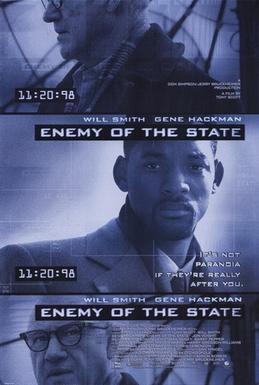
Behind the film
- Year
- 1998
- Director
- Tony Scott
- Writers
- David Marconi
- Runtime
- 2h 12m
- Genres
- Action, Thriller, Political thriller
- Production
- Scott Free Productions, Touchstone Pictures
- Country
- United States
- Cast
- Gene Hackman, Jon Voight, Jack Black, Gabriel Byrne, Regina King, Lisa Bonet, Barry Pepper, Jake Busey
About the film
Contains story spoilers.
Tony Scott’s Enemy of the State follows Robert Clayton Dean, a Washington labor lawyer whose professional life already involves threats and leverage. He is trying to pressure mob boss Paulie Pintero with a recording of Pintero meeting union officials, evidence gathered by the mysterious surveillance specialist Brill through Dean’s former girlfriend Rachel Banks. At home, Dean’s wife Carla objects to a proposed law that would expand government access to electronic communications. Dean dismisses her concern, unaware that the political fight will soon reach into his own life.
National Security Agency official Thomas Reynolds wants the surveillance measure passed and orders the murder of Congressman Phil Hammersley after he refuses to support it. Wildlife researcher Daniel Zavitz has captured the murder on a remote camera. As Reynolds’s team closes in, Zavitz transfers the recording to a computer disc, alerts a journalist and runs. He collides with his old college acquaintance Dean while fleeing and slips the disc into Dean’s shopping bag. Zavitz is killed in traffic, and Reynolds’s agents mistake Dean’s business card for evidence that he knows about the recording.
The agents first approach Dean posing as police officers and ask to search without a warrant. When he refuses, they break into his home and plant surveillance devices rather than finding the disc. They also manufacture evidence of money laundering and an affair with Rachel. The fabricated story circulates through Dean’s workplace and family: his law firm fires him, his accounts are disrupted and Carla asks him to leave. Since he cannot see what has been planted around him, he initially blames Pintero and the mob for the pressure campaign. The agency’s manipulation turns ordinary records and relationships into apparent proof against him.
Dean tries to reach Brill through Rachel, but Reynolds intercepts their contact and sends an impostor to the meeting. The real Brill intervenes and takes Dean away. He reveals himself as Edward Lyle, a former NSA operative who understands the agency’s tracking methods, and starts removing the transmitters hidden in Dean’s clothes. Dean’s escape moves through a hotel, a tunnel and the city’s surveillance infrastructure; he sheds the bugged garments and uses the environment to break the agents’ line of sight. These sequences turn routine systems—security cameras, communications links and vehicle tracking—into moving obstacles rather than a distant political abstraction.
Dean finds Rachel murdered, with evidence arranged to implicate him. He recovers the disc and brings it to Lyle, who identifies Reynolds as the man behind the operation, but a raid destroys their hideout and the recording. Lyle urges Dean to disappear; Dean insists on clearing his name. They turn the surveillance methods back on their pursuers, recording Congressman Sam Albert in a compromising situation and making Reynolds believe he faces blackmail. Their cooperation now has a different purpose: they cannot simply hand over the lost disc, so they must provoke a confrontation that exposes the people hunting Dean.
The final plan exploits the difference between the two recordings in Dean’s life. Pintero knows about the damaging tape Dean used in his earlier labor case, while Reynolds is after Zavitz’s footage of Hammersley’s killing. Dean lets Reynolds believe the murder recording is at Pintero’s restaurant, where federal investigators are watching. Reynolds arrives there with his team and confronts Pintero; the two sides misunderstand what the other wants, and a gun battle breaks out. The FBI moves in amid the violence, Reynolds and Pintero die, and the surviving agents are taken into custody. Dean is cleared, while the agency distances itself from Reynolds’s rogue operation. The immediate frame-up ends without dismantling the institution that supplied his pursuers’ tools.
Scott stages the story as a chase built around the act of watching. The film repeatedly cuts between Dean’s movements and the agency’s screens, satellite feeds and analysts, making surveillance part of the scene’s visual grammar. When Zavitz runs through a lingerie shop and collides with Dean, the image links an ordinary shopping trip to a much larger pursuit; later, Dean’s underwear-and-bathrobe flight makes his loss of status physically visible. Writer David Marconi said the pitch joined the electronic manhunt of North by Northwest to concerns he had researched in James Bamford’s book The Puzzle Palace. He also said Scott shaped the material toward entertainment, where the script he had hoped would prompt debate became a fast-moving action thriller.
The film’s closing scenes bring the public argument back through a television broadcast. The proposed bill is abandoned, and a Larry King segment revisits the surveillance controversy while Dean is restored to his family, and Brill sends him a final message from a remote holiday setting. The ending resolves the immediate frame-up but leaves the larger question of institutional power in circulation on the screen. Gene Hackman’s Brill also recalls his surveillance expert in The Conversation, a connection critics noted; here the character’s guarded habits become an ally’s toolkit for an action plot, as Smith’s pressured lawyer supplies the contrast between everyday identity and a record the government can rewrite.