
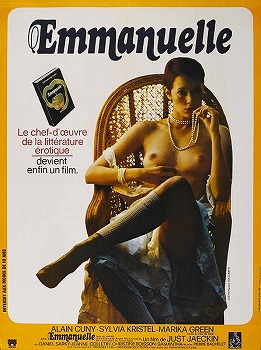
Behind the film
- Year
- 1974
- Director
- Just Jaeckin
- Writers
- Jean-Louis Richard, Emmanuelle Arsan
- Genres
- Erotic, Drama, Sexploitation, Softcore pornography
- Country
- France
- Cast
- Sylvia Kristel, Alain Cuny, Marika Green, Christine Boisson, Daniel Sarky, Jeanne Colletin, Samantha, Gabriel Briand
About the film
Contains story spoilers, including the ending.
Emmanuelle follows a young French woman who travels to Bangkok to join her husband Jean. Sylvia Kristel plays the title role in Just Jaeckin's 1974 film, which places her inside an expatriate social circle where marriage need not mean fidelity. Jean encourages her to seek experiences with other people. The suggestion unsettles her, but boredom and curiosity draw her toward new relationships. Marie-Ange and Ariane help introduce a social world that treats desire more openly than she is accustomed to. Bee, an archaeologist, offers a different attraction, away from the routines of the people around Jean. Later, the older Mario presents himself as someone able to free her from guilt. Each encounter changes the terms of her search. What begins with a husband encouraging adventure becomes a question of whose wishes and ideas are shaping Emmanuelle's choices.
Bee does not simply accept the place Emmanuelle wants her to occupy. When Emmanuelle gives her a bracelet and pursues a meeting, Bee tries to return the gift. Emmanuelle follows her to an archaeological dig, and their intimacy ends with Bee asking her to leave. She returns home upset. Jean suggests another lover, but that advice cannot erase the hurt of being rejected by this particular woman. Ariane's involvement with Jean produces another disagreement, exposing jealousy inside a circle that claims to welcome freedom. Emmanuelle then turns toward Mario. He argues that she should abandon monogamy and allow desire to guide her, but his supposed education includes a sexual assault in an opium den while he watches. That coercion differs from the relationships she chooses. Later, Mario continues directing how she should prepare for other encounters. The film ends with Emmanuelle at a mirror, applying makeup as she follows his instructions. Her pursuit of independence has brought her under the influence of a man who claims to know what her next self should become.
The film's Bangkok includes restaurants, nightclubs, streets and canals, alongside a country estate that gives the characters another place to leave their ordinary lives behind. Filming extended beyond Bangkok to Chiang Mai, while the opium-den sequence was made in a Paris studio. The imagined geography therefore combines Thai locations with a constructed interior elsewhere. Its final mirror image also recalls the opening. Film scholar Alexander J. Klemm reads that repetition as allowing the possibility that the adventure was a daydream. He also interprets it as a sign of Emmanuelle taking control of her future. Klemm presents that possibility as an interpretation of the repeated image, alongside his account of a woman becoming more independent. The return to a woman looking at her reflection brings the journey back to the question of how she sees herself. It gives a quieter final image than the encounters that precede it, while leaving room to disagree about whether Mario's promises amount to freedom.
Jaeckin approached the production as a first-time feature director adapting an already known book. Looking back, he said he could not regard Emmanuelle as wholly his own creation because its original idea belonged to the author. His background included photography and sculpture, and he resisted the idea that cinema had occupied his entire working life. The Thailand shoot was small and precarious. He recalled traveling with four people and a camera, on a budget he compared to less than a million contemporary euros. In his account, filming at a sacred site without permits brought the police and the threat of imprisonment. A cameraman's replacement of the film helped the group escape the worst consequences. The later success surprised him too: he remembered seeing a queue wrap around a Paris cinema and, having no previous feature release for comparison, initially thinking that this was normal. His recollections describe a production whose ambitions and eventual public reach greatly exceeded the resources with which it began.
Producer Yves Rousset-Rouard hired screenwriter Jean-Louis Richard and chose Jaeckin after seeing his photographs. The resulting film arrived in French cinemas in the summer of 1974, within a market still imposing limits on how sexuality could appear onscreen. Its success led Rousset-Rouard to produce Emmanuelle 2 and Goodbye Emmanuelle. Kristel continued acting in other films, including Claude Chabrol's Alice ou la Dernière Fugue, but the role remained closely attached to her public image. The international familiarity of Emmanuelle's name became an enduring professional constraint for the performer who had introduced her to cinema audiences. The book credited to Emmanuelle Arsan had circulated clandestinely before its wider French publication in 1967. The film carried its character to a much larger audience, while changing the balance between erotic adventure and philosophical discussion. Biographer Camille Moreau argues that the adaptation's popularity helped obscure the original's reflective concerns. That distinction matters to the movie's portrait of a woman testing the boundaries of marriage: its conversations and encounters belong to a particular adaptation, even when the character's name also evokes the book and the many films that followed.