
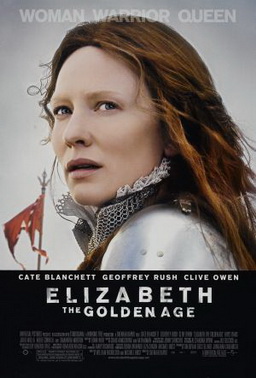
Behind the film
- Year
- 2007
- Director
- Shekhar Kapur
- Writers
- Michael Hirst, William Nicholson
- Runtime
- 1h 54m
- Genres
- Biographical, Drama
- Production
- StudioCanal, Working Title Films
- Country
- United Kingdom
- Cast
- Cate Blanchett, Geoffrey Rush, Clive Owen, Samantha Morton, Rhys Ifans, Jordi Mollà, Abbie Cornish, Eddie Redmayne
About the film
Contains story spoilers.
In 1585, King Philip II of Spain seeks papal backing for an invasion that would remove Elizabeth and restore Catholic rule in England. The queen has no child, and the next claimant is her Catholic cousin Mary, Queen of Scots. Adviser Francis Walsingham presses Elizabeth to marry, but she resists being treated as a route to an heir. The film sets public authority beside private vulnerability: a ruler defending a Protestant kingdom must decide how far she will restrict Catholics without becoming the kind of ruler she opposes.
Walter Raleigh returns from the New World with stories of exploration and catches Elizabeth's attention. She asks her favourite lady-in-waiting, Bess Throckmorton, to watch him; Bess falls for him too, and their attraction develops in secret while Elizabeth tries to keep Raleigh close without pursuing him openly. Walsingham warns that Spain is growing stronger and Catholic plots threaten the court. Elizabeth refuses to force her subjects to share her faith, a principled position that makes each conspiracy harder to answer without undermining her own rule.
In London, Jesuits and Philip's agents join forces to replace Elizabeth with Mary. The Babington Plot depends on secret correspondence from Mary in prison and Anthony Babington's willingness to kill the queen. Walsingham's intelligence network uncovers the scheme, though his Catholic brother's connection leads to the man's imprisonment. When Elizabeth confronts the Spanish ambassador, he denies the invasion plan, accuses her of receiving stolen Spanish gold and hints at her relationship with Raleigh. She expels the envoys; Philip is already cutting timber for the Armada, turning suspicion into preparation.
After Babington's failed shot at Elizabeth in the chapel, the court turns to Mary's role in the conspiracy. Walsingham insists the letters make her too dangerous to leave alive; Elizabeth hesitates over condemning her cousin, who is tried for high treason and beheaded. The film pauses on Mary's composure as the sentence is carried out, giving the death an intimate cost as well as a political one. Walsingham then sees that Philip never needed Mary restored to the throne: her execution provides the Catholic king with a cause for war and turns a failed plot into the pretext for invasion. Elizabeth has removed a rival claimant, but she has also made the Armada's threat public and immediate.
Bess tells Raleigh she is pregnant and asks him to leave, but they marry secretly. Elizabeth discovers the marriage, furious that Bess wed without royal permission and Raleigh seduced a royal ward; she banishes Bess and imprisons him. As the Armada approaches and coastal beacons report the fleet's arrival, Elizabeth sets aside her anger towards Bess and frees Raleigh to join the defence.
With the fleet approaching, Elizabeth goes to the troops in armor and on horseback. The queen orders prisons opened and their occupants armed, widening the defence beyond her court and professional soldiers. Her speech asks the gathered men to see England as theirs to defend, including Catholics she had refused to punish for their beliefs. The film moves the queen from private counsel to the public work of leading a country at war. The film's battle turns on the Spanish fleet's greater size, a storm that scatters its ships and English fire ships sent among them. From the coast, Elizabeth watches the Armada burn and sink, bringing the romance and military crisis together. Raleigh takes part in the sea fight, setting a burning ship toward the Spanish line before escaping into the water; the film gives him a direct role in a defeat that its own storm-and-fire sequence presents as a wider national struggle.
Following the Armada's defeat, Elizabeth visits Raleigh and Bess, who have a newborn son. She blesses the child and leaves them together, returning to her public role as the mother of her people and the Virgin Queen. The ending joins the private and political strands: Elizabeth has lost a possible life with Raleigh, yet claims the loyalty of the country she led through war.
Production design and effects make the political conflict legible through movement and scale. Production designer Guy Hendrix Dyas says the war council was first scripted around a table; his team instead covered the chamber floor with a researched, period-correct map of Europe. Elizabeth and her advisers cross it as they assess the invasion, while overhead views suit director Shekhar Kapur's preference for “God's eye” shots. Model ships inspired by Elizabethan brooches mark the conflict and lead into a reveal of the fleet at sea. For the battle, visual-effects supervisor Richard Stammers's team combined real-water plates, wakes and reflections with generated vessels. In one shot, the camera travels around a real wooden ship about a third smaller than the warship it represents to reveal the Armada behind it. Shots designed for as many as 130 ships could read as vast with roughly 50 carefully arranged vessels. Kapur describes the six-month battle as an event a film must compress into minutes; the burning fleet and queen on the cliffs turn that compression into a single operatic climax.