
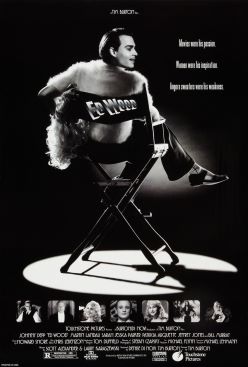
Behind the film
- Year
- 1994
- Director
- Tim Burton
- Writers
- Scott Alexander, Larry Karaszewski
- Runtime
- 2h 7m
- Genres
- Biographical, Drama, Comedy, Lgbtq-related
- Production
- Touchstone Pictures
- Country
- United States
- Cast
- Johnny Depp, Martin Landau, Patricia Arquette, Sarah Jessica Parker, Jeffrey Jones, Lisa Marie, Bill Murray, Vincent D'Onofrio
About the film
Contains story spoilers.
Ed Wood starts with a man who treats a closed door as a cue to try the next one. Edward D. Wood Jr. wants to direct films, write them and act in them, and he carries the same certainty into every meeting with a producer. His first major opportunity comes when George Weiss wants to exploit public interest in Christine Jorgensen’s transition. Wood pitches a film around that sensation, but the story he makes is about Glen, a man who wears women’s clothes and fears telling his fiancée. Wood’s own experience wearing women’s clothes gives him a personal connection to that subject; it is not the same story as Jorgensen’s. The resulting Glen or Glenda? also gives him a reason to bring his childhood screen hero, Bela Lugosi, back in front of a camera.
Wood is played as sunny, quick to improvise and almost impossible to embarrass. He wears angora sweaters and women’s clothes, but the film treats his clothing as part of his everyday life rather than a secret that must be punished. His girlfriend Dolores Fuller supports his ambitions at first and appears in his productions, though their relationship is strained by the way he puts filmmaking ahead of the people around him. Later, Kathy O’Hara becomes a partner who understands that the films are not a passing hobby for him. Wood’s confidence keeps his projects moving, but it also means that he can fail to notice the costs other people are carrying.
Lugosi enters Wood’s life as a famous Dracula actor whose career has fallen into decline. Wood’s admiration is uncomplicated: he wants Lugosi in his films even when the role is small, the budget poor or the project barely formed. Lugosi needs money and work, and Wood needs a recognisable star who might persuade backers to take a chance. That exchange begins as a practical arrangement and becomes the film’s emotional centre. Lugosi’s humor and old theatrical presence survive, but his illness and dependence make the friendship painful. Wood keeps finding another part for him, trying to give his hero a place in the movies even as Lugosi’s health worsens.
The productions bring an assortment of performers and outsiders into Wood’s orbit. Criswell, Vampira, Tor Johnson and Bunny Breckinridge are not presented as polished Hollywood professionals; they are people who fit into his makeshift world and are willing to help him keep a film moving. Money comes from unlikely sources, schedules and plans shift, and the crew works around problems that a larger production would solve before filming began. Wood’s lack of control over technique is part of the comedy, but the film gives his cast and crew enough affection and individuality that they do not exist only as punchlines.
Each new picture promises a fresh chance to prove himself. Wood moves from Glen or Glenda? to Bride of the Monster and eventually Plan 9 from Outer Space, gathering money and performers as he goes. After Lugosi dies, Wood uses previously filmed material and a stand-in to keep his friend’s presence in Plan 9. His stubbornness can look like loyalty when it keeps Lugosi visible, and like denial when he acts as if enthusiasm will repair every practical problem. The film’s version of Wood is often spared the bleakest parts of his later life, letting the story stay with the people and films he made during his brief run of productions.
Wood’s friendship with Lugosi also changes what his own ambition means. At first, he wants to direct movies because he is certain he belongs behind the camera. As Lugosi’s health declines, making films becomes one of the few concrete ways Wood can offer his friend money, work and company. Their bond carries a tenderness that Wood’s professional bravado usually hides. The relationship does not turn Lugosi into a prop for Wood’s success: he has his own memories, pride, anger and theatrical habits, and Martin Landau’s portrayal gives those qualities room to coexist with illness and vulnerability.
Near the end, Wood encounters Orson Welles, a director whose stature is the opposite of his own. Their conversation briefly places Wood’s improvised productions beside Welles’s own difficulties getting a film financed. The meeting gives Wood a kind of recognition he has been chasing from studio executives: another filmmaker understands the frustration of having a vision that money can stop. It does not make his work suddenly competent or grant him a major studio career. It lets him leave the meeting more certain that continuing to make films is the only answer he can accept.
Tim Burton films the story in black and white, giving the Hollywood of Wood’s cheap horror and science-fiction productions the same vivid presence as the people trying to make them. The movie recreates scenes from Wood’s films with a straight-faced excitement that lets the strange ideas and flimsy methods speak for themselves. Burton’s comedy is affectionate toward this group, while the scenes with Lugosi bring age, illness and the passing of public attention into the same frame. The story ends around the premiere of Plan 9 from Outer Space, at the point when Wood’s small circle can celebrate finishing another picture together. It is a deliberately shaped portrait of a filmmaker and his collaborators, built around the period when their friendship and work met.