
Behind the film
- Year
- 2007
- Director
- David Cronenberg
- Writers
- Steven Knight
- Genres
- Crime, Drama, Mystery, Crime drama
- Production
- Focus Features, Kudos
- Country
- Canada, United Kingdom, United States
- Cast
- Viggo Mortensen, Naomi Watts, Vincent Cassel, Armin Mueller-Stahl, Donald Sumpter, Jerzy Skolimowski, Sarah-Jeanne Labrosse, Josef Altin
About the film
Contains story spoilers.
Anna's search for a dead girl's relatives puts a newborn in danger. Tatiana dies after giving birth, leaving a Russian diary that takes the London midwife to restaurateur Semyon. Translation reveals that he raped Tatiana and fathered her baby. His son Kirill's unauthorized killing has meanwhile provoked Chechen revenge. Semyon promotes Kirill's driver Nikolai, then has him mistaken for Kirill at the baths, where Nikolai survives two attackers. Nikolai is secretly an FSB operative working with British permission; he has also protected Anna's missing uncle. He urges police to use the baby's paternity to prosecute Semyon. Ordered to kill the infant, Kirill takes her to the Thames, but Anna and Nikolai persuade him to surrender her. Anna kisses Nikolai before they part. She later adopts the child as Christine, while Nikolai takes Semyon's place at the head of the organization.
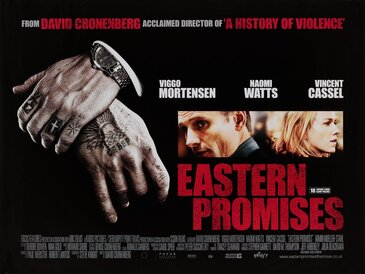
Nikolai's skin supplies the credentials that get him inside Semyon's world. The production applied 43 transfer tattoos for the full-body sequence, a job that took four hours. Their sizes ranged from a fingernail to most of Mortensen's back; twelve were Russian sayings. The stars on Nikolai's knees signify refusal to kneel before authority. Mortensen brought Cronenberg a documentary about Russian criminal tattoos, and the induction scene developed into an examination of the history written across Nikolai's body. Preparing for the role also took Mortensen to Russia, including the Urals. He watched Russian films and television, read Russian authors and practised a language he had begun studying before travelling. Cronenberg described Nikolai as cautious and controlled, while writer Steven Knight saw gentleness beneath his violence. That private preparation sits within a specifically chosen London: the production sought immigrant neighbourhoods, including the East End, and worn locations carrying traces of the past. Familiar tourist views would have offered a different city. Dialogue and dialect advisers divided responsibility for language and accents, with Esin Harvey working on Turkish and Andrew Jack concentrating largely on Eastern European accents in English. Naomi Watts's English accent also needed refinement.
Cronenberg found the characters and enclosed subculture already present when he first read Knight's screenplay, which had been developed at the BBC. What interested him was a community whose invented rules could acquire the force of natural law. Cronenberg also chose the curved blades in the bathhouse. They are ordinary linoleum knives, the kind their carriers could explain away as work equipment if challenged on the street. He connected their use to a further alteration of Nikolai's identity, as wounds change the skin that carries his supposed past. Neither the screenplay nor the finished film, he said, contains guns.
Speaking with Terry Gross, Cronenberg described the London mob as a displaced organization, carrying Russian criminal practices into a different country. His research included Violent Entrepreneurs, a book about criminality's role in the development of Russian capitalism. For this story, the geographical shift mattered: the group was growing under English conditions rather than simply reproducing life in Russia. Mortensen described a more physical route into Nikolai through speech. Different languages could change his tone and body language as well as his words, and Russian sounds helped him find the character. Some sounds came more easily through his experience with other languages; particular vowels were harder. He also speaks a little Ukrainian in the film, a brief change he thought Russian and Ukrainian speakers would recognize. Cronenberg told Gross that a death on screen should carry consequences for the audience, rather than pass as an easy, disposable event.
Supervising sound editor Michael O'Farrell resisted the idea that the soundtrack was simply naturalistic. He described a claustrophobic drama about relationships and concealed information, where leaving room for quiet mattered as much as adding noise. As the dramatic pressure changes, the effects become more forceful and can grow stranger. In his account, tension makes those heightened sounds feel acceptable within the scene. The work depends on dynamic contrast, moving between softness and hardness rather than maintaining one volume. O'Farrell also described laying down an early effects version during his first weeks, then welcoming other people's responses when they heard possibilities he had missed.
Deep Focus Review reads the title through immigrants whose hopes of a better life become opportunities for exploitation. Its account connects Tatiana's fate with Anna's home life and her uncle's disappointment in London. The same reading treats the criminal family as a system of control: Kirill calls Nikolai his brother while ordering him about, and his father's homophobia shapes those demands. Nikolai's false history complicates the apparent certainty of his tattoos. Even stripped bare, he remains difficult to know. Anna offers a different response to this world, pursuing the child's safety through direct action rather than assuming a fabricated identity. Tatiana's diary also gives her a voice after death, which the review understands as a woman's perspective on a world otherwise controlled by criminal men.