
Behind the film
- Year
- 2006
- Director
- Bill Condon
- Writers
- Bill Condon
- Runtime
- 2h 10m
- Genres
- Musical, Drama, Romance
- Production
- DreamWorks, Paramount Pictures, Laurence Mark Productions
- Country
- United States
- Cast
- Jamie Foxx, Beyoncé, Eddie Murphy, Danny Glover, Anika Noni Rose, Jennifer Hudson, John Lithgow, John Krasinski
About the film
Contains story spoilers.
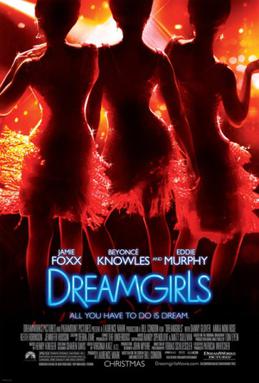
Dreamgirls follows singers entering a music business in which success depends on who gets heard, who gets seen and who controls the act. Curtis Taylor Jr., played by Jamie Foxx, is a car salesman determined to establish a record label. He spots the Dreamettes, a young trio whose talent has not yet carried them beyond homemade dresses and small opportunities. Jennifer Hudson plays lead singer Effie White, Beyoncé plays Deena Jones and Anika Noni Rose plays Lorrell Robinson. Their first important opening comes as backing singers for Eddie Murphy's Jimmy 'Thunder' Early. Curtis then launches them as the Dreams and puts Deena at the front, preferring her image and adaptability to Effie's powerful voice. The change joins commercial ambition to a personal betrayal, making the group's rise inseparable from the question of whose talent is allowed to define it.
Effie's dismissal leaves her pregnant with Curtis's child while the reshaped group becomes successful. Years later, she is raising her daughter Magic in Detroit and attempting to rebuild her career with Jimmy's former manager Marty. Jimmy's own fortunes decline as Curtis concentrates on Deena, whom he has married. His drug use, dismissal from the label and death expose the human cost of that control. Effie's brother C.C. eventually breaks with Curtis and reconciles with her, producing 'One Night Only'. Curtis counters its growing popularity with a disco version by the Dreams and pays to promote it. Deena discovers the scheme and helps bring Effie to Los Angeles with legal support. Curtis agrees to distribute Effie's record rather than face exposure of his payola. Deena leaves him, and the Dreams return to Detroit for a farewell performance, inviting Effie to sing lead again. In the audience, Curtis encounters Magic and realizes that she is his daughter. The reunion restores a shared voice to the women, while that recognition leaves Curtis confronting a consequence his management never accounted for.
Bill Condon's adaptation had to translate a stage musical whose story often moves through sung exchanges. In his Blackfilm interview, he gives the example of Effie expressing her feelings for Curtis during a telephone conversation in the theatre version. For the film, that exchange became the new performance song 'Love You, I Do'. Singing within a rehearsal or act allows the emotion to enter an identifiable everyday setting, while editing can reveal something the singer does not see. Condon describes cutting from Effie's declaration of trust to Curtis looking at Deena in a mirror. The audience can therefore register the beginnings of betrayal alongside Effie's happiness. It is a specific example of adapting both the number and its dramatic information: the song expresses one character's understanding while the images expose another person's divided attention.
The director treated Deena's eventual independence as a musical event too. In his JoBlo interview, Condon explains that 'Listen' was added because her recognition of Curtis's control needed expression in song. Her discovery of her own voice supplies a culmination to a relationship that has shaped the story from their first meeting. He also distinguishes the Dreams' fictional history from the real performers who inspired the material. Motown and the Supremes are acknowledged influences, but the film is not a literal account of those lives. That distinction matters for a story involving exploitation, intimate betrayals and death: its characters carry their own dramatic histories. Condon's account makes the added song part of that construction, giving Deena an explicit moment of self-understanding after a long period in which her public image has served someone else's plans.
The movement from rehearsal to stardom is especially concentrated in 'Steppin' to the Bad Side'. Condon's Directors Guild breakdown describes intercutting Curtis's efforts to raise money for radio payoffs with the dancers' preparation, so commercial compromise and performance develop together. Red becomes a dominant colour as Curtis crosses that line. Lamps once used for drying paint in his car business now light rehearsals, turning the dealership into a space for another product. The sequence then moves into an Apollo performance filmed at the Orpheum Theatre in Los Angeles. Matching camera moves connect the rehearsal line of dancers with their costumed appearance onstage. Steadicam movement lets the camera respond to the performers, while wider views reveal John Myhre's rising platforms and metallic set. The number carries plot through its staging: the act gains scale and confidence as the business behind it takes a more dangerous direction.
Condon also researched the world surrounding the fiction. In his Santa Barbara Independent interview, he describes spending months studying Diana Ross, Berry Gordy, Motown and images of Detroit before filming. The historical preparation supplied a setting for the narrative while leaving him more freedom than he had felt when portraying a specific historical person in Kinsey. His account of a long take moving between Murphy, Foxx and Beyoncé also points to the challenge of handling several strong presences within one scene. That research and ensemble work sit beside the film's more overt musical construction. Detroit, the record business and the changing opportunities for Black performers provide the background; the invented Dreams carry a story in which the pursuit of a marketable sound repeatedly changes loyalties, relationships and the right to stand at the microphone.