
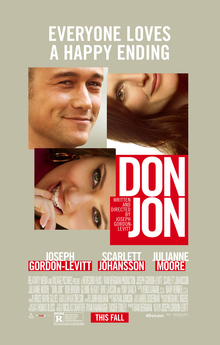
Behind the film
- Year
- 2013
- Director
- Joseph Gordon-Levitt
- Writers
- Joseph Gordon-Levitt
- Runtime
- 90 minutes
- Genres
- Drama, Romantic comedy
- Country
- United States
- Cast
- Joseph Gordon-Levitt, Scarlett Johansson, Julianne Moore, Tony Danza, Brie Larson, Rob Brown, Italia Ricci, Anne Hathaway
About the film
Contains story spoilers, including the ending.
Don Jon follows New Jersey bartender Jon Martello through a tightly organised life of gym visits, a clean apartment, church and casual relationships. He begins dating Barbara Sugarman, who wants a committed partner and encourages him to take evening classes. His pornography use continues despite their relationship, and his lies about it eventually lead Barbara to leave him. At college he meets Esther, an older classmate who questions the way he separates his private fantasies from being with another person. Esther is grieving her husband and son, who died in a car accident. As Jon comes to understand that loss, their relationship develops a closeness missing from his encounters with Barbara. He later apologises to Barbara for lying, while also telling her that he could not meet her demands. She ends their contact. Jon continues seeing Esther, with neither of them pursuing a conventional marriage. His changed outlook also meets an unexpected response at confession: the priest's routine questions do not recognise the difference Jon feels in his life. The ending leaves him building a relationship outside the formula he once followed.
Writer-director Joseph Gordon-Levitt described Jon and Barbara as people comparing real relationships with simplified fantasies. Jon judges partners against pornography, while Barbara takes expectations from romantic films. He wanted the comedy to expose what those comparisons cause them to miss about an actual person. His decision to direct grew out of thinking about the camera, editing and music as he wrote; the character's portrayal would depend on all of them. Rian Johnson was the first person he showed an early screenplay draft. Johnson offered criticism but encouraged him to keep going because he could see a film in the story. Gordon-Levitt recalled similar support from Christopher Nolan and Steven Spielberg, with whom he had also worked before making Don Jon. His experience of short films gave him a place to begin turning those planned images into a feature.
Gordon-Levitt wanted the audience to understand Jon's viewpoint without having to share it. He explained that an actor must find respect for a character even when they disagree with his attitudes, and that he tried to extend the same consideration to Jon. The intimate scenes use Jon's narration to stay with the argument he is making in his own head. Gordon-Levitt said he wanted that perspective rather than the feeling of watching the characters from outside. Julianne Moore was his first choice for Esther, although the initial description of the script made her reluctant to read it. Reading changed her understanding of the material. Gordon-Levitt credited Moore and Scarlett Johansson with combining comedy and emotional honesty in their characters. He also connected the film's concern with objectification to his upbringing. His mother had taught him to regard men and women as equals and to notice television portrayals that demeaned women. That memory gives a specific background to the filmmaker's interest in the images Jon and Barbara take for granted.
The disagreement about cleaning Jon's apartment became a way to show Barbara disregarding something important to him. Gordon-Levitt and Johansson wrote the scene together relatively late in the process. They chose an attachment already established near the beginning: Jon takes pride in keeping his home clean. While shopping for curtains, his wish to buy cleaning supplies clashes with Barbara's idea of how a man should behave. Gordon-Levitt saw that pride as a contradiction within Jon's otherwise conventional display of masculinity. His body language followed a more outwardly macho pattern. Cast member Jeremy Luke encouraged him to push his shoulders back and make himself look larger, while time in the gym let him observe men studying themselves in mirrors. Those physical choices belong to Jon's concern with presenting a manly image. The cleaning argument exposes a part of him that does not fit Barbara's version of that image. It gives their disagreement a domestic subject beyond the arguments about what Jon watches, and shows how a small purchase can reveal a larger difficulty between them.
Gordon-Levitt spent several years living with Jon in his imagination while writing the film. He said that familiarity made production easier because he knew the material so thoroughly before shooting began. It still left room for changes on set, where the actors and the circumstances could bring something he had not anticipated on the page. He described Johansson and Moore's performances as a continuing surprise, with details that went beyond what he had written without necessarily departing from the script. His experience making collaborative short projects also shaped his understanding of directing Don Jon. Although he wrote, directed and played the lead, he stressed that many other people contributed to the finished film. Asked about the distracted members of Jon's family, he resisted treating media or technology themselves as the cause of the problem. His distinction concerned how people use them. That answer leaves the comedy's attention on habits and choices, including the ways the characters let images occupy the space where they might otherwise notice another person.