
Behind the film
- Year
- 2011
- Director
- Charles Martin Smith
- Runtime
- 1h 53m
- Genres
- Drama, Children's
- Production
- Alcon Entertainment, Jam Filled Entertainment
- Country
- United States
- Cast
- Morgan Freeman, Ashley Judd, Kris Kristofferson, Harry Connick Jr., Nathan Gamble, Frances Sternhagen, Tom Nowicki, Kim Ostrenko
About the film
Contains story spoilers.
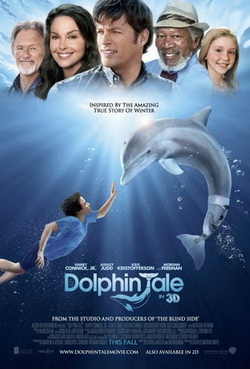
At Clearwater Marine Hospital, the injured dolphin Winter becomes the focus of Sawyer Nelson's summer. An introverted eleven-year-old, Sawyer finds a place among the people caring for her after she loses her tail. He brings his friends and family into the effort, including his initially doubtful mother, Lorraine, and asks prosthetics specialist Dr. McCarthy to help. Clay Haskett runs the hospital while raising Hazel, who lives with him and her grandfather Reed on a nearby houseboat. Sawyer's father has left, and the aquarium gives him a surrogate father in Clay and a brother figure in returning serviceman Kyle.
A hurricane leaves the financially troubled aquarium facing closure and sale. Sawyer proposes Save Winter Day after meeting a girl with a prosthetic limb who has travelled to see Winter. Clay agrees, and Kyle arranges a race against Donovan with television coverage. Winter rejects the new tail until Sawyer recognises that its base irritates her skin; McCarthy makes a gel-like sleeve that lets her accept it. At the benefit, Sawyer receives school credit for his work. Kyle and Donovan's race becomes a shared swim when Winter and children join them, leaving no clear winner. The developer agrees to keep the aquarium open and fund it. The film then moves into documentary footage of Winter's rescue, her different prosthetic tails and real visitors with limb differences.
The real Winter was found in Mosquito Lagoon in 2005, entangled in crab-trap line that cut off circulation to her tail. Her tail deteriorated and was lost. Hanger worked with Clearwater Marine Aquarium's animal-care team and Dr. Mike Walsh on a prosthetic attachment. Walsh's account of her care describes problems that preceded the film's dramatic breakthrough. Without a tail, obtaining regular blood samples became difficult, even as infection risk made monitoring necessary. Considering a prosthetic took time, with different people and companies proposing approaches. Walsh said Hanger offered a way forward that would avoid damaging Winter's skin. He also credited veterinarian Janine Cianciolo and the aquarium team with nursing her through infection, wound healing and growth. That work belonged to a continuing rehabilitation effort involving several people.
Screenwriters Karen Janszen and Noam Dromi built the human story around that real animal. Janszen described Winter, the aquarium's carers and the two doctors who developed her tail as the factual core; the surrounding drama had to be invented for a feature film. There was no real Sawyer or single mother behind those characters, and Dromi explicitly identified the returning serviceman as an invention too. Janszen drew on her experience as a single mother for Lorraine and on her daughter for Hazel. She conceived Sawyer as a boy who feels powerless after his father's departure, then finds new family relationships at the hospital. Dromi credited Janszen with the family dynamic. Their treatment of the prosthetics specialists also retained a second doctor in the scene where McCarthy visits a parts supplier, rather than making Freeman's character the sole equivalent of both real men.
Aquarium CEO David Yates described a deliberate effort to bring Winter's story to national and international media. Coverage by NBC's Today show and the Associated Press in 2006 helped spread it; Alcon's Richard Ingber saw a Today segment and called him. Yates hoped a film would draw attention and financial support to the nonprofit aquarium's rescue and rehabilitation work, which depended on volunteers and donations. Aquarium board member Tom Orr recalled that discussions with Alcon lasted more than a year and that early scripts struggled to capture Winter's story. In his account, Smith revised the screenplay after meeting her. Orr also described Connick's Clay as a composite of himself, Yates and their veterinarian. That overlapping inspiration leaves room for the invented hospital household, rather than making Clay's home and family a biography of one aquarium employee.
Charles Martin Smith began by visiting Winter and watching her behaviour. He wanted to capture the animal's own habits, and incorporated her blue mattress, rings and birdlike vocalisation. A yellow duck became another toy, with its design taking months. Working with cinematographer Karl Walter Lindenlaub, Smith discussed a hot Florida look and an underwater opening that would introduce Winter's world. Around her, he wanted a slightly magical setting for children: Hazel could roam the aquarium, know its animals and decorate a crow's nest on the houseboat. Rufus began as Smith's idea for a seagull before Alcon suggested a pelican. Smith nevertheless wanted the children to behave naturally. He pointed to Hazel running away when Clay announces the closure, treating her wish to hide her tears as a recognisable child's response within the larger fantasy.
Winter played herself, and filming used the actual aquarium. Although it closed to public visitors for three months, the animal hospital continued operating around the clock. Orr said two of Winter's regular trainers were hired to teach her new commands and behaviours for the shoot. Yates said filming proceeded at Winter's pace, with actors introduced early so she could become familiar with them. Austin Highsmith, who plays trainer Phoebe, recalled holding Winter while trainers taught her to close her eyes for a scene depicting illness. The closing documentary sequence came from a different kind of encounter. Smith said editor Harvey Rosenstock assembled footage of children with disabilities visiting Winter. They placed it before the credits so the images could play without credit text over them.