
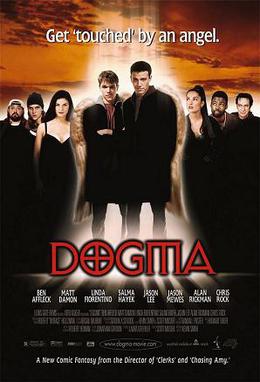
Behind the film
- Year
- 1999
- Director
- Kevin Smith
- Writers
- Kevin Smith
- Runtime
- 2h 0m
- Genres
- Fantasy, Comedy, Adventure
- Production
- View Askew Productions
- Country
- United States
- Cast
- Ben Affleck, George Carlin, Matt Damon, Linda Fiorentino, Salma Hayek, Jason Lee, Jason Mewes, Kevin Smith
About the film
Contains story spoilers.
Dogma builds its fantasy around a contradiction. Bartleby and Loki, two angels banished to Wisconsin, discover that a church in Red Bank, New Jersey, is preparing a rededication ceremony that promises a plenary indulgence to anyone who passes through its doorway. The rite would forgive every sin. If the angels first become mortal, enter the church and then die, they believe they can return to Heaven. But God’s decree exiled them; if a church ceremony makes that decree reversible, it would prove God fallible and unravel the creation that depends on divine infallibility. Their plan is therefore a personal bid for home that could destroy every other life.
Bethany Sloane has little appetite for a cosmic assignment. She works as a counselor at an abortion clinic and attends church without much conviction. The film’s opening draws her attention to John Doe Jersey, a homeless man lying in a coma after an attack; people are raising money to prevent a hospital from ending his life support. Then Metatron, the angel who speaks for God, appears to her in a pillar of fire and explains what the returning angels would do to existence. Metatron sends her to stop the rededication from giving Bartleby and Loki a way home. The scale of the mission collides with her private disappointment and fatigue. She questions why an all-powerful God cannot intervene directly.
Bethany’s unlikely guides arrive in the form of Jay and Silent Bob, whom the prophecy calls two “prophets.” They are comic opposites: Jay talks constantly and thinks about immediate appetites, while Bob watches and says little. Rufus, the thirteenth apostle, joins them and gives the story another perspective on who gets left out of official religious history. Serendipity, a Muse who works at a strip club while searching for inspiration, also joins the journey. The group does not travel as a polished band of heroes. They make mistakes, argue about the rules and try to understand why the mission was assigned to Bethany.
The threat grows because the angels have help. Azrael, a demon who would rather see existence end than continue in Hell, sent them the newspaper clipping that revealed the indulgence. He dispatches the Stygian triplets, three teenage attackers, to eliminate Bethany and her companions. He also unleashes the Golgothan, a creature made from human excrement, which Silent Bob immobilizes with air freshener. The grotesque gag sits beside a more serious difference between the fallen angels: both want to return to Heaven, but Loki begins to understand that their success would erase everything. Bartleby is still angry at God for exiling him and for granting humans free will while demanding obedience from angels. Their disagreement turns the scheme from a simple escape plan into a choice between longing for home and accepting the cost of that longing.
During the trip to Red Bank, Bethany gets drunk and tells Bartleby what she has been sent to do. He tries to kill her, but Silent Bob throws the angels off the train. This delay does not change Bartleby’s mind. At the destination, Bethany asks why God cannot resolve the danger without using her; Metatron admits that God’s location is unknown after a visit to New Jersey in human form. Cardinal Glick, who is promoting a smiling “Buddy Christ” and a more fashionable church image, refuses to cancel the rededication. Bethany also learns she is the last scion, descended from Jesus’s siblings. Jay steals one of Glick’s golf clubs before Azrael traps them in a bar; the cardinal had blessed the club for his game. Silent Bob uses that club to kill Azrael; Bethany then blesses the bar sink, and the group uses its holy water to drown the Stygian triplets.
By the time the group reaches the church, Bartleby has killed Glick and the people gathered for the ceremony. Loki has already lost his wings and become mortal; he tries to stop Bartleby, who kills him too. Bethany finally recognizes the connection between the mission and John Doe Jersey. She and Silent Bob race to the hospital while Jay helps delay Bartleby. In the gunfire, Jay destroys Bartleby’s wings, making the angel mortal. Bethany disconnects John’s life support, which releases God, but the act kills her. God appears at the church and annihilates Bartleby with a voice. Silent Bob carries Bethany’s lifeless body to God, who brings her back to life and conceives a child in her womb, continuing the family line that Bethany had carried.
The film closes by letting its companions leave the cosmic dispute with changed lives: God, Metatron, Rufus and Serendipity return to Heaven, while Bethany, Jay and Bob remain on Earth. Kevin Smith described God’s infallibility as the fulcrum of the plot, and that rule gives the comedy an unusually specific structure. The jokes about church fashion, angelic bodies and pop culture keep rubbing against arguments about free will, mercy and religious authority. Bethany’s path also moves from exhausted skepticism toward a choice that costs her life before it gives her a future as a mother. Smith compared his angels to the superheroes he grew up reading: extraordinary beings whose powers make arguments about rules and obedience physically consequential. He also distinguished his Catholic upbringing from his broader faith in God, a distinction reflected in the comedy’s tension between institutional doctrine and personal belief.