
Behind the film
- Year
- 1972
- Director
- John Boorman
- Writers
- James Dickey, John Boorman
- Genres
- Rape and revenge, Thriller, Lgbtq-related, Drama
- Production
- Warner Bros. Entertainment, Warner Bros. Pictures
- Country
- United States
- Cast
- Jon Voight, Burt Reynolds, Ned Beatty, Ronny Cox, James Dickey, Bill McKinney, Billy Redden, Charley Boorman
About the film
Contains story spoilers, including the ending.
Four friends from Atlanta set out to canoe a river before a dam project floods the valley in Deliverance. John Boorman's 1972 film makes that weekend excursion a test of how little the visitors understand the place they have entered. Lewis, played by Burt Reynolds, supplies the confidence and the survivalist talk. Jon Voight's Ed, Ned Beatty's Bobby and Ronny Cox's Drew are less practised outdoors. Before they launch, Drew plays guitar with a local boy on banjo, briefly finding a shared language where the visitors have otherwise met suspicion. The musical exchange belongs to a journey that begins with the excitement of whitewater and the promise of escape from suburban routine. Once Ed and Bobby become separated from the other canoe and stop on the bank, two men approach them. The river trip turns into a violent struggle to get home.
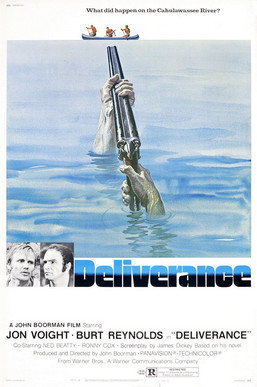
After Bobby is raped and Ed threatened, Lewis kills one attacker with an arrow. Drew wants to report the death; Lewis argues that a local jury will favour the dead man's relatives. The group buries the body. Further downstream, Drew falls into the water, Lewis is injured and Ed must climb the cliff above the river to confront a suspected gunman. He kills a man, but checking the corpse's teeth cannot settle whether this was the escaped attacker. Finding Drew's body offers no certainty either: the wound might have come from a bullet or a rock. The survivors conceal what happened and give the authorities an account of a drowning. Sheriff Bullard allows them to leave with a warning to stay away. At home, Ed dreams of a hand breaking the reservoir's surface and wakes beside his wife. The image does not identify a body or solve the killings. Getting out of the valley has left him with questions that the return to his bedroom cannot answer.
The boats' small size against the river's force keeps the men's vulnerability visible. Rapids, wrecks and the steep cliff turn an outing into work that can kill them, even without a human pursuer. The dam adds another kind of pressure. The landscape they wanted to visit is already scheduled to disappear, and that same flooding offers a way to hide evidence. A wish to experience the wilderness therefore becomes entangled with the possibility of burying the consequences of their own actions. Deliverance puts the visitors' civilized self-image under strain: defending themselves requires violence, then safety appears to require concealment. Their return to the reach of doctors and police is physically necessary, while their account of the journey has to leave out the acts that made the return possible. The law becomes both a refuge and a threat.
James Dickey adapted his own novel, but he and Boorman disagreed about how to bring the four men to the screen. Dickey wanted the opening to establish their comfortable lives in Atlanta. Boorman preferred to let behaviour on the expedition reveal who they were. Removing that extended introduction places the audience beside the men on unfamiliar ground, with their different responses becoming legible as the trip proceeds. The disagreement was part of a difficult collaboration that eventually saw Dickey leave the location. He nevertheless appears in the finished film as Sheriff Bullard. Casting also changed during development: Boorman discussed the lead roles with Jack Nicholson and Marlon Brando before the proposed fees proved unacceptable to the studio. The eventual ensemble paired Reynolds and Voight with Beatty and Cox, whose work in theatre preceded their film debuts here.
Cinematographer Vilmos Zsigmond and Boorman planned an image that would resist turning the Georgia scenery into a picturesque holiday. Zsigmond wanted sharp detail and strong contrast while restraining the colours. He rejected the flashing and fog filters used for the softer period look of McCabe & Mrs. Miller, choosing instead to work with Technicolor on the colour balance. The intended effect kept skin believable while darkening the landscape around it. Shooting in Tallulah Gorge also made the terrain a practical problem for the company. Cast, crew and equipment had to reach locations below steep cliffs; even lunch travelled down by cables and pulleys. Water-level camera positions put the apparatus close to the current. Those working conditions connect the film's view of the river to its actual geography, where footing, access and the movement of water determined what could be photographed.
The actors' later recollections describe extensive preparation for that physical work. Cox remembered Boorman canoeing the river beforehand and encouraging the performers by doing demanding work himself. Beatty recalled discussions about how to convey a canoe's speed, a problem that depends on where the camera sits as much as on the boat's movement. Reynolds and Voight remembered Zsigmond's agility with the camera and his ability to find shots around them. Their accounts place the survival scenes within a coordinated effort by performers, director and camera crew. The men on screen have to react to an environment that is moving faster than they can control; the filming had to give that movement a readable shape. A trip introduced through conversation and music becomes a series of urgent physical decisions, with the performers' bodies carrying the change in circumstances.