
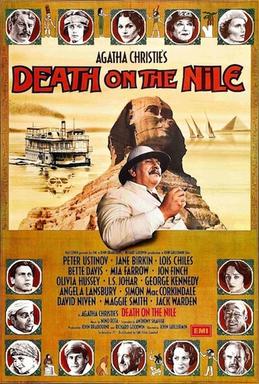
Behind the film
- Year
- 1978
- Director
- John Guillermin
- Writers
- Anthony Shaffer
- Runtime
- 2h 21m
- Genres
- Crime, Thriller, Suspense, Mystery
- Production
- Paramount Pictures, EMI Films
- Country
- United Kingdom, Egypt
- Cast
- Peter Ustinov, David Niven, Simon MacCorkindale, Lois Chiles, Mia Farrow, Bette Davis, George Kennedy, Maggie Smith
About the film
Contains story spoilers, including the identity of the killers and the ending.
Agatha Christie’s 1937 mystery reaches the screen as an ensemble journey whose geography steadily narrows. The story begins with heiress Linnet Ridgeway and her friend Jacqueline de Bellefort, whose fiancé Simon Doyle becomes Linnet’s husband instead. The newlyweds travel through Egypt, but Jacqueline keeps appearing wherever they go. Their attempt to get away brings them aboard the S.S. Karnak, a Nile paddle steamer carrying Poirot, his fellow investigator Colonel Race, and a collection of passengers whose private histories provide possible motives. The 1978 film was directed by John Guillermin, scripted by Anthony Shaffer, and introduces Peter Ustinov as Poirot.
Jacqueline's pursuit eventually erupts into a late-night confrontation with Simon aboard the Karnak. She fires at his leg, and the apparent injury turns their private history into a spectacle the passengers must deal with. A doctor is needed for Simon; Jacqueline is sedated and watched by Miss Bowers. The next morning Linnet is discovered shot in her cabin. The obvious suspect appears to have been under supervision, while the husband who might inherit her wealth seems physically incapable of leaving his place. This arrangement gives Poirot two problems at once: the voyage has supplied plenty of hostility, but its most conspicuous triangle appears to contain an obstacle to every easy solution. The audience has seen a violent quarrel whose consequences must now be reconsidered.
Linnet’s wealth has entangled her with people who depend on, resent or covet what she controls. Mrs. Van Schuyler wants her pearls; her companion Miss Bowers carries an older grievance involving Linnet’s father. Maid Louise Bourget says Linnet withheld money she had been promised, while lawyer Andrew Pennington has been misusing funds entrusted to him. Novelist Salome Otterbourne faces a libel action from Linnet, and her daughter Rosalie is protective of her. James Ferguson resents Linnet’s class and fortune; Dr. Bessner is troubled by her criticism of his clinic. Jacqueline’s motive is intimate and conspicuous. The resulting web ranges from financial fraud and a threatened lawsuit to class resentment, family history and a disputed promise. These motives make Linnet’s wealth the common point of contact, but they do not establish that any suspect acted. Each thread gives Poirot a reason to ask not only who disliked her, but who could convert a grievance into opportunity.
Poirot and Race work through physical clues rather than accepting the emotional spectacle as proof. The missing pistol is recovered from the Nile, wrapped in a stole with a stained handkerchief. The stole could muffle a shot, but the scorching around Linnet's wound indicates that her killer fired without it. Its use therefore belongs to a different part of the night's events. A bottle labelled as pale nail polish contains red ink, explaining a stain that looked like blood. These everyday objects turn the mystery toward the construction of an apparent injury: what the passengers believed they saw may have been carefully prepared for them.
The investigation becomes a threat to anyone who has seen too much. Louise is found with her throat cut and a fragment of a banknote in her hand, suggesting that her knowledge has become the basis of a blackmail demand. Salome then offers Poirot the identity of Louise's killer, only to be shot through a doorway before she can name the person. This second witness murder uses Pennington's revolver, a weapon too large to account for Linnet's wound. The growing list of victims follows the practical problem of suppressing testimony. Linnet's killing can no longer be considered only through the many grievances surrounding her: someone is actively removing people who could describe what happened afterward.
In the saloon, Poirot reconstructs Simon and Jacqueline's conspiracy. They remained lovers and planned for Simon to inherit Linnet's fortune. Jacqueline's first shot missed Simon; the red stain supplied his apparent wound. Once everyone was attending to Jacqueline or fetching the doctor, he ran to Linnet's cabin, killed her and returned. He then genuinely shot his leg through the stole and threw the incriminating bundle into the river. Jacqueline killed Louise to stop her blackmail and Salome because she had seen Jacqueline leaving Louise's cabin. The distinction between the staged shooting and the later real wound explains how a man who required medical treatment could nevertheless have committed the first murder.
The pair challenge Poirot to produce proof. He proposes a wax test for gunpowder on Simon's hands, and the threat brings their resistance to an end. Race later admits that he had no wax to carry it out. Jacqueline confesses, embraces Simon and takes back her pistol, killing him and then herself. Poirot's explanation restores the sequence of events but cannot stop the final deaths. The farewell also gives Rosalie and Ferguson a different prospect: they announce their engagement as the surviving passengers leave.
The film's luxury-tour setting was built through work in Egypt and London, with the Egyptian shoot exposing the cast to intense heat and a boat too cramped to provide everyone with a separate dressing room. Actors travelled by speedboat from their hotel in Aswan to the filming location. That physical production underlies the contrast between the holiday's attractive surfaces and the confinement that follows the murder. Anthony Powell's costumes, which won the Academy Award for costume design, supply another layer of period construction around the travelling ensemble. Jack Cardiff photographed the film and Nino Rota composed its music. Ustinov, David Niven, Bette Davis, Maggie Smith and Angela Lansbury bring distinct presences to the shipboard encounters: detective and fellow investigator, wealthy passenger and companion, and the flamboyant novelist whose attempt to tell the truth becomes fatal.