
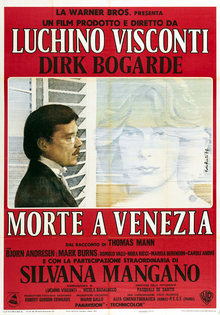
Behind the film
- Year
- 1971
- Director
- Luchino Visconti
- Writers
- Nicola Badalucco, Luchino Visconti, Thomas Mann
- Runtime
- 2h 10m
- Genres
- Drama, Lgbtq-related
- Production
- Warner Bros. Entertainment, Alfa Cinematografica, Warner Bros. Pictures
- Country
- France, Italy, United States
- Cast
- Dirk Bogarde, Romolo Valli, Mark Burns, Nora Ricci, Marisa Berenson, Carole André, Björn Andrésen, Silvana Mangano
About the film
Contains full story spoilers, including the ending.
Luchino Visconti's Death in Venice follows Gustav von Aschenbach, a composer who arrives at a seaside hotel hoping to recover his health. Dirk Bogarde plays a man whose cultivated reserve gradually gives way to an attraction he cannot put aside. The object of his attention is Tadzio, played by Björn Andrésen, a Polish adolescent visiting with his family. Visconti adapts Thomas Mann's novella through an emphasis on faces, glances and the spaces between people. Aschenbach watches from dining rooms, corridors and the beach, while Tadzio remains part of a family holiday. Their unequal awareness of those encounters gives the hotel's ordinary routines an increasingly private meaning for its solitary guest.
The film changes Aschenbach's profession from Mann's writer to a composer and makes music part of his characterization. Passages from Mahler's Third and Fifth Symphonies accompany a figure whose appearance also recalls the composer. The Adagietto from the Fifth frames the journey, sounding over the arrival by sea and returning near the end. This is not a biographical account of Mahler. Aschenbach remains a fictional character, and the film uses remembered conversations with Alfred to give his artistic convictions a spoken form. The men dispute whether beauty comes from the artist's disciplined creation or exists independently in the natural world, an argument that becomes difficult for Aschenbach to keep separate from Tadzio.
At first, Aschenbach's movements are those of a guest settling into an unfamiliar resort. He unpacks, listens to the guests and observes the boy across the hotel. Tadzio's companions speak Polish, while other holidaymakers fill the beach with several languages. Aschenbach learns the boy's name by hearing it called. He is close enough to follow the family's routine and far enough away to know little of their lives. His attention begins to interfere with the rest he came to seek. He decides to return to Munich, but a mistake sends his luggage on the wrong train. The resulting delay gives him a reason to go back, and he returns to the hotel with relief.
Venice's apparent hospitality grows less reassuring as signs of illness break through the tourist surface. Aschenbach sees a man collapse, hears reports of cholera and encounters evasions from those who have an interest in keeping visitors calm. A clerk eventually tells him about the epidemic. Even then, knowledge of the danger does not produce a departure. Aschenbach imagines warning Tadzio's mother but remains caught in his own fascination. He follows the family through the city, including into St Mark's Basilica. The distance he crosses through streets and public buildings does not bring a conversation with Tadzio. The two exchange looks, while the composer's decisions become increasingly governed by the possibility of another sighting.
Aschenbach's attempt to improve his appearance makes his decline more visible. A barber dyes his hair and applies cosmetics, offering a surface of youth that cannot repair the exhausted body beneath it. Earlier, the composer recoiled from a conspicuously made-up older man on the boat; he now approaches the appearance that disturbed him. When Tadzio's family prepares to leave, Aschenbach makes his way to the beach. He sees a rough game between Tadzio and another boy, then watches Tadzio move toward the water. From his chair he reaches toward the distant figure and dies. The final gesture does not close the space between them, and the boy remains at the shoreline.
Visconti described the adaptation as a project that had stayed with him for years before demanding to be made. He said such projects could recede from attention, then return at a particular point in a filmmaker's life. He also connected its sparse dialogue to material concerning Mann and Mahler, while allowing that some of his own contribution might be present. That mixture helps explain why the conversations about art sit beside long passages of observation. The literary source supplies the encounter and its fatal direction; the composer's identity gives those questions a musical setting. Flashbacks interrupt the holiday's present, bringing Aschenbach's remembered arguments with Alfred into the same film as his largely silent pursuit of Tadzio. He resisted assigning individual lines to a single voice, treating the dialogue as a meeting of the filmmaker and his subjects.
The period setting involved unusually exact choices of clothing and objects. Bogarde wore a raw silk summer suit made in 1911, and women's linen was left soft and creased rather than pressed into a later silhouette. Even Aschenbach's unopened trunk was packed with the clothes his stay would require. Visconti could also change course during filming. He recruited singer Masha Predit, who was appearing among the hotel guests, to sing a Mussorgsky lament during the beach death. He discarded an image of Aschenbach picking up a dead crab when it did not fit the scene. Such choices join a carefully furnished social world to the composer's failing body without requiring him to explain every feeling aloud.