
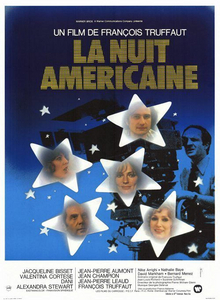
Behind the film
- Year
- 1973
- Director
- François Truffaut
- Writers
- François Truffaut, Suzanne Schiffman, Jean-Louis Richard
- Runtime
- 1h 55m
- Genres
- Drama, Tragicomedy
- Country
- France, Italy
- Cast
- Niké Arrighi, Jacqueline Bisset, Jean-Pierre Léaud, Jean-Pierre Aumont, Valentina Cortese, François Truffaut, Nathalie Baye, David Markham
About the film
Contains story spoilers.
Day for Night follows the production of Meet Pamela, a conventional romantic melodrama being made at a studio in Nice. François Truffaut plays Ferrand, the director, who has to turn a script about a father running away with his son's new wife into scenes that can be shot on schedule. The film begins by letting us watch one of those scenes: a crowded Paris square, an angry young man crossing it, and a slap delivered to the older man playing his father. A call of “cut” widens the scene into a set, with crew members resetting the crowd for another take. From there, the camera keeps moving between the fiction being filmed and the practical work that makes it possible.
The melodrama's small family is played by performers carrying larger histories onto the set. Jean-Pierre Aumont is Alexandre, the father; Jean-Pierre Léaud is Alphonse, his son; and Valentina Cortese is Séverine, the mother. Jacqueline Bisset plays Julie Baker, the young wife at the centre of the story. Séverine once had a relationship with Alexandre, and their old connection sits beside the roles they now play. Julie is recovering from a nervous breakdown and has married a doctor, which makes her an insurance concern to the producer. The crew has to treat her as an actress, a colleague and a person whose health could interrupt a costly production.
The first serious strain comes from Alphonse's private life. He has helped his girlfriend Liliane get work as a trainee script girl, but grows jealous when she flirts with the stills photographer. Soon she leaves him for a member of the crew, and Alphonse is too hurt to return to the set. Ferrand tries to keep the film moving while Joëlle, his script supervisor, handles the daily details around the actors. When Julie comforts Alphonse, he mistakes sympathy for a promise of love. He tells her husband about their encounter, turning a moment of consolation into a new threat to her recovery and her place in the production.
Séverine's trouble takes a different form. The former star has turned to drink, and during a simple scene she cannot remember her lines or find the right door, repeatedly opening a cupboard instead. Each failed take brings the cast and crew back to their starting marks. Ferrand has to keep his direction clear without humiliating her, while the work around them continues: props are borrowed from the hotel, food is reshaped to satisfy a performer, and a cat refuses to drink milk when the camera needs it to. Even the apparently minor tasks require adjustment, patience and another attempt.
The film keeps placing those ordinary hold-ups beside emergencies that could stop Meet Pamela altogether. A pregnant actress objects to appearing in a swimsuit; the producer worries about Julie's insurance; and Alphonse's disappearance leaves a role and a relationship unsettled. Ferrand has nightmares about the movie and increasingly treats simply reaching the end of the schedule as an achievement. The crew solves problems by dividing them into things that can be handled now: a prop is found, a scene is reblocked, an actor is coaxed back. The work's momentum depends on everyone accepting a compromise and returning to the next setup.
The production's most serious interruption is Alexandre's death in a car accident. A performer has vanished from the company, and the melodrama itself must be rearranged around the loss. The incident changes the mood on set, but the remaining cast and crew gather for a final effort rather than abandon the picture. Meet Pamela is completed successfully. After the shoot, a television reporter asks how everything went, and the props man says it was wonderful. His cheerful answer compresses the exhaustion, improvisation and private trouble into the polished version of events that a production can present to the public.
Truffaut said he treated the shoot as a documentary, keeping the action within one place and period while listing plausible obstacles that could threaten a production. That method makes the crew's practical work part of the story: actors, script girl and props man each matter alongside the stars, and a scene can be held up by a cat or a misplaced door. The film keeps returning to the collective effort of resetting, adjusting and trying again. Ferrand's recurring dream of stealing stills from Citizen Kane adds a private memory to a director whose working day is otherwise full of questions from everyone around him.
The title names the technique of filming a night scene in daylight, using exposure or a filter to create the illusion. The film also shows how a movie's artifice can be made visible without ending its illusion. Its opening crane shot pulls back from the square to reveal the false facades; a second take then exposes how the scene is rebuilt. Music is treated as part of that process: the opening titles include fragments of a recording session, while Georges Delerue's score later returns over the image of celluloid being cut. After Alexandre dies, Ferrand reworks the script and shoots around the absent performer, dropping a costume-ball scene. The finished melodrama is therefore shaped by both practical limits and deliberate choices about what the camera can preserve.