
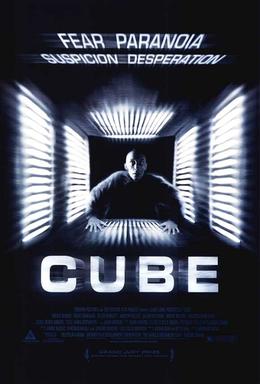
Behind the film
- Year
- 1997
- Director
- Vincenzo Natali
- Writers
- Vincenzo Natali, Graeme Manson, André Bijelic
- Runtime
- 1h 30m
- Genres
- Horror, Science fiction, Psychological horror fiction
- Production
- Cineplex Odeon Films, Viacom, Telefilm Canada
- Country
- Canada
- Cast
- Nicole de Boer, Nicky Guadagni, David Hewlett, Andrew Miller, Julian Richings, Wayne Robson, Maurice Dean Wint
About the film
Contains story spoilers.
Cube begins with Alderson waking alone in a bare metal chamber, where identical hatches open onto rooms that look almost the same. One wrong step through a doorway brings a razor-wire trap down on him, and that blunt opening sets the rules: the rooms offer no explanation, and curiosity can kill before anyone has time to plan. In another chamber, Quentin, Holloway, Leaven, Rennes and Worth meet without knowing who brought them there. Six doors connect each room to its neighbours, but there is no food or water, so staying still is not a safe choice either. Every move means trusting a stranger’s guess about what waits on the other side.
Rennes seems best equipped to take charge. He has escaped from several prisons and tests a simple idea by tossing his boot into the next room, hoping a trigger will react to movement before a person enters. It works often enough to get the group moving, until an acid trap kills him. The loss leaves the others without their most confident navigator and makes the numbered plates beside each hatch the only clue they can study. Leaven, a mathematics student, starts looking for a pattern. At first the group treats prime numbers as warnings, but the labels turn out to encode coordinates in a vast grid. The puzzle is not a code that explains why they are captive; it is a practical way to plot where they are.
The room has collected people whose skills fit together, though they do not immediately see it that way. Leaven can work with the numbers, Holloway is a doctor who insists that Kazan, a young man with a cognitive disability, deserves their protection, and Quentin is a police officer who quickly assumes command. Worth stays withdrawn and hard to read. When the group learns that he helped design the Cube’s outer shell, his knowledge answers one question while making the larger mystery more disturbing: he can describe the structure he worked on, but he does not know who ordered it or what purpose it serves. The characters reach for theories about governments, corporations and wealthy eccentrics because an unexplained machine is harder to face than a named enemy.
Holloway and Quentin clash over what survival permits. She sees Kazan as a person who should not be abandoned; Quentin increasingly treats him as a risk that slows the group down. The rooms sharpen those arguments into immediate choices. They cross a room rigged to react to sound, where Kazan’s cry almost gets Quentin killed. At the edge of the structure, Holloway tries to swing across a gap on a rope made from their clothes. Quentin catches her as the rope slips, then deliberately lets her fall and tells the others it was an accident. Holloway’s distrust of institutions makes her suspect a hidden authority behind the maze, while Worth’s account of its construction points toward something less deliberate: a huge project assembled through layers of contractors, with no one taking responsibility for the whole. The idea does not give them comfort or a villain to confront, and their arguments grow more personal as the exits remain out of reach. Quentin tries to separate Leaven from the others and attacks Worth when Worth intervenes.
The group’s route repeatedly seems to circle back on itself. When they find Rennes’s body in a room they have visited before, Worth realizes the rooms have been shifting through the structure; what looked like a return to the same place may actually mark a change in the Cube’s position. Leaven revises her reading of the numbers: a room’s label can signal danger when its values are powers of prime numbers, rather than simply primes themselves. She and Kazan work together to identify a possible bridge room that will briefly line up with the outer shell. The calculations offer a route and a window of time, not a way to control the machinery, so they still have to wait and move when the rooms align.
With Kazan’s rapid calculations helping Leaven navigate, the survivors reach the moving bridge and see a way out. Quentin, whom they had trapped behind them, returns at the worst moment and attacks. He fatally stabs Leaven and Worth before Worth grabs him as the bridge shifts; Quentin is crushed between the moving structures, while Kazan steps alone into the bright opening. The film leaves the machinery and its designers unexplained, so escape answers only the immediate question of whether anyone can get out. Natali has described the original idea as a way to make one set stand in for many, letting the characters travel through a maze without the production needing a maze of locations. That constraint shapes the experience: small changes in color, framing and sound make each room feel newly uncertain, while the confined space keeps every disagreement close enough to become physical.