
Behind the film
- Year
- 1986
- Director
- Peter Faiman
- Writers
- Paul Hogan, John Cornell, Ken Shadie
- Genres
- Adventure, Romantic comedy
- Country
- Australia
- Cast
- Paul Hogan, Linda Kozlowski, Mark Blum, David Gulpilil, John Meillon, Reginald VelJohnson
About the film
Contains story spoilers.
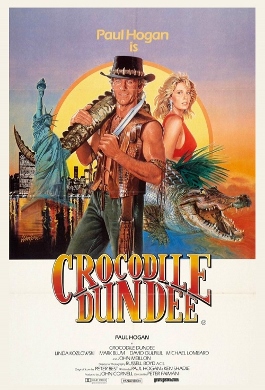
Sue Charlton, a reporter for her father’s New York newspaper, heads to the Northern Territory to meet a man whose story sounds nearly impossible: Mick Dundee supposedly lost part of his leg to a crocodile, then crawled a hundred miles back to safety. In Walkabout Creek, she meets Walter Reilly, Mick’s business partner, and waits for the famous bushman to arrive. When he does, Sue discovers that the missing leg is a local exaggeration. Mick has a long scar, which he calls a “love bite,” and a relaxed manner that leaves her unsure how seriously to take him. He is capable and friendly, but also rough around the edges and too ready to assume that a woman from the city cannot manage alone.
The outback portion lets Sue test the legend against the person. Mick handles a water buffalo, a snake and a crocodile with the ease of someone who knows the land; he also gets the better of kangaroo hunters by making them think one of the animals is shooting back. Sue sees that the danger is real, even when the stories around Mick have grown larger than life. They meet Neville Bell, a local Aboriginal man, and Mick’s everyday relationships in the township become part of what she is learning. The attraction between Sue and Mick develops through teasing and practical dependence, especially after Sue goes out by herself to prove she can survive without his supervision. Mick quietly follows her and rescues her when a crocodile attacks at a billabong.
Sue invites Mick to New York on the pretext of finishing her feature. Walter initially laughs at the idea, then accepts when he learns the newspaper will pay. The change of setting reverses the first half’s dynamic. In Australia, Sue was the visitor trying to understand Mick’s world; in Manhattan, Mick arrives with no experience of city customs and no reason to treat them as mysterious. He checks into the Plaza, watches the crowded streets and responds to situations with the same unhurried common sense he used in the bush. His knife, confidence and plain speaking make him difficult to intimidate, even when the obstacle is a mugger or a city resident who assumes he is an easy target.
Sue’s life in New York is already connected to Richard Mason, her editor and boyfriend. Mick’s arrival forces that relationship into view. Richard belongs to Sue’s professional and family world, and he is comfortable at the dinner table with her wealthy father, Sam Charlton. Mick is a stranger there, but he is not impressed by Richard’s status or by the rules that are meant to protect it. At an Italian restaurant, Richard repeatedly makes jokes at Mick’s expense until Mick punches him; Sue reprimands Mick, and the moment shows that his instincts can complicate her life as quickly as they can help her. Their differences do not disappear when they are in the same room. Sue has to weigh the affection she has developed for Mick against the relationship she already knows how to maintain with Richard.
The city sequences are less about Mick learning to become a New Yorker than about him moving through the place without surrendering the habits that make him Mick. He befriends people who live and work around him, navigates street encounters and treats the city as another environment to read. Sue’s family dinner brings those worlds together. Richard unexpectedly proposes marriage in front of her father and the assembled guests. Sue says yes, though the public proposal leaves little room to pause and reconsider. Mick, who has grown attached to her, interprets it as a decision and prepares to leave.
Mick tells the hotel doorman, Irving, that he is setting off on walkabout across the United States. Sue arrives after he has checked out and runs barefoot toward the subway station. At the platform she cannot get close enough to call to him, so she asks the crowd to pass her message along: she has changed her mind about marrying Richard and loves Mick. The commuters carry the words through the station. Mick hears her, walks across the raised hands and shoulders of the crowd, and reaches Sue. The city becomes a place where strangers briefly cooperate so two people can find one another.
The romance depends on both characters changing their assumptions. Sue begins with a newspaper assignment and an idea of Mick built from an exaggerated survival story; living beside him in the outback complicates her view. Mick initially underestimates Sue’s ability to travel alone, then follows her without taking over the moment she tries to prove herself. In Manhattan, she helps him read an unfamiliar social world, but he does not need to become polished to fit into it. Peter Faiman’s film shifts between open Australian landscapes and busy New York streets, giving the courtship two different kinds of space to move through.