
Behind the film
- Year
- 1972
- Director
- Ingmar Bergman
- Writers
- Ingmar Bergman
- Runtime
- 1h 30m
- Genres
- Drama, Historical
- Production
- SF Studios
- Country
- Sweden
- Cast
- Harriet Andersson, Kari Sylwan, Ingrid Thulin, Liv Ullmann, Inga Gill, Erland Josephson, Linn Ullmann, Ingrid Bergman
About the film
Contains story spoilers.
The first thing Cries and Whispers gives us is time passing: clocks fill a quiet house with ticking, then Agnes wakes in pain and sets one clock going again. She is dying of cancer in the family’s large country home, where her sisters Maria and Karin have come to stay. Anna, the maid, is already there and does most of the daily nursing. The film keeps us close to these four women, moving between the bedside vigil and memories that reveal why the sisters can sit in the same room yet find comfort so difficult to offer. Its late nineteenth-century setting is suggested through the mansion, clothes and household hierarchy, while the story’s attention stays on bodies and relationships.
Agnes has spent much of her life alone in the house. She recalls watching her mother in the garden, hoping for affection that never comes. As the illness tightens its hold, her cries interrupt the composed routines around her. Bergman keeps Harriet Andersson close as Agnes endures wave after wave of pain. For these scenes of suffering and death, he cleared away crew members who were not needed, protecting the privacy of the performance. Anna answers Agnes’s cries. Having lost her own young daughter, she holds the sick woman against her breast in bed, offering warmth and contact when medicine and formal prayer cannot make the pain disappear.
Maria’s past comes into the present when the family doctor, David, visits Agnes. Maria has been having an affair with him, and the history between them is not a tender refuge: David studies the changes in her face and names the vanity and indifference he believes he sees. Their private conversation exposes how little Maria can admit about herself, even to a man with whom she has been intimate. A flashback reaches further back, to the affair’s start, when David was called to treat Anna’s ailing daughter. Maria’s husband Joakim discovered enough to attempt suicide, leaving the marriage shadowed by guilt and evasion. These episodes explain the brittle mood Maria carries into the sickroom, while her apparent ease around Agnes cannot become steady care.
Karin’s memories lead to a different kind of enclosure. She lives with Fredrik in a marriage built on hostility, and his effort to approach her in bed feels to Karin like another demand she cannot bear. She cuts herself with a piece of glass and uses the blood to repel him. The scene is shocking because it makes her refusal bodily and impossible to smooth over afterward. Yet when she and Maria are alone together, Karin briefly lets the anger fall. The sisters touch and speak with unusual directness, and the closeness seems to promise that they might begin again. When Maria later leaves, though, Karin asks whether she remembers that exchange; Maria brushes it aside and turns her attention to the family waiting outside.
Agnes’s final decline brings the house’s uneasy rituals into sharper focus. The doctor can attend her body but cannot comfort her; the priest who comes to pray over her admits that his own faith is weak. After Agnes dies, his words ask her to pray for those left alive, turning the person who has suffered into the one expected to intercede for everyone else. Bergman then shifts from the funeral’s ordinary aftermath to an episode that the film leaves uncertain: Anna hears a child cry and finds Agnes awake again, calling for her sisters. Karin refuses to come close, and Maria is frightened when Agnes reaches for her. Anna returns to the bed and gives the dead woman the embrace neither sister can sustain.
As the sisters and their husbands prepare to leave, they offer Anna a keepsake; she declines, and the film does not turn their departure into reconciliation. Bergman first pictured sisters in white within a red room, then chose Taxinge-Näsby manor rather than building the interiors in a studio. He and cinematographer Sven Nykvist tested the wall coverings, upholstery, carpets, costumes and makeup before filming. Nykvist explained that dawn and dusk close-ups required laboratory filters as well as lighting because color film carried too much color; makeup also kept the red from reflecting harshly on faces. That planning makes the close framing precise: faces nearly touch while the room's color surrounds them.
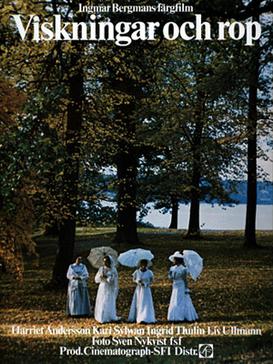
That last departure is followed by an image from Agnes’s diary, not a return to the family’s present. Anna reads about a mild autumn day when Agnes, Maria and Karin went outside with her, walked to an old swing and laughed together. The sisters wear white against the garden’s late light, far from the crimson rooms where most of the vigil has unfolded. Because we know the scene is a remembered day that Agnes treasured, its calm does not erase the sisters’ failures at her bedside. It preserves one occasion when their bodies shared warmth and easy company.