
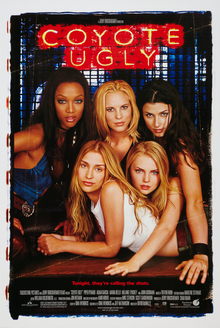
Behind the film
- Year
- 2000
- Director
- David McNally
- Writers
- Gina Wendkos
- Runtime
- 1h 41m
- Genres
- Romantic comedy, Musical, Drama
- Production
- Touchstone Pictures
- Country
- United States
- Cast
- Piper Perabo, Adam Garcia, Maria Bello, Melanie Lynskey, Tyra Banks, John Goodman, Izabella Miko, Bridget Moynahan
About the film
Contains story spoilers.
Violet Sanford leaves New Jersey for New York, hoping to sell her songs. Rejection and a burgled apartment lead her to Lil's Coyote Ugly bar, where she earns money and begins dating Kevin. Her father Bill discovers her bar work and withdraws from her. A quarrel with Kevin and dismissal from the bar send her home. After a car hits Bill at his toll-booth job, Violet considers staying. He urges her onward and admits her mother abandoned singing because of him, rather than stage fright. With Kevin's help, Violet performs at the Bowery Ballroom before her friends, father and fellow Coyotes, earning a record-label deal. Three months later, LeAnn Rimes sings Violet's recorded song at the bar; Violet joins her. She has bought back Kevin's lost comic book, lets Bill win an auction and celebrates by kissing Kevin.
Elizabeth Gilbert's account of working at the real Coyote Ugly Saloon describes a noisy East Village workplace. Owner Liliana Lovell trained her by letting her follow and watch, rather than beginning with recipes or the cash register. Gilbert remembers customers falling for their bartenders and Lil keeping control while drinking with them. Her own late shifts moved from dancing to improvised entertainment: a customer's torn shirt became a Zorro mask, a beer banner became his cape, and garbage-can lids served as shields in a broomstick duel. Screenwriter Gina Wendkos brought her own experience of bartending and performance art; she described the women as possessing power over their sexuality.
Kevin Smith's contemporary account of his rewrite separates dialogue from the scenes and relationships he helped develop. He recalled that almost none of his lines survived, although scenarios and character names did. He said he changed the father from an old-country Italian figure into someone closer to John Goodman, with a Garden State Parkway job. Smith specifically denied creating the boyfriend's comic-book plot, crediting a later writer with that material. Director David McNally recalled returning to Gilbert's article and Wendkos's more romantic screenplay to bring those elements together. He wanted a warmer emotional core alongside the bar setting and romance. McNally remembered assembling material from several scripts during filming. Jeff Nathanson read the drafts and the director's notes, then supplied new pages for changes agreed with Bruckheimer.
The production notes describe a New York setting assembled across both coasts. The first month used Manhattan and New Jersey locations, including South Amboy and Sea Bright. Hurricane Floyd disrupted the final eastern work before the move to Los Angeles, where the bar and Violet's apartment were built on a Playa Vista stage. Production designer Jon Hutman and set decorator Rosemary Brandenburg researched bars in and beyond New York, drawing on material from Chicago, New Orleans, Austin and Montana. Hutman's design began with exposed brick, iron columns and beams, then placed a worn bar within that industrial shell. The imagined history was that Lil had found the premises, cleaned them out and kept their accumulated character. Brandenburg filled the space with borrowed bar-room details, including pictures and bumper stickers. A wall logo made from beer-bottle caps turned the name into part of that collected decoration.
The dancing required its own preparation and practical safeguards. Choreographer Travis Payne recalled a bootcamp that identified each performer's strengths, with rehearsals squeezed into available spaces, including a café parking lot. McNally remembered spotters among the crowd and Coca-Cola applied to the bar to improve grip. Costume designer Marlene Stewart made clothes suited to movement: leather trousers could stretch, and garments had gussets and waterproofing. In ET's archival set interview, Maria Bello described watching a water dance at another New York bar; a similar routine entered the film.
Music work continued around the filming schedule. Piper Perabo recalled shooting all day, taking lessons and then recording late at night in a Hollywood Hills house with songwriter Diane Warren and producer Trevor Horn. Horn remembered working closely with her on the rooftop singing material, part of a film with more extended music than he usually encountered. When he heard Warren's demo of 'Can't Fight the Moonlight', he asked for its multitrack recording so he could draw on the arrangement and pay her programmer. He then worked with a small group of musicians to develop the record. Perabo also remembered a practical difference between the original venue and its screen replacement: the real Coyote Ugly's low ceiling made shooting difficult. The enclosed set had four walls, helping her feel that she was working inside a complete bar.
The ending's music changed late. McNally recalled preview audiences sensing that the finale did not quite work; Jerry Bruckheimer interpreted the response as a need for a stronger song. Warren wrote 'Can't Fight the Moonlight', prompting a reshoot of Violet's gig. Music supervisor Kathy Nelson recalled securing Rimes's participation by including her in the last bar scene. Rimes also supplied Violet's singing voice, matching already-shot footage.