
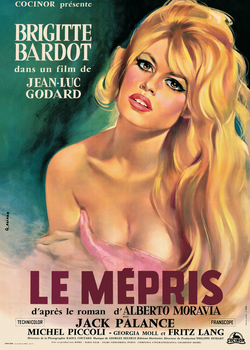
Behind the film
- Year
- 1963
- Director
- Jean-Luc Godard
- Writers
- Jean-Luc Godard
- Runtime
- 1h 42m
- Genres
- Drama
- Country
- France, Italy
- Cast
- Brigitte Bardot, Michel Piccoli, Jack Palance, Giorgia Moll, Fritz Lang, Jean-Luc Godard, Linda Veras, Raoul Coutard
About the film
Contains story spoilers.
Contempt follows a marriage coming apart during the preparation of another film. Jean-Luc Godard’s 1963 drama stars Michel Piccoli as screenwriter Paul Javal and Brigitte Bardot as Camille, his wife. Paul is hired to rewrite a script and becomes absorbed in the work while the producer takes an interest in Camille. The assignment brings the couple into a luxurious filmmaking world, including the Villa Malaparte on Capri. The professional opportunity and the private relationship occupy the same spaces, leaving Camille to judge what Paul is willing to overlook in order to remain useful to the man employing him.
The producer, Jerry Prokosch, wants Paul to rework Fritz Lang’s adaptation of The Odyssey. After a discussion at the studio, Prokosch offers Camille a ride in his sports car. Paul allows her to go alone and follows by taxi, arriving late. She begins to suspect he is using her to improve his standing with the producer. Back at their apartment, their argument reaches the point where she tells him she no longer loves him. They nevertheless travel to Capri for filming. There Paul supports Prokosch’s interpretation of Odysseus against Lang’s, reinforcing Camille’s belief that he will submit to the producer. She lets Paul discover her embracing Prokosch, then accuses her husband of having effectively bartered her away. Paul offers to leave the job and the island, but she departs with Prokosch instead. Both die in a car crash. Paul prepares to return to the theatre, while Lang continues making the film.
Paul initially takes the rewrite partly to pay for the couple’s apartment, giving his compromise an ordinary domestic justification. That apartment becomes the setting for the long middle section, where the pair argue, retreat and briefly approach reconciliation while going about small household actions. Godard gives the disagreement time to change shape rather than reducing it to a single accusation and answer. The camera moves with them as they walk away, bathe or stop to do something else, keeping their bodily familiarity beside their growing difficulty in speaking to one another. Paul wants an explanation for the change he senses, but his questions repeatedly reopen the wound. The film then moves to Capri, where the expensive surroundings offer no escape from what has happened between them. Its broad CinemaScope frame holds a domestic dispute inside spaces usually associated with spectacle. The apartment and the island do different work: one keeps the couple close enough to keep arguing, while the other places the broken relationship within the film production and its competing claims on Paul. The change of location does not give him a fresh start with Camille.
The opening bedroom scene grew out of pressure from the financiers. Godard said they wanted added material showing Bardot and Piccoli undressed, after finding the film insufficiently commercial. He used red and blue lighting to make the scene more unreal and grave than a simple display of the star. That response is visible in a film whose story already concerns disagreements between artistic purpose and a producer’s demands. Godard also described Lang as the director and conscience of cinema, giving the real filmmaker a symbolic responsibility within the fictional production he is trying to finish.
In a separate contemporary statement about the adaptation, Godard described keeping Alberto Moravia’s main theme while changing details, including the characters’ nationalities. He thought putting written material on film already made it different. The languages were part of the design: each character speaks their own, creating the feeling of people lost in a foreign country. He set modern Rome against Capri as an older, natural world. That distinction gives the journey a purpose beyond finding a picturesque place to shoot. Godard also explained that he filmed the Odyssey scenes assigned to Lang’s character while appearing as the director’s assistant himself. The arrangement turns the film within the film into an actual exchange of roles: Lang performs the filmmaker whose work Godard supplies. Godard compared his characters to survivors of the modern world arriving on a mysterious island, while the camera watches their search in place of the gods watching Odysseus.
Cinematographer Raoul Coutard remembered a practical difference between this production and other Godard shoots. Contempt had a numbered screenplay and a work plan, and each evening a telex told the American producers which numbered scenes had been completed. On other films, he recalled Godard arriving in the morning and explaining what they would do that day. The scheduled, reported progress of Contempt therefore placed its director inside a more formally supervised production. That recollection gives a concrete working counterpart to the film’s arguments over who controls a movie: the work was being tracked and reported as well as imagined and photographed.
Godard was still describing his dispute with Joseph Levine in an interview published in Film Quarterly in 1964. He said the requested changes were extensive enough that he considered removing his name. In the same conversation he challenged the assumption that an inexpensive film makes its director less important, arguing that modestly financed pictures could still aim at artistic quality. Contempt sits directly within that concern. Its international stars and larger production gave him resources, but also brought demands about the picture those resources were supposed to buy. The conflict over the added bedroom scene was one specific result of those expectations, rather than an abstract disagreement about art and money.