
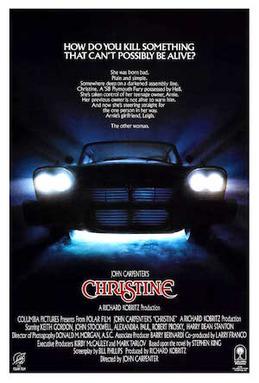
Behind the film
- Year
- 1983
- Director
- John Carpenter
- Writers
- Stephen King, Bill Phillips
- Runtime
- 1h 50m
- Genres
- Horror, Mystery, Drama, Thriller
- Production
- Columbia Pictures
- Country
- United States
- Cast
- Keith Gordon, John Stockwell, Alexandra Paul, Robert Prosky, Harry Dean Stanton, Roberts Blossom, Malcolm Danare, Kelly Preston
About the film
Contains story spoilers.
Arnie Cunningham buys a 1958 Plymouth Fury despite his friend Dennis's objections. Restoring Christine at Darnell's garage changes the bullied teenager into an arrogant man. His girlfriend Leigh nearly chokes inside the car, whose locked doors delay her rescue. After Buddy's gang vandalises Christine, Arnie sees the car repair itself. Christine kills the gang, causes a gas-station explosion and returns burning to the garage, where she kills Darnell. Her restored condition and Arnie's alibi deflect detective Junkins's suspicions. Dennis and Leigh decide to destroy her with a bulldozer. During the garage battle, Arnie drives Christine into Darnell's office while trying to kill Leigh. Thrown through the windscreen, he is impaled on glass and dies. Christine keeps attacking until Dennis and Leigh flatten her. At the junkyard, her remains become a compacted cube. The survivors regret losing Arnie, while a twitch of the grille hints that Christine remains alive.
Screenwriter Bill Phillips gave Arnie's change a visible marker: he stops wearing glasses. Stephen King's novel had him lose his acne, a transformation Phillips felt would be less suitable for the screen. He also expanded Buddy's death from being run over on a road into the gas-station attack. In Phillips's description, Christine smashes Buddy's car, blows up the station and pursues him while burning before running him down. The flames carry through the chase to Buddy's death, replacing the book's simpler roadside killing. Music offered another way to introduce the car. At his girlfriend's suggestion, Phillips proposed George Thorogood's Bad to the Bone for the assembly-line opening. He recalled singing it to Carpenter and producer Richard Kobritz at a meeting, where they agreed to use it. Phillips also described filming a cameo with Thorogood that was cut, including his appearance pretending to operate a crane at the ending. His own explanation of the story connected high-school insecurity with ownership: a possession takes control of the person who buys it, turning Arnie's car into the source of his undoing.
Carpenter's approach gave Christine room to move through the night. In his GamesRadar interview, he described using a Panaglide to keep the camera moving, while the accompanying account connects that mobile photography with the synthesiser score and 1950s rock songs. He said the car was the star and explained that deaths from the novel were changed to make more of her movement as she stalks people. The Plymouths acquired for filming needed refurbishment and painting before they could play Christine. Her ability to recover from damage required a different kind of preparation. The original plan avoided showing a restoration as it happened, but Carpenter later decided to show the process. Arnie steps back from the wreck and waits as its headlights come on and the body reforms. Carpenter credited Roy Arbogast with finding the solution. A hollowed-out car contained hydraulics that pulled its body inward, producing the crushed shape. Running that footage backwards made the metal appear to straighten itself. The physical car was damaged for the camera so that the fictional Christine could visibly undo her injuries.
The adaptation also removed Roland LeBay's rotting-corpse presence from the novel. In an interview with The Flashback Files, Carpenter was asked about that decision and the resulting suggestion that the car itself is evil. He responded with uncertainty rather than offering a firm defence of the change. Asked what makes King's writing difficult to adapt, he pointed to the freedom of long novels: readers can lose themselves in their length, while a screen version has different limits. His explanation concerns the change of medium, without supplying a single rule for which parts of Christine had to go.
Keith Gordon recalled learning about the photography while playing Arnie. Once Carpenter understood his interest in directing, he let Gordon look through the camera and explained choices of lenses, lighting and film stock. Gordon wanted to see the dailies too, but said Carpenter kept those screenings closed to everyone. His account of the set extends beyond the camera. Carpenter worked with familiar crew members, joked around and ate with them. Gordon remembered cast and crew spending time together, with fewer divisions between groups than he had encountered elsewhere. He treated that atmosphere as a lesson in running a film set.
The American Film Institute's compiled production history places the acquisition of King's novel before its publication. King had given Richard Kobritz the manuscript, and its teenagers, rock music and car culture attracted the producer. The Los Angeles shoot needed locations without palm trees to suggest an ordinary northern California town. Production designer Daniel Lomino and location manager Karlene Gallegly searched for that setting, while Lomino and set decorator Cloudia recreated a 1950s automobile plant inside a former furniture factory. For the explosion, the production built an entire gasoline station on a Newhall lot, with Valencia's skyline behind it. The station was designed around the destructive shot, and the explosion was achieved on the first take.