
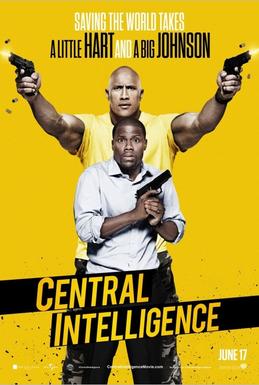
Behind the film
- Year
- 2016
- Director
- Rawson Marshall Thurber
- Writers
- Ike Barinholtz, Rawson Marshall Thurber
- Genres
- Comedy, Buddy, Action
- Production
- Universal Pictures, New Line Cinema, RatPac-Dune Entertainment
- Country
- United States
- Cast
- Dwayne Johnson, Kevin Hart, Aaron Paul, Amy Ryan, Megan Park, Danielle Nicolet, Slaine, Thomas Kretschmann
About the film
Contains story spoilers, including the ending.
Central Intelligence pairs a dissatisfied accountant with the schoolmate he once helped during a humiliating assembly. Kevin Hart plays Calvin Joyner, a former star athlete whose adult life has fallen short of his expectations. Dwayne Johnson plays Bob Stone, formerly Robbie Weirdicht, who has become a CIA operative. CIA officer Pamela Harris tells Calvin that Bob murdered his partner and plans to sell satellite codes. Bob insists he is pursuing the criminal responsible. Calvin's marriage to Maggie becomes another pressure point when Harris threatens her arrest. The case eventually exposes Bob's supposedly dead partner Phil Stanton as the Black Badger. After Stanton's defeat, the friends reach their school reunion. Calvin reconciles with Maggie and rigs the prom-king vote for Bob. Bob confronts his old bully and publicly reclaims his identity. Later, Calvin joins him at the CIA, where Bob returns the varsity jacket Calvin once used to protect him.
The competing accounts of the Black Badger make Calvin's trust a recurring problem. Bob describes losing Phil in an operation and needing Calvin's financial skills to follow the stolen codes. Harris instead presents Bob as unstable and responsible for his partner's death. Calvin wants to return home, but neither account offers an easy route back to ordinary life. When Phil appears alive at the deal, he and Bob each claim to be the criminal, leaving Calvin caught between armed men whose explanations contradict one another. Phil eventually admits that he invented the Black Badger and faked his death. His contempt for Bob includes resentment at hearing repeated stories about Calvin's kindness at school. Bob explains that shooting Calvin was intended to save his life. The criminal's confession ties the espionage deception back to the friendship that Calvin has struggled to understand. Bob has remembered an act of decency for far longer than Calvin realised.
Director Rawson Marshall Thurber deliberately gave Hart the more grounded role. Calvin supplies the audience's perspective while Bob brings much of the eccentric comedy. Thurber described tone as the central directing problem: if the jokes make everything harmless, the action loses its danger; if the violence becomes too grim, the audience has little room to laugh. He also had to be selective with the performers' comic additions. Hart could generate so much funny material that retaining it all would turn the film away from its story. Thurber estimated that improvisation accounted for only a small share of the finished movie, despite giving both stars room to play after filming the scripted material. He linked the film's anti-bullying intention to the lasting damage cruelty can cause. Bob's final speech mattered to him for that reason. Johnson contributed the thought about being oneself, connecting the reunion's comic release with the insecurity that follows Bob into adulthood. Calvin's quieter position lets that insecurity remain visible alongside Johnson's physical confidence.
Bob's imposing body was designed to coexist with the boy he used to be. Thurber explained that an earlier conception involved an out-of-shape man with formidable fighting skills. Casting Johnson changed the joke: the exterior could become muscular while the old vulnerability remained underneath. Johnson cited Tom Hanks in Big and Bill Murray in What About Bob? as performance references for that innocence. Bob's tastes also hold him close to the period of his humiliation. The wardrobe department gathered images of clothes and hairstyles from the 1990s, and his Public Enemy shirt belongs to that design. Thurber described Bob's inner world as having stopped at that point in high school. Hart's action experience, meanwhile, was built around Calvin being thrown into situations he did not choose. He described falls, car accidents and jumps, crediting his stunt double's work. The partnership therefore places a capable fighter with old emotional wounds beside an ordinary man whose reactions register the immediate physical danger around them.
Thurber took direct responsibility for most of the action filming. He estimated that he shot between eighty-five and ninety percent himself, with Joel Kramer and Allan Poppleton handling the smaller second-unit contribution. Much of the action involved the principal performers, which helped keep it within his own unit. He described action preparation as an extensive process involving stunts, visual effects, practical effects, storyboards and shot lists. Once those decisions were settled, filming felt more relaxed to him than comedy, where a new line or reaction could require an immediate adjustment. His reference points included Die Hard, Beverly Hills Cop, Lethal Weapon and 48 Hours. Those interests explain his attraction to an action comedy after We're the Millers. Central Intelligence gave him a film in which the mechanics of a dangerous encounter and the timing of a joke had to work together around the same two actors, rather than treating the action as a separate production exercise.
Theodore Shapiro and Ludwig Göransson shared the score. Recording took place at Shapiro's ELBO Studios in Glendale, with Göransson conducting a twenty-piece string ensemble and Shapiro working in the booth. Brass was recorded separately as part of the sessions. Music editor Ron Webb, music supervisor Gabe Hilfer and librarian Mark Graham worked with the composers, while Chris Fogel handled scoring-mixer duties. The sessions brought an orchestral element to the film's combination of spy action and comic performance.