
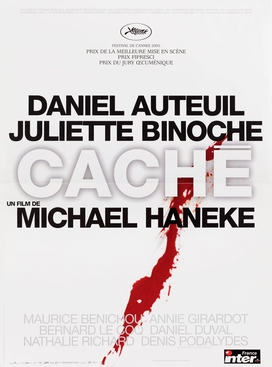
Behind the film
- Year
- 2005
- Director
- Michael Haneke
- Writers
- Michael Haneke
- Genres
- Drama, Thriller
- Production
- Les Films du Losange, BiM Distribuzione, France 3
- Country
- France, Germany, Austria, Italy
- Cast
- Daniel Auteuil, Juliette Binoche, Annie Girardot, Aïssa Maïga, Maurice Bénichou, Bernard Le Coq, Caroline Baehr, Christian Benedetti
About the film
Contains story spoilers, including the ending.
Georges Laurent, a television presenter in Paris, receives anonymous recordings of his home. Police do not regard the initial recordings as a crime. The tapes and disturbing drawings bring his childhood back into his family life with Anne and their son Pierrot. Georges follows a recorded route to Majid, an Algerian man his parents once intended to adopt. Majid's parents disappeared during the 1961 Paris massacre. As a boy, Georges resented the adoption and told lies that resulted in Majid being sent away. Majid denies making the tapes, but Georges threatens him; a recording of their encounter reaches Anne and Georges's employer. When Pierrot disappears, police arrest Majid and his son. Pierrot returns from staying with friends. Majid later summons Georges and kills himself in front of him. Georges tells Anne about his childhood lies: he claimed Majid was coughing blood and tricked him into killing a rooster. Majid's son confronts Georges about his father's death and also denies sending the recordings. In the closing school scene, Majid's son speaks with Pierrot. Their conversation supplies no confirmed explanation of the surveillance. The film leaves the tape maker unidentified, even after revealing the childhood act Georges has tried to conceal.
Haneke described Caché as a film about living with the consequences of harm. In his interview with Karin Schiefer, he shifted attention away from deciding whether a six-year-old could be guilty and towards the adult's response to another person's suffering. He connected Georges's retreat under the bedcovers to a wider habit of giving something to charity and then putting uncomfortable obligations aside. That comparison was Haneke's stated interpretation of the gesture. He also said that he wanted to leave the film open to the viewer. A thriller's customary solution could calm its audience; his intention was to let the unease continue after the ending.
The relationship between the surveillance images and the rest of the story also shaped the photography. Haneke said that everything was shot in high definition, his first feature on video, and that post-production required repeated corrections to image and sound. Interiors in Georges's house and Majid's apartment were filmed in Vienna; the exteriors were made in France. The staircase and Georges's street were reconstructed for continuity. Haneke credited production designer Christoph Kanter with making those separate locations fit together. The resulting homes belong to the same story world despite the divided shoot. Cinematographer Christian Berger recalled frequent technical breakdowns with the HD equipment. Following the shooting list helped formulate the approach. He said they were pleased with the result, describing the intended relationship between the tapes' appearance and the sense of reality.
At Cannes, Haneke discussed the opening shot as an example of the film's treatment of images. What initially appears to be the present reality of the story is revealed as footage taken by a video camera. He said this use of video unsettled the viewer's confidence in what appeared real, connecting the device to his mistrust of images presented as reality in the media. The actors' accounts of working with him were concerned with precision rather than an explanation of the mystery. Juliette Binoche recalled that Haneke initially said very little to her, unlike their experience on Code Unknown. After a month, she asked about his silence. He then became much more involved during the remaining fortnight. She described a director attentive to breathing and pauses who still allowed actors freedom. Daniel Auteuil preferred practical instructions about entering, leaving and changing speed. Maurice Bénichou likewise resisted having everything explained: he thought an actor could end up playing an explanation instead of an interpretation. For him, the written screenplay passed through the actor's body. These accounts describe a shared production in which detailed physical direction could coexist with questions the story did not settle.
The historical connection was discussed directly when Haneke spoke with historian Benjamin Stora for La Vie. Haneke said he had wanted to write a role for Auteuil and to confront an adult with the consequences of a harmful childhood act. A documentary about the 1961 demonstrations supplied a catalyst. Haneke was disturbed by the killings and what he understood as forty years of silence, but said he had not set out to make a film about the Algerian war. Stora corrected the claim of complete silence: French newspapers had reported the demonstrations and police repression immediately, with concealment taking hold after 1962. Their exchange therefore distinguishes the filmmaker's discovery from the history of public knowledge. Haneke also acknowledged that Stora's interpretation of Majid's suicide had not been in his mind during filming. He connected repression to Austria's refusal to face its Nazi past and suggested that the story could have been set in other countries. The French setting remained specific, while the conflict he wanted to examine extended to how people suppress responsibility for earlier actions.