
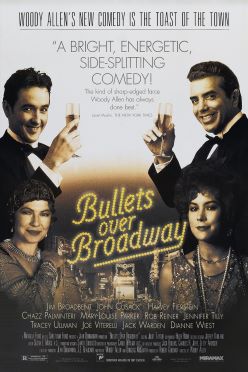
Behind the film
- Year
- 1994
- Director
- Woody Allen
- Writers
- Woody Allen, Douglas McGrath
- Genres
- Gangster, Comedy, Romantic comedy
- Production
- Miramax
- Country
- United States
- Cast
- John Cusack, Dianne Wiest, Jennifer Tilly, Chazz Palminteri, Mary-Louise Parker, Jack Warden, Joe Viterelli, Rob Reiner
About the film
Contains story spoilers.
In 1928, playwright David Shayne, played by John Cusack, agrees to cast Olive Neal to secure financing from her gangster boyfriend. Jennifer Tilly plays Olive; Dianne Wiest is fading star Helen Sinclair. Olive's bodyguard Cheech, played by Chazz Palminteri, starts rewriting David's script. The actors embrace his changes. David has an affair with Helen, while Warner Purcell takes up with Olive. Unable to get Olive fired, Cheech kills her and dumps her body in a river. On opening night, the gangster's men shoot Cheech backstage. Dying, he gives David a new final line. The play succeeds, but David admits his lack of talent, proposes to Ellen and decides to return to Pittsburgh. His professional triumph belongs largely to the dead man whose revisions he accepted, while his own decision takes him away from Broadway.
The screenplay's actual collaboration began with a much friendlier invitation. Douglas McGrath told Patrick McDonald at HollywoodChicago that he knew Allen socially through Jane, his future wife, who had worked for Allen as an assistant and associate producer. Allen asked her whether McGrath might like to write a film with him. When Jane telephoned him in California, he spent twenty minutes wondering whether she was joking. He remembered the work as an extraordinary writing lesson, with Allen treating him as a collaborator rather than asserting his status. McGrath was careful about what he claimed for himself. When viewers suggested that the film's difference from other Allen pictures must be his contribution, he pointed out that Allen had approved every line. He described his own part as steering their discussions toward particular ideas instead of others they were considering.
Wiest's account begins with her own telephone call asking Allen for a part. Speaking to Bonnie Churchill in The Christian Science Monitor, she recalled his promise to write something for her and an idea about Broadway and gangsters scribbled inside a matchbook. Helen nevertheless proved difficult to play. After the first scenes, Allen sent Wiest to watch the dailies and work out what was wrong. She could see the problem without knowing how to solve it. The answer came during a fitting with costume designer Jeffrey Kurland. While pinning her costume, he spoke in a deep, theatrical baritone. Wiest answered in the same register and suddenly recognised the voice Helen needed. She associated that throaty delivery with a stage actress's enormous ego. She used it the following day, and Allen reshot her earlier scenes. Later, a brief reminder about the voice was enough when she slipped back into her ordinary delivery. Wiest also described his willingness to accept actors' suggestions and replace his dialogue. She cited Cusack and Palminteri's last scene together as an example, saying their exchange was improvised rather than scripted and that Allen kept what they had done.
Wiest also named the performers she had thought about: Tallulah Bankhead, Zoe Caldwell, early Joan Crawford, Marlene Dietrich and Bette Davis. In Mal Vincent's Virginian-Pilot interviews, Tilly expressed sympathy for Olive, a woman who worked hard without possessing talent. Palminteri welcomed the chance to act without controlling the writing. Though he often wrote roles for himself, he enjoyed leaving that responsibility to Allen here. Wiest described Helen as containing something of each star; Tilly found Olive scarily easy to play. Palminteri told The A.V. Club that Juliet Taylor knew his stage work. A Bronx Tale was still unreleased; he read twice before being cast.
Tilly had deliberately made herself visible to Taylor. In a thirtieth-anniversary interview with Joe McGovern at TheWrap, she recalled moving to New York and taking theatre roles with the casting director in mind. At her audition for Olive, she improvised through twelve pages of dialogue. That gamble helped her win the role, and she remembered being allowed to depart from the script during filming too. One addition was Olive's repeated greeting, 'charmed, charmed.' Her recollection gives the deliberately dreadful actress some of Tilly's own spontaneous energy. After the release, she took a similarly direct approach to publicity. She recalled paying for trade-paper advertisements herself and appearing on talk shows to promote her performance. The eventual Oscar nomination followed a campaign she had helped organise and finance, rather than simply waiting for the distributor to promote her.
Carlo Di Palma photographed the film. Camera assistant David Baron, who worked with him throughout the production, described his methods to Peter Tonguette for Senses of Cinema. Discussing their work on Allen's films, including this one, Baron remembered minimal equipment and frequent camera movement. Di Palma would conceal a zoom inside a pan or dolly movement, changing the size of the image without advertising the adjustment. Baron also described the warm interiors: colour came from the lighting and laboratory printer lights, rather than lens filters. Those movements could sometimes let an entire scene unfold without having to cut between shots.