
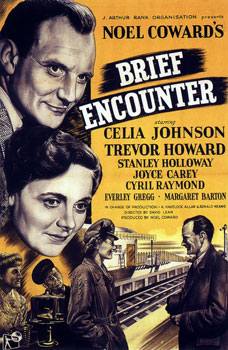
Behind the film
- Year
- 1945
- Director
- David Lean
- Writers
- Noël Coward, David Lean, Anthony Havelock-Allan, Ronald Neame
- Genres
- Romance, Drama, Flashback
- Country
- United Kingdom
- Cast
- Celia Johnson, Trevor Howard, Cyril Raymond, Stanley Holloway, Joyce Carey, Everley Gregg
About the film
Contains story spoilers, including the ending.
Brief Encounter follows Laura Jesson, a married woman whose regular outings become the setting for a relationship she cannot fit into her home life. Celia Johnson plays Laura, while Trevor Howard plays Alec Harvey, the doctor who removes a piece of grit from her eye at a railway station. The small act of care leads to further meetings and an attraction neither has planned. Both have families, and the pleasure of their afternoons together depends on returning to those families afterwards. Laura remembers the romance while sitting at home with her husband Fred, played by Cyril Raymond. Her account is an inward confession: she can describe her feelings to us while Fred remains outside that conversation, occupied with his crossword. Their separate lives are waiting at the other end of the railway line.
An attempted private meeting at a borrowed flat leaves Laura ashamed when Alec's friend returns unexpectedly. She runs away and wanders through town before Alec finds her at the station. They recognise that their love cannot remove the guilt or the obligations to their families. Alec decides to take a medical job in Johannesburg and bring his wife and children with him. On their last day together, they return to the station refreshment room, where Laura's acquaintance Dolly Messiter interrupts the farewell. Alec leaves with a brief touch on Laura's shoulder while Dolly continues talking. Laura rushes onto the platform as an express approaches, intending to throw herself in front of it, but cannot do so. She returns to the refreshment room and eventually goes home. The film closes with Fred recognising her unhappiness and thanking her for coming back. She cries in his arms. His tenderness gives her somewhere to turn, although the scene does not establish how much he knows about Alec.
The railway setting was assembled through location work and studio construction. Shooting at Carnforth usually ran from half past ten at night until six in the morning, before commuters arrived. Lean had an alternative refreshment-room exterior built at the station, while the interior was filmed at Denham on a set modelled on the actual room. He also made use of the station clock, arranging a dummy face so its time could suit the scene and remain legible in longer shots. Express trains posed a different problem: drivers slowed down when they saw the production's lights, suspecting something was wrong. A railway traffic officer had to arrange reassurance that they could maintain speed. Those practical details mattered in a story where a train's arrival ends a conversation and a clock can measure the few minutes two people have left together.
Although released in 1945, the story belongs to the late thirties. Its lit stations and everyday purchases belong to that earlier world, while the people making it worked during the war. The company moved from a planned London station to the safer northern location of Carnforth because of the threat of German attacks. Robert Krasker's black-and-white photography makes the station's smoke and night lighting part of Laura's experience. In moments of distress, the camera moves towards Johnson as her surroundings fade into darkness. During the express-train sequence, it also tilts, upsetting the level view of the platform. Johnson wrote to her husband about the difficulty of playing passages covered by commentary: her face had to carry feelings that her spoken conversation could conceal. The voice and the visible performance give different access to Laura's thoughts.
The film grew from Noël Coward's one-act play Still Life, but its screenplay developed through collaboration. Ronald Neame recalled returning from America to work with Lean on a second draft. They wrote during the day, then read their work to Anthony Havelock-Allan in the evening and heard his suggestions. If two of the three agreed about a change, the third would concede. Neame credited Lean especially with the screenplay's construction and its flashback frame. He also remembered taking new scenes to Coward, sometimes asking him for dialogue and sometimes supplying dialogue themselves. In Neame's account, Coward could dictate a needed scene while walking about the room. That recollection describes an exchange between the playwright and the filmmakers as they expanded the station-bound play into Laura's remembered days away from home.
Dolly's interruption depended on casting someone whose curiosity could make the lovers feel exposed. Havelock-Allan later told film historian Charles Drazin that Joyce Barbour, originally chosen for the role, seemed too kind: he believed she would keep a suspected affair to herself. Everley Gregg replaced her, bringing the possibility of gossip into the room. Havelock-Allan also remembered Johnson's ability to follow Lean's precise directions without losing feeling. She could finish an emotional scene and return to her crossword between takes. His account of the borrowed-flat sequence describes another practical decision behind the couple's unease. Lean wanted the apartment on the fourth floor, but Havelock-Allan argued that a staircase reaching the second floor would provide the necessary tension at less expense. Laura's climb could still convey the furtiveness of the visit. These recollections put performance, casting and the physical set around the same problem: two people trying to keep an intimate relationship from becoming public knowledge.