
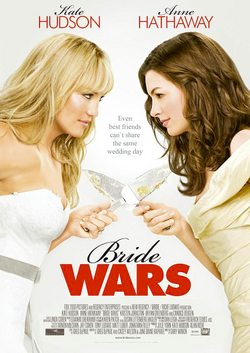
Behind the film
- Year
- 2009
- Director
- Gary Winick
- Writers
- Greg DePaul, Casey Wilson, June Diane Raphael
- Genres
- Romantic comedy, Female buddy
- Production
- 20th Century Studios, Regency Enterprises
- Country
- United States
- Cast
- Kate Hudson, Anne Hathaway, Candice Bergen, Chris Pratt, Bryan Greenberg, Steve Howey, Kristen Johnston, Hettienne Park
About the film
Contains story spoilers, including the ending.
Bride Wars turns a shared childhood dream into a fight over who gets to keep it. Kate Hudson plays Liv and Anne Hathaway plays Emma, best friends who have spent years imagining their weddings at New York's Plaza Hotel. They have planned the celebrations in detail long before either ceremony can happen. When a clerical error leaves them with clashing dates, their attachment to that picture of the future becomes a problem for the relationship they already have. Giving up a booking means surrendering something each woman has expected to be hers. Keeping it means competing with the person who was supposed to be beside her. Gary Winick's 2009 comedy builds its conflict around that collision between an ideal wedding and a lifelong friendship.
Liv is a corporate litigator who expects to take charge, while Emma is a schoolteacher more comfortable making room for other people. Hudson and Hathaway play friends whose habits have allowed those differences to coexist: one pushes forward, the other gives way. The wedding dispute makes that arrangement harder to sustain. Emma wants the same chance to have her own day, and Liv can no longer assume that her friend will accommodate her. Hathaway described Emma's change as learning to take control of her life and set boundaries. That gives the feud a consequence beyond the booking itself. An argument over a ceremony becomes an opportunity for a woman accustomed to surrendering the spotlight to decide when she should hold on to it.
The practical arrangements offer both women plenty of ways to interfere. Liv changes Emma's dance instructor and turns her spray tan bright orange; Emma sends Liv sweets to threaten the fit of her dress and tampers with her hair dye, leaving it blue. Emma also crashes Liv's bachelorette party and outdances her. These attacks work because the friends know what matters to each other. The preparations meant to make them feel beautiful and confident become chances to make the other woman uncomfortable. The rivalry reaches beyond appointments and parties into their relationships with their fiancés. Fletcher resists Emma's new outspokenness, while Liv grows closer to Daniel as she becomes more willing to show her feelings. Liv's wedding stress also disrupts her work. The woman used to being in control finds that the competition is making her life less manageable.
On the wedding day, Liv tries to stop her worst prank: replacing Emma's sentimental video with footage from a wild spring break. Her attempt fails, and the video plays as Emma walks down the aisle. Emma rushes into Liv's ceremony and tackles her. Their fight finally gives way to exhaustion and an admission that neither wants to continue. When Fletcher condemns Liv's influence, Emma tells him that the girl he fell in love with ten years earlier has changed. They want different things, and the wedding is called off. Liv and Emma apologise to each other, and Emma stands beside Liv for the ceremony that goes ahead. A year later, Emma has married Liv's brother Nate. Both friends reveal that they are pregnant, with the same due date. Another shared date ends in delight rather than a dispute. Their lives can coincide without requiring one of them to lose.
The wedding clothes make the difference between the two brides visible. Costume designer Karen Patch worked with Vera Wang on the gowns: Emma wears her mother's dress, an off-the-shoulder, layered taffeta design with the feel of an earlier period, while Liv has a lace bodice, a full tulle skirt and a long train. Patch described Liv's look through the image of the bride on top of a wedding cake. The clothes reflect their circumstances as well as their tastes, with Emma's teaching income set against Liv's successful legal career. Production designer Dan Leigh gave the childhood wedding that inspires them a white, silver and crystal setting. That early picture of luxury establishes what the women are chasing as adults. Boston's Fairmont Copley Plaza also stood in for its Manhattan counterpart. The story's coveted destination was built on screen through location choices, wedding design and two carefully differentiated bridal looks.
The screenplay's development involved a different partnership between women. June Diane Raphael recalled that New Regency asked her and Casey Wilson to pitch a new approach to an existing script called Bride Wars after their sketch-comedy work brought them to an executive's attention. To introduce their pitch, they wrote a mock trailer and had a voice artist record it. Raphael said they learned feature writing while doing the job. An executive's request for more set pieces initially confused them; they later understood it as a call for larger physical comedy that could supply trailer moments. That account describes the scale of the studio comedy they were learning to write. The film's attacks on hair, tanning and wedding-day dignity turn a private falling-out into incidents that can be understood immediately through the brides' appearance and behaviour.
Raphael described the original attraction as a romantic comedy centred on two women's friendship, with wedding planning putting a bond that might last a lifetime at risk. She also said the finished studio film differed considerably from their initial script after input from many people. Her description gives a useful context for the unusual romantic arrangement: Liv and Emma are not fighting for the same man. Each has a fiancé, but the rupture between the friends drives the action. Their eventual apologies restore the relationship that the wedding competition has nearly destroyed.