
Behind the film
- Year
- 1999
- Director
- Kimberly Peirce
- Writers
- Kimberly Peirce, Andy Bienen
- Runtime
- 1h 58m
- Genres
- Romance, Docudrama, Drama, Transgender
- Production
- Searchlight Pictures, Killer Films
- Country
- United States
- Cast
- Hilary Swank, Chloë Sevigny, Peter Sarsgaard, Brendan Sexton III, Lecy Goranson, Jeannetta Arnette, Matt McGrath, Alison Folland
About the film
Contains story spoilers.
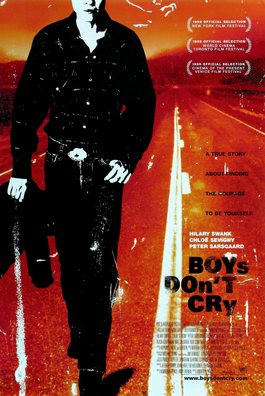
Brandon Teena is a young trans man trying to build a life in Nebraska in 1993. Threats and trouble in Lincoln push him toward Falls City, where a new circle of friends offers the prospect of a fresh start. The town’s social life is narrow and repetitive: people gather at bars and trailers, work long shifts, drink or get high, and make their own entertainment on the road. Brandon’s ease with the local men helps him fit in quickly. A barroom fight and a night of reckless driving give him the sort of rough camaraderie he has been seeking, while the film lets that excitement carry a real sense of risk. The contrast is present in the way scenes move between a crowded group and a sudden openness outside town. A fight or car ride gives Brandon room to join in without having to explain himself, while a return to the trailer home brings back John’s unpredictable authority. The film’s rough, dusty locations keep escape visible as a direction but make it feel far away. Peirce uses close-ups and saturated colour to draw viewers into Brandon’s experience. The opening attention to his face and reflection establishes a person preparing to meet the world, before anyone else gets to define him.
Lana is drawn to Brandon even though her life is tied to the unstable circle around her mother, John and Tom. John is possessive and volatile; Tom follows his lead, and both men bring a threat into the home that can sit beside ordinary affection and joking. Lana and Brandon’s attraction develops through hesitant meetings, teasing and time spent away from the group. Brandon treats her tenderly and offers the possibility of leaving town together, while Lana’s hopes of singing professionally give their imagined future a specific destination: Memphis. The group’s rituals of masculinity are a source of both belonging and danger. Brandon joins the men’s games and jokes, but John’s status comes from control and aggression. The women around the house are left to manage those moods while working, drinking and trying to keep a household going. Lana’s interest in Brandon therefore grows inside a social world that offers her little privacy. Their time away from the others gives Lana room to respond to Brandon without John directing the encounter.
The relationship becomes more intimate, and Lana accepts Brandon as the person she knows. Their plans depend on keeping the truth of Brandon’s past from the people around them, especially John and Tom. The film’s small-town routines make that concealment difficult: people share houses, gossip travels quickly, and the same friends who make Brandon feel welcome also control much of his access to shelter and safety. The contrast between his confident public manner and the danger of being exposed grows sharper as the romance becomes more serious. Peirce has explained that the intimate scene was shaped around what Lana can accept without being forced to leave Brandon. That detail helps connect their physical closeness to the tension that follows: Brandon is not simply hiding a fact for a twist, but navigating what he can disclose and still preserve the relationship. The jail scene later makes the gap between private affection and public scrutiny impossible to avoid.
When authorities detain Brandon over earlier offenses, the jail places him in the women’s section. Lana comes to get him and asks what happened. Brandon tries to explain the placement through a story about being intersex and awaiting surgery; Lana stops the explanation and says that she loves him regardless. That moment does not remove the danger around them, but it shows that their bond is not built on a simple misunderstanding. Lana chooses the person she knows even as the outside world presses a different account of him upon her. Peirce and co-writer Andy Bienen worked from interviews and trial material, but the film simplifies parts of the case and changes some names and events. That makes it useful to distinguish the film’s story from a documentary account. Its jail sequence is especially important to the drama because the jail placement threatens the privacy Brandon has relied on. Lana’s loyalty comes into focus beside that official failure, and the two responses show why simply being discovered is not the same as being understood.
John and Tom eventually discover Brandon’s trans identity. They forcibly expose him, then drive him to an isolated place where they beat and rape him. Brandon escapes after they take him to Tom’s house, and Lana persuades him to report the attack despite their threats. Rather than receiving reliable protection, he faces suspicion and indifference from people who should help. John and Tom later find him at Candace’s house and murder both Brandon and Candace. Lana tries to stop them and is left beside Brandon’s body. Lana survives and leaves Falls City; the film closes with Brandon’s letter to her, preserving his words after the town’s violence has ended his plans. The film’s development began with Peirce’s research in the mid-1990s, including visits to Falls City, interviews with Lana Tisdel and her mother, and a short student film before the feature. She then worked with Bienen on the screenplay and filmed the feature in Texas, standing in for Nebraska. Those choices help explain the mix of intimate character scenes and a broad, empty landscape. The closing letter returns the story to Lana after the violence, giving Brandon the last voice in the film even though he cannot take part in the future they planned.