
Behind the film
- Year
- 1950
- Director
- George Cukor
- Writers
- Garson Kanin, Albert Mannheimer
- Runtime
- 1h 43m
- Genres
- Romantic comedy, Comedy drama
- Production
- Columbia Pictures
- Country
- United States
- Cast
- Judy Holliday, Broderick Crawford, William Holden, Grandon Rhodes, Claire Carleton
About the film
Contains story spoilers, including the ending.
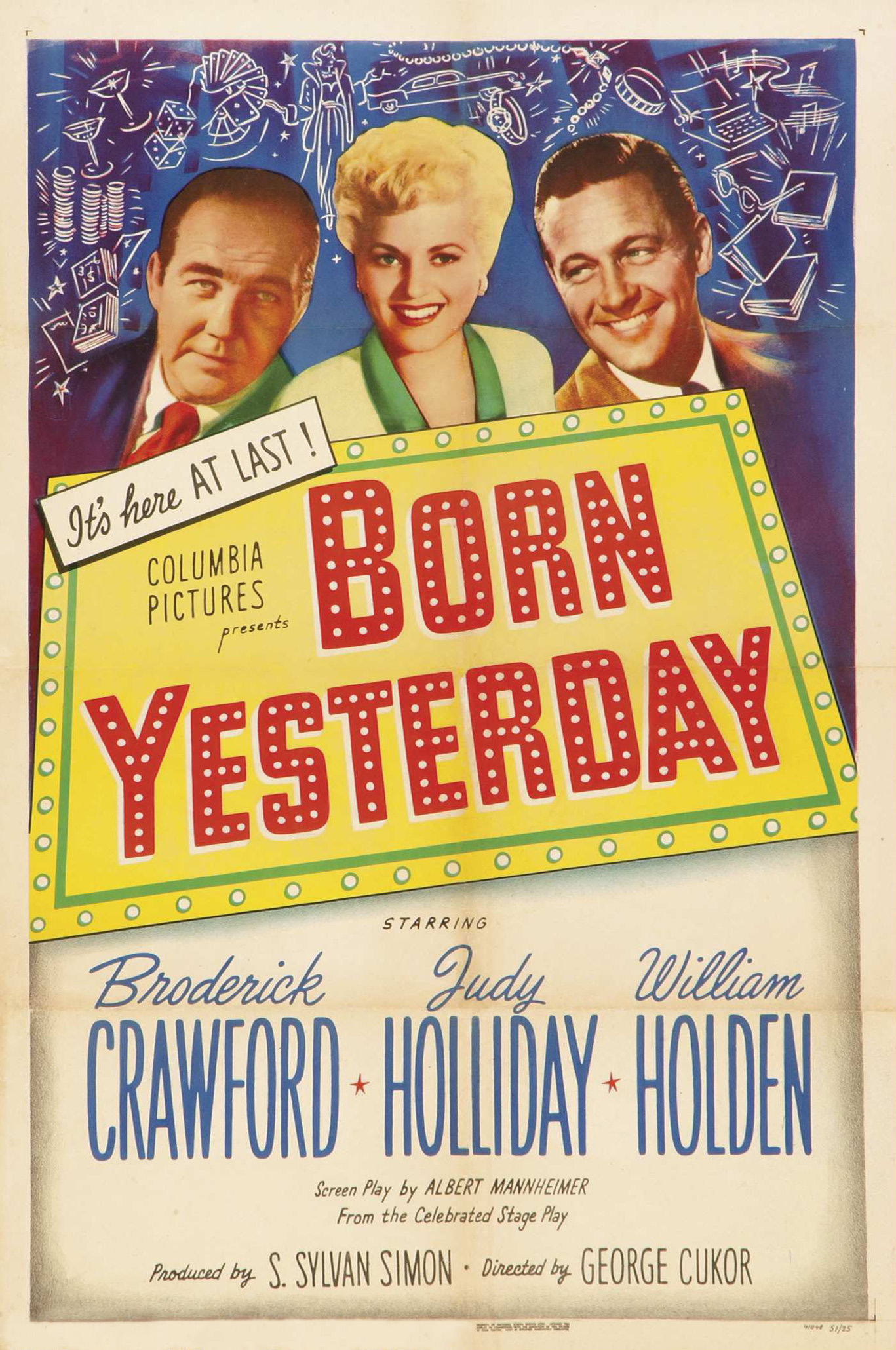
Born Yesterday puts Billie Dawn's education at the centre of a romance and a struggle for independence. George Cukor directs the 1950 Columbia film, with Judy Holliday as Billie, Broderick Crawford as junk dealer Harry Brock and William Holden as journalist Paul Verrall. Harry brings Billie to Washington, hoping to improve his standing while doing business in the capital. He sees her manners as an obstacle and pays Paul to tutor her. The arrangement assumes that Billie can acquire enough knowledge to satisfy Harry without questioning his conduct. Instead, she begins to see the relationship differently. Learning and falling in love happen together, but Billie's refusal to remain under Harry's control also draws on an honesty and strength that the men around her have underestimated.
Harry's lawyer Jim Devery has helped place business holdings in Billie's name. Her signature therefore matters to a man who otherwise treats her opinions as irrelevant. Paul gives her books, asks her to mark unfamiliar words and takes her around Washington. She soon applies the lessons to the people in Harry's hotel suite, including Congressman Norval Hedges. When asked to sign papers, she insists on reading them first. Harry responds by hitting her, and Billie leaves. She later helps Paul take the documents that could expose Harry's dealings. Harry's offer of marriage fails, as does his attempt to buy Paul off. Billie proposes returning one company a year if Harry behaves, and she marries Paul. The film's comic encounters were carefully prepared: the cast performed for audiences of studio employees before filming. A gin-rummy game lets Billie repeatedly beat Harry while humming and rearranging her cards. He may think of her as foolish, but the game gives her a field in which his confidence and bluster cannot secure a win.
Cukor and Garson Kanin had to negotiate the Production Code's restrictions on language and sexual implication. Cukor later recalled the difficulty of suggesting that Billie and Harry lived together, even when that arrangement was central to the story. Kanin devised business such as Billie entering the apartment by a back route. The objections reached individual words and the way Holliday's dresses would be photographed. A line in which Billie asks whether Paul is interested in action also drew an objection, but Cukor kept it. These negotiations affected how directly the characters could express themselves without removing the adult relationship underneath the comedy. Albert Mannheimer receives the screenwriting credit. The production also brought together cinematographer Joseph Walker, editor Charles Nelson, production designer Harry Horner and costume designer Jean Louis. Their work gives a hotel-suite argument and an education around the capital the same black-and-white screen world.
Holliday had already played Billie on Broadway, but that success did not settle her film casting. Columbia head Harry Cohn considered other stars before her appearance in Adam's Rib helped persuade him. Film scholar Yola Le Caïnec connects Cukor's support for Holliday with his interest in performers who resisted conventional expectations of women. Her account also draws attention to Billie's voice. Cukor opposed reducing its high register through studio sound work because he associated changes in pitch with particular comic and emotional effects. The sound of the performance was therefore part of its meaning, rather than a rough edge to remove. Holliday's Billie speaks outwardly and forcefully, making her reactions difficult for Harry to overlook even before she has the vocabulary to challenge him. The role won Holliday the Academy Award for Best Actress. Le Caïnec contrasts that performance with Melanie Griffith's more inward approach in the later remake, which approached the same character through a different actor's voice and temperament.
The screenplay's development complicates its single writing credit. Kanin's stage play opened on Broadway in 1946, and, according to Kanin's account, Cukor asked him to rewrite the film script when Mannheimer's version failed to capture the play. Kanin described the original work as an attack on the deals between businessmen and politicians that he disliked in Washington. Harry's effort to shape policy for private profit gives the teaching plot a public consequence. Billie's lessons cover law, politics and history as well as social manners; she learns to recognise a crook rather than merely avoid embarrassing him. Harry had used her name to conceal his holdings, and her ability to understand that arrangement gives her leverage over the person who controls her money. The learning changes the practical balance between them. The film's political content also provoked attacks in the anti-communist climate of its release, alongside its commercial success and Holliday's acting awards.
Billie and Paul's visits to public buildings take their relationship outside Harry's private rooms. The Library of Congress, National Gallery and Jefferson Memorial become places to look, ask questions and spend time together. Ariel Schudson reads those excursions as both romantic encounters and an invitation to public knowledge. Washington contains more than the people Harry hopes to purchase. Its books, art and monuments offer Billie another understanding of who can take part in the country's life. Her growing interest in them accompanies a decision that she can make choices without Harry's financial or emotional permission.
The story's optimism has also been contested. Reviewing a stage revival decades later, Mimi Kramer described Kanin's work as a postwar political fable in which a racketeer's plan to educate his mistress creates a responsible voter. She discussed the objection that its democratic victory still depends on taking Harry's papers and property. That debate belongs to the play's critical history, alongside the film version's influence on how Billie is remembered. Holliday's performance made a particular voice, card-playing manner and outspoken heroine inseparable from later encounters with the role.