
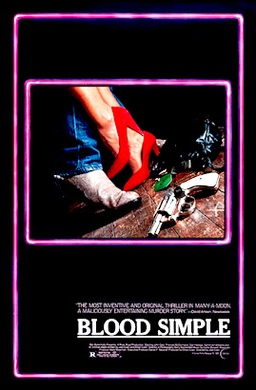
Behind the film
- Year
- 1984
- Director
- Joel Coen, Ethan Coen
- Writers
- Joel Coen, Ethan Coen
- Genres
- Crime, Neo-noir, Film noir, Drama
- Country
- United States
- Cast
- John Getz, Frances McDormand, Dan Hedaya, Samm-Art Williams, M. Emmet Walsh, Holly Hunter, Barry Sonnenfeld
About the film
Contains story spoilers, including the ending.
Blood Simple places four people inside a crime that none of them fully understands. Julian Marty owns a Texas bar; his wife Abby has begun a relationship with Ray, one of his bartenders. Loren Visser, the detective Marty employs, sees a chance to turn the husband's jealousy into a safer profit for himself. The Coens began with a central double-cross and developed ways for the surviving characters' positions to become progressively worse. They wanted the audience to understand what was happening while the people involved remained confused, so the suspense depends on the gap between knowledge and action. Joel Coen described Texas as a deliberately heightened setting with both practical and aesthetic attractions. Its bars, roads and isolated spaces belong to a recognizable crime world. The title comes from Dashiell Hammett's Red Harvest and refers to the mental confusion that follows involvement in murder.
Visser produces doctored photographs suggesting that Abby and Ray are dead, collects Marty's payment and shoots him with Abby's stolen gun. Ray discovers the wounded husband and assumes Abby has done it. He cleans the office and takes Marty away to bury him, then finds that the man is still alive. Ray completes the burial anyway. His effort to protect Abby therefore makes him responsible for a death she did not arrange. When he tells her he has handled the situation, she cannot understand what he means. Their conversation rests on a secret that only Ray believes they share, deepening mutual suspicion.
Visser subsequently shoots Ray from outside Abby's apartment. Abby believes Marty is pursuing her and hides from an attacker she cannot correctly identify. During the pursuit she traps Visser's hand at a window and drives a knife through it. He fires through the adjoining wall, cutting the darkness with shafts of light. Abby finds her gun and shoots him through the bathroom door. She addresses him as Marty, still unaware of who has attacked her or why. The dying detective laughs at the mistake. His final response leaves her misunderstanding intact even after she has survived his assault.
Barry Sonnenfeld's photography was planned around a low budget and a tightly organized chain of visual information. Every scene was storyboarded, allowing repeated images, match cuts and sound overlaps to be arranged before the crew reached the set. Sonnenfeld recalled that preplanning was both an economic necessity and a response to the plot's complexity. Camera movement could be made with inexpensive physical devices: grips dragged him on a sound blanket, while a long plank carrying a camera provided a fast approach toward the actors. Another rig locked McDormand and the camera together for a transition in which Abby appears to fall from one location into her bed. The darkness was equally deliberate. Sonnenfeld chose strong contrast and direct lights, treating illumination as a psychological device rather than requiring every beam to have an ordinary visible source. The final bullet holes turn that approach into part of the physical threat, splitting Abby's hiding place into bright, unnatural streaks.
Frances McDormand came to Abby through an audition process that had first involved Holly Hunter. Hunter was committed to a stage job and could not take the part on the production's timetable. McDormand remembered struggling with a screenplay that described camera movements and repeatedly used POV directions; as a theater actor, she had not yet learned how to read that kind of information. The film gave Abby relatively little dialogue to explain herself, making the immediate situation and her reactions especially important. McDormand later described the difficulty of maintaining fear across the different angles of the final pursuit. She could not rely on the month of rehearsal that theater might provide to build a complete emotional route through the scene. Instead, she had to work from the moment, the other people present and the practical demands of filming. She also recalled lasting relationships forming among the crew, who were drawn together by the screenplay and the brothers' confidence in their plans.
The film's color is less uniform than the restrained palettes the Coens would develop with designers on later projects. Revisiting Blood Simple with Sonnenfeld, Joel recalled that a large part of the production-design budget went into neon. Sonnenfeld remembered the bar's colors initially looking excessive until he printed the footage darker. Those saturated areas coexist with deep shadow, so familiar commercial lighting becomes part of a hostile environment. The filmmakers' later discussion also stressed how intentionally they had arranged camera moves and lighting, despite their inexperience in these jobs. The hard-boiled story emerged from a project first presented to investors with stronger horror and exploitation associations. That early background remains visible in the last confrontation's bodily danger and abrupt shocks. At the same time, the underlying structure keeps returning to mistaken assumptions: an image can look conclusive, a body can look dead, and a reassuring sentence can carry an entirely different meaning for the person who hears it.