
Behind the film
- Year
- 1959
- Director
- Marcel Camus
- Writers
- Vinícius de Moraes, Jacques Viot, Marcel Camus
- Runtime
- 1h 47m
- Genres
- Fantasy, Musical, Romance, Drama
- Production
- Warner Bros. Entertainment, Warner Bros. Pictures
- Country
- France, Brazil, Italy
- Cast
- Breno Mello, Marpessa Dawn, Léa Garcia, Adhemar da Silva, Cartola, Marcel Camus
About the film
Contains story spoilers.
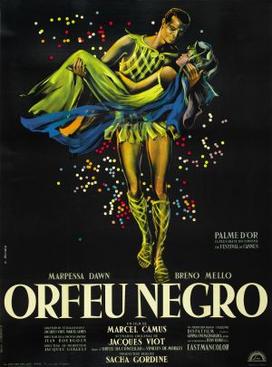
Black Orpheus places an ancient love story in the hills and streets of Rio de Janeiro during Carnival. Orfeu is a streetcar conductor whose singing makes him popular in his neighbourhood and whose guitar can, in the film’s playful telling, bring the sun up in the morning. Eurydice arrives from the countryside, anxious and alone, with a man dressed as Death following her. The film introduces them against a rush of preparations: costumes, dancing, music and the movement of people through the city. Their names point toward the Greek story, but they live ordinary lives in a place where the yearly festival lets everyday identity give way to masks and performance.
Orfeu is already engaged to Mira, though he is not eager to marry. They go to the courthouse for a marriage licence, where a clerk jokes about whether Mira is Eurydice; afterward, Mira asks for an engagement ring. Orfeu has just been paid, but he would rather use the money to retrieve his guitar from a pawnshop before Carnival. Mira offers to lend him money for the ring, and the scene establishes how differently they approach the future: she wants a public promise, while his attention returns to music and the festival. When he reaches home, he discovers that Eurydice is staying next door with her cousin Serafina. She has fled the countryside because a strange man in a Death costume is pursuing her.
The danger follows Eurydice into the neighbourhood, but Orfeu chases Death away and the two become lovers. Serafina’s sailor boyfriend Chico arrives, so Orfeu offers Eurydice his home and sleeps outside in a hammock. As Carnival approaches, the characters’ practical ties run alongside the myth: Orfeu, Mira and Serafina belong to the same samba school, and Serafina wants time with Chico during the parade. She puts Eurydice in her Queen of the Night costume and covers her face with a veil. Orfeu knows the substitution; Mira does not. In the procession he dances with Eurydice rather than his fiancée, until Mira recognizes Serafina in the crowd and tears away the veil. Eurydice runs, first from Mira and then from Death.
Eurydice reaches Orfeu’s own trolley station and climbs onto a power line to escape Death. Orfeu turns on the electricity, accidentally electrocuting her; Death knocks him unconscious and claims her body. The mistake changes his attempt to recover her from a rescue into mourning. Although station guard Hermes has told him she is dead, Orfeu searches at the Office of Missing Persons. At night the office contains only papers and a janitor, who takes pity on him and leads him down a dark spiral stairway toward a Macumba ritual. The descent makes a city building serve the underworld journey: a guard dog named Cerberus stands at the gate, and Orfeu must enter a gathering whose music and spiritual practice continue independently of his grief.
During the ritual, the janitor tells Orfeu to call Eurydice by singing. Her spirit speaks through the body of an old woman and begs him not to look at her, warning that he will lose her forever if he turns. He cannot resist seeing the person before him; the spirit departs. Orfeu wanders in mourning, retrieves Eurydice’s body from the morgue and carries her across town and uphill to his home, which is burning. Mira throws a stone at him, striking his head and sending him over a cliff with Eurydice still in his arms. The ending completes the tragedy without granting the lovers a second reunion: Orfeu’s devotion carries him through the city, but it cannot restore her or protect him from Mira’s anger.
The final scene gives the guitar to Benedito and Zeca, two boys who have followed Orfeu and believed his claim that his playing brings up the sun. After his death, Benedito insists that Zeca play; dawn comes, a little girl gives Zeca a flower, and the children dance. The sequence lets music survive the singer without suggesting that the violence has been undone. It also returns the film to the children’s point of view, where a playful promise can still organize how the world is understood. Orfeu’s legend ends in loss, while the instrument and its story pass to another generation.
The film’s form binds that tragedy to its sensory world. Composer Antônio Carlos Jobim and guitarist Luiz Bonfá’s bossa nova themes sit alongside samba and the sounds of the Carnival crowds, while Jean Bourgoin’s vivid colour photography turns the city into a shifting field of costumes, hills, wires and street movement. Director Marcel Camus adapts Vinicius de Moraes’s play Orfeu da Conceição and the Greek myth with a cast led by soccer player Breno Mello as Orfeu and Pittsburgh-born dancer Marpessa Dawn as Eurydice. That beauty is part of the film’s appeal, but it also shapes the debate around it: Brazilian critics have objected that Camus’s outsider view presents the favela as an exotic, joyful spectacle and softens the realities of poverty. The music, myth and imagery are inseparable from both the film’s emotional force and the questions its portrait of Rio leaves open.