
Behind the film
- Year
- 2018
- Director
- Susanne Bier
- Writers
- Eric Heisserer
- Genres
- Drama, Horror, Science fiction, Thriller
- Production
- Netflix
- Country
- United States
- Cast
- Sandra Bullock, Trevante Rhodes, John Malkovich, Sarah Paulson, Jacki Weaver, Rosa Salazar, Danielle Macdonald, Lil Rel Howery
About the film
Contains story spoilers, including the ending.
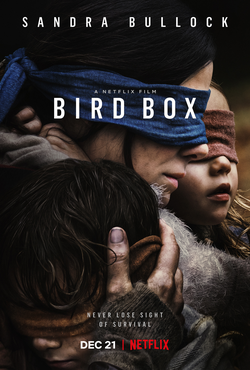
Bird Box follows a woman raising children in a world where looking outside can kill. Sandra Bullock plays Malorie in Susanne Bier's 2018 adaptation of Josh Malerman's novel, written for the screen by Eric Heisserer. The film alternates between the outbreak and a river journey five years later. In the later timeline, Malorie calls the children Boy and Girl, keeps their eyes covered and gives them instructions whose severity comes from knowing what a moment of disobedience could cost.
The earlier story begins while Malorie is pregnant and still able to leave home without a blindfold. A hospital visit with her sister Jessica becomes an escape through streets overtaken by panic. Jessica sees something that changes her behaviour, crashes their car and dies. Malorie reaches a house where strangers have gathered, bringing different temperaments into an improvised shelter. Tom becomes an ally, while Douglas is suspicious of newcomers. Covering the windows protects them from the immediate danger but leaves them dependent on one another for food, information and decisions. Another pregnant woman, Olympia, joins the group. Pregnancy now means planning for a future that none of them can picture, inside a house whose safety depends on controlling what enters it. The people beyond its walls cannot all be approached as fellow survivors.
A supply trip uses a car with covered windows and GPS directions; birds warn the group when the entities approach. Olympia later admits Gary, whose arrival proves disastrous. While she and Malorie give birth, he exposes the household to the creatures. Tom kills Gary, but most of the shelter's occupants are lost. Five years later, Tom and Malorie have made a family with both children. A radio message promises refuge downriver. Before they can reach it, people able to look at the entities attack. Tom removes his blindfold to fight them, then kills himself, leaving Malorie to take the children onwards alone.
The river journey tests the rules that kept this family alive on land. Malorie has to guide a boat without being able to inspect the water ahead, then protect the children when the journey carries them into the forest. After they become separated, voices imitate people they know and try to lure them into removing their blindfolds. Finding one another requires trust in a situation where even a familiar voice can be dangerous. The destination finally offers a community at a school for blind people, with birds providing warning of an approaching threat. Safety does not depend on curing the world or revealing what the creatures are. It comes from finding people who have made a place to live within its changed conditions. Malorie gives the children the names Tom and Olympia, connecting their future to the people who helped make it possible.
Heisserer built the danger around the impulse to seek an explanation. In an interview, he described the human need to know as part of what makes the premise frightening: looking for information can become the act that destroys you. The covered car turns that idea into a practical sequence. He extended the protection to the rear-view camera and treated GPS as the occupants' means of navigating, drawing inspiration from the way a submarine crew depends on instruments in The Hunt for Red October. A proposed glimpse of a creature in a nightmare was eventually dropped. Keeping its appearance unavailable preserves the difference between the characters' theories and anything the audience can confirm. The script gives people competing explanations while limiting what can be established from their position inside the emergency.
The two timelines also had different shapes on the page. Heisserer described river passages containing roughly a hundred words per page, leaving room for actions, sensations and the time needed to experience them. Scenes inside the crowded house were denser, with voices overlapping as the occupants tried to make sense of events. That contrast helps explain how the same story can move between an argument among strangers and a mother listening for danger on the water. The writing changed with Bullock's involvement, too. Her perspective on motherhood helped reshape Malorie rather than simply supplying a performer for a finished part. Heisserer had also drawn on his wife's experience of becoming a mother. Malorie's stern instructions and emotional distance consequently belong to a character being worked out through parental fears as well as the requirements of a survival thriller.
Making the river convincing required a mixture of location photography, controlled filming and digital water. Visual-effects supervisor Marcus Taormina described water levels falling between the location scout and the shoot, changing the rapids available to photograph. The team combined practical material with simulated water and background work, using still-image surveys and scans to reconstruct parts of the environment. The forest needed another solution. Pulling real trees with wires did not produce the intended response to an unseen presence, so digital foliage and debris supplied much of that disturbance. The birds were similarly a mixture: real animals could provide quieter moments, while computer-created birds allowed precisely timed agitation. In one drinking sequence, a digital bird connects with a photographed bird inside the box. These small transitions support a story in which a movement of leaves or a sudden flutter matters because the people carrying the box cannot safely look for the cause.