
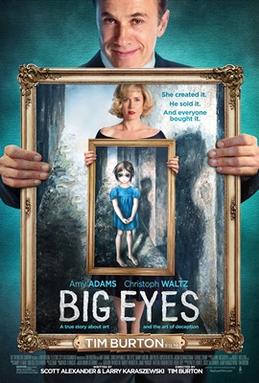
Behind the film
- Year
- 2014
- Director
- Tim Burton
- Writers
- Scott Alexander, Larry Karaszewski
- Runtime
- 1h 46m
- Genres
- Biographical, Drama, Romance, Trial
- Production
- The Weinstein Company
- Country
- United States
- Cast
- Amy Adams, Christoph Waltz, Krysten Ritter, Danny Huston, Jason Schwartzman, Terence Stamp, Jon Polito, Leela Savasta
About the film
Contains story spoilers.
Big Eyes follows Margaret Ulbrich, a mother who leaves her husband and takes her young daughter Jane to San Francisco. She finds commercial work painting decorations on children’s furniture, then spends weekends making portraits for outdoor art shows. She has not yet finalized her divorce when the film begins. Her subjects are children with unusually large, watchful eyes. At first she charges little and struggles to sell them. At one of these shows she meets Walter Keane, a sociable salesman who has his own Paris street scenes on display. He seems to understand the crowd and Margaret’s uncertainty, and soon the two marry.
Walter secures a place for their paintings at the hungry i nightclub, where they hang in a hallway near the restrooms. The portraits of children attract more attention than his city scenes. When Walter is asked about the big-eyed pictures, he accepts the credit rather than correcting the mistake. The paintings are all signed Keane, and he tells Margaret that people are more likely to buy art if they think a man made it. He handles the sales and publicity while she paints at home, a division that makes the business successful and gives Walter a public identity as the artist.
The arrangement grows into a market. Walter’s charm brings collectors, celebrities and reproductions, while Margaret keeps producing new faces in a studio that becomes increasingly cut off from ordinary life. Margaret even keeps the arrangement from Jane for a time, so the deception follows her into family life as well as the art world. Outside the house, she watches the world praise Walter. Her friend DeeAnn sees how little space Margaret has to herself and urges her to question the bargain. Walter’s control is wrapped in compliments and promises: he says he is protecting their family and that the lie has become too large to undo. Each new sale makes speaking up feel riskier, since it could cost Margaret her work, home and marriage.
That strain comes into view around Tomorrow Forever, a large painting Walter wants shown at the 1964 New York World’s Fair. Art critic John Canaday attacks it in print, and the fair removes the work. Walter takes the criticism personally and turns his anger on Margaret. At home he drinks, blames her for the setback and becomes frighteningly violent, even throwing lit matches into the locked studio where she and Jane have hidden. They escape and drive away. The rupture is more than a fight over taste: Walter’s public role depends on Margaret staying silent, and the failure of the painting gives him a new excuse to punish her.
The film moves to Hawaii, where Margaret and Jane try to build a life apart from him. Walter offers a divorce only if Margaret signs over the rights to the paintings and agrees to make more. She initially accepts because she wants the conflict to stop. Her growing involvement with Jehovah’s Witnesses makes the secrecy harder to live with, and she begins signing her own name to the pictures. On a radio program she tells listeners that she painted the famous children. The announcement spreads, while Walter answers through a gossip columnist, insisting that Margaret is unstable and that he remains the artist.
Margaret takes the dispute to court, suing Walter and the newspaper over his public claims. The newspaper case is dismissed, leaving Walter to answer the accusation of slander. He tries to represent himself, draws out the testimony and eventually cross-examines himself. The judge cuts through the performance by ordering both sides to paint a big-eyed child in the courtroom. Margaret sets to work; Walter stalls and says his arm hurts too much to hold the brush. The simple demonstration carries the weight of the whole story because the paintings themselves are the proof. Margaret wins, and a woman in the crowd asks her to sign one of Walter’s books.
Tim Burton keeps the visual design close to the paintings and the late-1950s and 1960s settings, holding back his more familiar effects because, as he told Slant, the story itself already felt outlandish. Burton had initially joined as a producer, with screenwriters Scott Alexander and Larry Karaszewski intending to direct. After the project stalled and he had made several large productions, he took the smaller film on himself. He also says the courtroom behaviour was toned down from the real events rather than exaggerated for the screen. Production designer Rick Heinrichs describes a careful effort to rebuild Margaret’s world: the crew used family photographs to place specific paintings and furniture in the right homes and stages of her life. They also recreated nearly two hundred portraits, printing them on canvas and adding oils and gesso where close shots needed to show brushwork. Those details make the paintings feel like objects Margaret has physically made, while the camera follows the people and rooms that turn her work into a public brand. The film compresses the real chronology, including when Margaret spoke publicly and when the court case happened, so its courtroom paint-off serves as a clear dramatic resolution rather than a complete record of the Keanes’ legal history.