
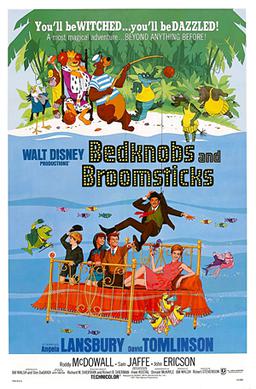
Behind the film
- Year
- 1971
- Director
- Robert Stevenson
- Writers
- Don DaGradi, Bill Walsh, Ted Berman, Ralph Wright
- Runtime
- 1h 59m
- Genres
- Fantasy, Musical, Adventure, Children's
- Production
- The Walt Disney Company
- Country
- United Kingdom, United States
- Cast
- Angela Lansbury, David Tomlinson, Cindy O'Callaghan, Roddy McDowall, Sam Jaffe, John Ericson, Reginald Owen, Tessie O'Shea
About the film
Contains story spoilers, including the ending.
During World War II, Charlie, Carrie and Paul move to a small village where Eglantine Price becomes their host. Their temporary guardian is an unlikely witch in training: she studies through a correspondence course and practices in secret. When the children discover her flying attempts, Price admits that she wants to use magic to help Britain in the war. Paul has found a brass bedknob, and Price enchants it so the bed can travel wherever he wishes. That small object turns a wartime placement into an adventure, but the children still have their own ideas about where they belong.
Price’s course closes before she can learn Substitutiary Locomotion, the spell she believes could help defend the country. She takes the children to London to find Professor Emelius Browne, the school’s supposed head. Browne is really a street magician, performing tricks from an old spellbook he bought on Portobello Road. Price quickly sees that the magic is real, even if Browne has treated it as a stage act. The book’s final pages are missing, and the group learns that the five words they need are engraved on a star-shaped medallion. A storybook Paul brought from Browne’s library points them toward the Lost Isle of Naboombu.
The enchanted bed carries the travellers to Naboombu, where they encounter talking animals and meet the lion king, who wears the medallion. Browne becomes the referee in the king’s football match, giving him a chance to take the star. The animated island sequence gives the film a sudden change of scale: London’s streets and Price’s cottage give way to a world with its own ruler, rules and underwater ballroom. The detour still serves the search for the spell. When they return to England, the medallion itself cannot cross between worlds, but Paul’s book preserves an illustration of its inscription. Price can now try the words she has been chasing.
The spell first brings clothes and shoes to life, with more enthusiasm than Price can control. Soon, though, the village faces a German invasion. Frightened by the idea of becoming a family with Price and the children, Browne heads to the railway station. There he discovers that the invasion is underway. He changes himself into a rabbit and slips into the museum to join Price and the children, who have been imprisoned there. Price animates the suits of armour and other displays, then leads the ghostly army from her broomstick. The invaders retreat; a bomb destroys her magical laboratory and ends the spell’s effect.
After the attack, Price gives up witchcraft, while Browne chooses to enlist and promises to return after the war. The children remain with Price, who has moved from looking after them as a temporary duty to wanting them as her family. That ending keeps the story’s two kinds of service together: Price’s magic has helped repel the invasion, and Browne’s next step is to join the real military effort. The Home Guard escorts him away believing they helped defeat the Germans. The film leaves the family with a separation, but also with Browne’s promise and the bedknob Paul still has.
The film draws on Mary Norton’s The Magic Bed-Knob and Bonfires and Broomsticks, but it reshapes their material around Price’s wish to help in wartime. Richard M. Sherman later described the central idea as an amateur witch wanting to do something useful with her magic. The filmmakers changed the old magician in Norton’s story into Browne, a London performer who sells tricks without knowing that the spells work. That choice gives Price a companion whose confidence and competence develop in a different direction from hers. Their partnership begins as a search for missing words and grows through the risks they share.
The song choices also reflect the film’s shared history with Mary Poppins. The Sherman Brothers wrote the songs, including “The Beautiful Briny,” which had first been written for Mary Poppins. Price and Browne sing it during the underwater ballroom sequence, linking a song associated with one Disney project to another story about British magic. The songs also give Price’s ambitions a voice: “Substitutiary Locomotion” turns the search for a spell into a memorable refrain, while “The Old Home Guard” returns at the story’s wartime close. The Portobello Road dance sequence was later cut down from ten minutes to four.
The animation on Naboombu and the live-action scenes use different visual worlds for different parts of the adventure. Ward Kimball directed the island’s animation, while the village, cottage and London street were built on Disney’s Burbank studio lot. Portobello Road received a large set filled with market stalls and period objects. The film’s release history also matters when comparing versions: the original release ran 117 minutes, while a 1979 reissue was shortened to 98 minutes, and later restorations returned some removed material. The musical sequences were among the material cut, so details can vary by edition.