
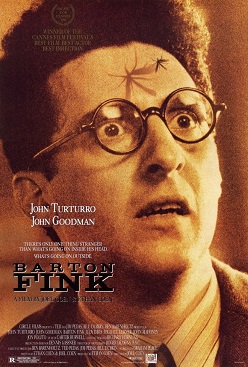
Behind the film
- Year
- 1991
- Director
- Joel Coen, Ethan Coen
- Writers
- Joel Coen, Ethan Coen
- Runtime
- 1h 56m
- Genres
- Neo-noir, Comedy drama, Black comedy, Drama
- Production
- Working Title Films
- Country
- United States, United Kingdom
- Cast
- John Turturro, John Goodman, Michael Lerner, Judy Davis, John Mahoney, Tony Shalhoub, Jon Polito, Steve Buscemi
About the film
Contains story spoilers.
In 1941, New York playwright Barton Fink has found success with a stage drama about ordinary people. Hollywood offers him a lucrative contract, and he moves to Los Angeles expecting to bring that interest in the common man to the screen. Capitol Pictures assigns him a wrestling picture for actor Wallace Beery. Studio chief Jack Lipnick talks up the project and says he wants a script with the distinctive Barton Fink touch, but Barton has little idea how to write a commercial wrestling story. He checks into the Hotel Earle, a mostly empty, run-down building whose heat makes the wallpaper peel. The only clear image in his room is a small picture of a woman sitting on a beach. Barton sits at his typewriter and cannot get beyond the opening lines.
The Hotel Earle seems to isolate Barton from the bright, busy world of the studio. He hears noises through the wall and calls the front desk to complain about his neighbor. Charlie Meadows, a large, friendly insurance salesman, comes over to apologize and invites Barton to talk. Barton tells him at length that his plays are meant to speak for working people, the “common man”; Charlie responds with stories from his own life, which Barton barely lets him finish. Their conversation establishes a mismatch between Barton’s idea of ordinary people and the person actually sitting beside him. The two men form a strange acquaintance, including an odd exchange of shoes, while Barton remains stuck at his desk.
Producer Ben Geisler tries to help by sending Barton to meet W. P. Mayhew, an established novelist who has also been hired to write for the studio. Barton admires Mayhew’s literary reputation, but finds him drunk, volatile and unable to offer useful advice. Mayhew’s secretary, Audrey Taylor, tells Barton that she has been writing some of Mayhew’s scripts for him. With his deadline near and still no usable pages, Barton phones Audrey for help. She comes to his hotel room, and they sleep together. The next morning he wakes beside her body and a bloodied mattress. He panics and calls Charlie, who removes the body and tells him not to contact the police. Barton tries to return to work, but the combination of an unexplained murder and his unchanged script leaves him with little control over what is happening around him.
Charlie later tells Barton that he will be away in New York for several days and asks him to watch a sealed package. Two detectives arrive at the Earle and reveal that Charlie is actually Karl “Madman” Mundt, a serial killer known for decapitating his victims. They connect him with the murders of Mayhew and Audrey, and Barton understands that the package may contain something terrible, but he does not open it. He leaves it on his desk. The news does not make the writing process clearer; instead, Barton suddenly writes with speed, completing the wrestling screenplay in a burst of concentration while the box remains beside him. He goes out dancing to celebrate, then returns to find the detectives waiting in his room. They accuse him of helping Mundt and handcuff him to the bed while they wait for Charlie to come back.
The hotel erupts into flames when Charlie returns in the elevator. He shoots the detectives and tells Barton that he has been ignoring the reality of the people he claims to understand. Charlie releases him from the bedframe and goes back into his own room as the fire spreads. Barton leaves carrying both his finished script and the unopened package. He tries to call his family in New York, but nobody answers. Later, Lipnick meets him in a military-style uniform and rejects the script as a melodramatic wrestling story. The studio wanted a basic picture with a few distinctive touches, not a personal drama. Lipnick nevertheless keeps Barton under contract in Hollywood, saying that none of his work will be produced until he grows up. The writer has finally completed a screenplay, only to discover that finishing it has not given him control of his career or a place to return to.
Barton walks onto a beach with the package still in his hands. A woman sits nearby, looking exactly like the figure in the hotel-room picture. She asks about the box, and he admits he does not know what it contains or who it belongs to. He asks whether she has ever been in pictures; she says she has not, then turns toward the water in the same pose as the image. The film leaves the package unopened and the relationship between the beach and the picture unresolved. Its final movement brings Barton into the image that has been his only view of the outside world, while the hotel, the murder case and his work for the studio remain behind him. The story moves from a confident speech about working people to a crisis that exposes how little he listens to them, and how thoroughly Hollywood can own the work he produces.