
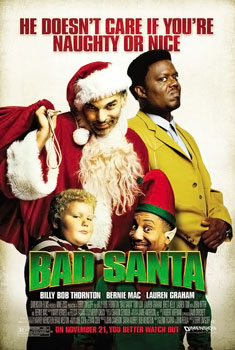
Behind the film
- Year
- 2003
- Director
- Terry Zwigoff
- Writers
- Glenn Ficarra, John Requa
- Genres
- Comedy, Christmas, Crime
- Production
- Dimension Films, Columbia Pictures
- Country
- United States
- Cast
- Billy Bob Thornton, Bernie Mac, Lauren Graham, Tony Cox, Brett Kelly, Lauren Tom, John Ritter, Octavia Spencer
About the film
Contains story spoilers.
Willie and Marcus rob malls while working as Santa and his elf; Marcus's wife Lois drives their getaway car. In Phoenix, Willie meets bartender Sue and befriends bullied Thurman, then exploits the boy's home as a hideout. Security chief Gin discovers the robbery plan and demands half the proceeds. Marcus and Lois kill him. Willie's confession letter, entrusted to Thurman during a suicidal crisis, alerts police to the Christmas Eve heist. Willie opens the safe and takes a pink elephant for Thurman. Marcus prepares to kill his increasingly unreliable partner, but police interrupt. Willie escapes to deliver the gift and is shot on Thurman's porch. He survives. In the theatrical epilogue, his hospital letter explains that police embarrassment has spared him prosecution and brought a counseling job. Sue becomes Thurman's guardian, Marcus and Lois are imprisoned, and Thurman finally fights back against his bully.
Director Terry Zwigoff's preferred version arrived on DVD in 2006, after the theatrical release and the expanded Badder Santa edition. The longer Badder Santa was a studio assembly of discarded material, not his director's cut. In his interview with Jeffrey M. Anderson, Zwigoff argued that the added footage disrupted comic timing. His own cut was shorter than the theatrical film, despite containing more than a thousand changes, many of them small adjustments to characterization. He wanted the characters' feelings to remain credible beneath the jokes; otherwise, he said, the result would amount to disconnected gags. The director's cut removes Willie's opening narration, the Advent-calendar sequence and the material about teaching Thurman to fight his bullies. It also replaces the theatrical epilogue with a briefer ending. Zwigoff explained that the narration had helped test audiences start laughing sooner because it signaled that laughter was allowed. He accepted that removing it might delay the first laughs, while believing the film would work better over its full length. For him, early audience response did not settle the editing decision.
In Bruce Pretts's oral history, John Requa and Glenn Ficarra recalled the Coen brothers proposing a bad Santa and directing them toward Bad News Bears. Requa said the instruction was to delay redemption until the end. The dialogue was written with James Gandolfini's rhythm in mind; when Billy Bob Thornton took the part, it remained unchanged, putting a Southern delivery against New York phrasing. Casting the supporting leads produced accounts that still disagree. Tony Cox recalled roughly nine auditions and Zwigoff promising to leave if he could not hire him. Zwigoff said the studio preferred a conventionally cute child to Brett Kelly, while Bob Weinstein disputed that account and blamed the Coens for wanting another boy. After a poor test-screening score, Weinstein brought Todd Phillips in to direct additional footage when Zwigoff declined. Requa described pressure to make Willie more redeemable. Weinstein believed the film needed more heart; Thornton understood the demand for broader comedy. Zwigoff wanted Thurman's effect on Willie to emerge later, without forcing the change ahead of the relationship.
Small pieces of business helped the actors play these uneasy encounters. Recalling the production at a later question-and-answer event, Zwigoff described Bernie Mac becoming nervous opposite John Ritter, whom he had admired growing up. Although Mac had rehearsed his lines successfully, his first attempt at their scene became mumbled and difficult for Ritter to follow. Zwigoff took him aside, and Ritter helped reassure him. The director then suggested that Mac peel an orange during the exchange to reduce his self-consciousness. When Mac ate it messily, Zwigoff encouraged him to exaggerate that behavior in front of Ritter's prudish manager. The orange gave Gin something to do while making his counterpart's discomfort more visible. Thurman's clothing came from another practical discovery. According to Zwigoff, Kelly arrived with his mother wearing the outfit that became the boy's costume; he told wardrobe to copy it or save the original for filming.
Thornton described a different problem in playing Willie: setting aside his own affection for children to play Willie's hostility. Speaking to IndieLondon, he said Kelly's expression could make maintaining a straight face difficult, as could acting opposite his close friend Ritter. The Santa costume brought physical discomfort as well. Shooting took place in the Los Angeles summer, making the suit hot, but Thornton found the scratchy beard worse. He argued that once Thurman pulled it down, a man as careless as Willie would simply leave it there. Children's reactions were also moved between scenes. Thornton recalled that his attack on a donkey prop surprised the young performers, and that reaction shots from that incident were used elsewhere. Their apparent responses therefore did not always correspond to the action filmed alongside them.
Music changed the treatment of Willie's loneliness and the mechanics of the robbery. Zwigoff told Julia Bozzone that The Anvil Chorus made the cross-cutting between Marcus chopping a mannequin and Willie hammering a safe work comically. He also described choosing melancholy Chopin for Willie sitting alone amid a festive bar crowd. The studio substituted the Chipmunks' Jingle Bell Rock to identify the film as comedy earlier. Zwigoff recalled fighting to restore his choices, with substantial success.