
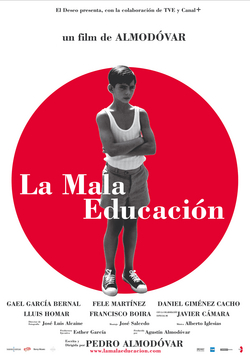
Behind the film
- Year
- 2004
- Director
- Pedro Almodóvar
- Writers
- Pedro Almodóvar
- Genres
- Neo-noir, Coming-of-age, Drama, Lgbtq-related
- Production
- El Deseo
- Country
- Spain
- Cast
- Gael García Bernal, Fele Martínez, Lluís Homar, Javier Cámara, Daniel Giménez Cacho, Paco Maestre, Francisco Boira, Leonor Watling
About the film
Contains story spoilers, including the ending.
Bad Education begins with a filmmaker being offered a story that seems to belong to him already. Enrique Goded is visited by an aspiring actor who says he is Ignacio, the boy Enrique knew at Catholic school. He brings a manuscript called The Visit, drawing on the childhood the two men shared and the abuse inflicted by Father Manolo. Enrique can turn it into a film, and the visitor wants a part in that film. Pedro Almodóvar's 2004 drama makes that transaction the doorway into several versions of the past. The adult meeting, the written story and its screen adaptation do not all tell the same truth. Gael García Bernal plays the visitor and the drag performer Zahara, a character inside The Visit, while Fele Martínez plays Enrique. Someone else's arrival gives Enrique material for his work, but it also brings back a relationship he thought he understood.
At school, Ignacio and Enrique's attachment is threatened by Father Manolo, whose interest in Ignacio is predatory. The boys find moments of freedom at the cinema, away from a religious institution that controls their daily lives. Manolo has Enrique expelled, breaking the relationship apart. The Visit then imagines an adult return to that world through Zahara, who confronts the priest and attempts to blackmail him. That movement from a child's vulnerability to an adult's demand for payment gives the manuscript a purpose beyond confession. It is a story that can hurt the man who once had the power.
The visitor's insistence on playing Zahara complicates Enrique's decision to make the film. When Enrique questions the casting, the actor is prepared to withdraw the story. Enrique investigates and discovers that Ignacio is dead: the man in his office is Ignacio's younger brother, Juan, who also uses the name Ángel. Knowing this does not stop Enrique from casting him or becoming involved with him. Each man can use what the other wants. Juan needs a director and a role; Enrique wants the story and is drawn to the person bringing it. Their working relationship continues under an impersonation Enrique has already uncovered.
The later arrival of Berenguer, formerly Father Manolo, supplies an account of Ignacio's actual death. He had left the priesthood, and Ignacio had been blackmailing him. Berenguer became involved with Juan, and the two arranged Ignacio's fatal heroin overdose. This confession must be kept separate from Zahara's murder in Enrique's film: a performed death and a real death occupy different levels of the story. Juan eventually brings Enrique an unfinished letter Ignacio had been writing when he died. Enrique refuses Juan's excuses and sends him away. The closing account follows their lives beyond the production, reporting Juan's acting career and Berenguer's later death in a hit-and-run. Finishing the film cannot restore Ignacio or make the relationships behind it harmless. Enrique now has an explanation, but the person whose name opened the door is still absent. The letter briefly returns attention to Ignacio's own attempt to reach Enrique, after so much of his life has been retold by others.
Almodóvar builds the mystery through cinema as well as through concealed identities. The opening titles recall Saul Bass, while Alberto Iglesias's score draws on the sound of Bernard Herrmann's thrillers. Vertigo and Double Indemnity sit behind the doubled identities and the criminal relationship, placing desire close to danger. García Bernal's roles make that instability visible in a single face. He studied performers including Barbara Stanwyck and Sara Montiel, and identified Alain Delon's Ripley in Purple Noon as a particular model. Montiel also appears on the cinema screen the schoolboys watch, linking their escape from school with Zahara's later performance. The three main periods, 1964, 1977 and 1980, give these changing selves distinct settings. Childhood, the manuscript's adult encounter and the making of Enrique's film are separated by years, even when the film brings them close together through faces, names and remembered events.
Almodóvar described Bad Education as an intimate film without presenting it as his life story. His memories of school and of the periods depicted helped him write it, but he distinguished those memories from a literal account of what happened to him. He was interested in the freedom available to the adult characters in early-1980s Spain after the repression of the 1960s. That freedom lets people pursue their own bodies and desires without removing the damage they carry. The director also regarded the film as noir, despite its humour and the singing children. Its structure grew through years of work on the script and remained open to changes during filming and editing. He described three stories arranged around three triangles that finally become one story. The childhood scenes required particular care: Almodóvar directed the two boys as he would adults, with the casting director helping explain their actions and the circumstances of each scene.