
Behind the film
- Year
- 2015
- Director
- S. S. Rajamouli
- Writers
- S. S. Rajamouli, K. V. Vijayendra Prasad
- Genres
- Action
- Production
- Arka Media Works
- Country
- India
- Cast
- Prabhas, Tamannaah Bhatia, Rana Daggubati, Anushka Shetty, Nassar, Sathyaraj
About the film
Contains story spoilers.
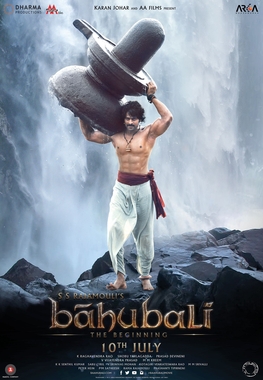
The film opens with a wounded woman fleeing Mahishmati with an infant. She reaches a river and holds the baby above water as the current carries her away. Villagers rescue the child, and Sanga adopts him as Sivudu. He grows up below a waterfall, strong enough to move a huge Shiva lingam but unable to climb the cliff he has fixated on. His foster mother warns him away, but a wooden mask washed down from above gives him someone to seek. The route from river to village to cascade introduces a story built around inheritance, though Sivudu first understands his life as a personal adventure rather than royal history.
At the top, Sivudu finds Avantika, a warrior in a rebel group trying to free Devasena, a former queen imprisoned in Mahishmati. He falls for Avantika and takes over her mission. He disguises himself in the capital during Bhallaladeva’s birthday celebrations, where citizens are forced to help raise a giant golden statue of their ruler. When it threatens to fall, Sivudu saves the workers. An artisan recognizes his resemblance to the old Baahubali, and the crowd’s chant unsettles Bhallaladeva, who sees the name as a challenge to his rule. The rescue mission has become entangled with the identity of the person who undertakes it.
That night, Sivudu reaches Devasena’s outdoor cage and escapes with her. Kattappa, the commander bound by an oath to Mahishmati’s throne, and Bhallaladeva’s son Bhadra pursue them. Sivudu kills Bhadra. Kattappa is ready to attack until he sees the young man’s face; then he drops his weapon and kneels, identifying Sivudu as Mahendra Baahubali, son of Amarendra and Devasena. The rebels and Sivudu’s foster parents ask what happened. The film shifts into Kattappa’s history, changing a personal rescue into a court struggle recounted by a man who served the royal family.
Kattappa’s account begins after King Vikramadeva’s death, when Sivagami becomes regent and raises two possible heirs: her son Bhallaladeva and the orphaned Amarendra. Their ideas of power diverge. Amarendra gains the people’s trust by attending to their needs, while Bhallaladeva pursues advantage under the influence of his father, Bijjaladeva. Devasena’s imprisonment in the present gains context through that history. Kattappa serves the throne by inherited obligation even as its ruler abuses power. His narration makes loyalty a practical dilemma: he knows what the kingdom demands, and that duty keeps him close to injustice.
The Kalakeya army threatens Mahishmati, and Sivagami gives each prince command of a division. She says the ruler should be the one who defeats the enemy chief, Inkoshi. Bhallaladeva uses a forceful chariot and pursues the commander; Amarendra looks for ways to protect civilians and soldiers. Before the fighting, the film lays out the battlefield’s geography and formations so the audience can follow the confrontation. The war makes the princes’ competing definitions of victory visible. The throne is the prize, but the people facing the invasion are the stakes of each tactical choice.
Amarendra’s forces use planned traps, but the defence buckles as Kalakeya fighters break through and take civilians hostage. He rallies the soldiers and frees the captives with a counterattack. Bhallaladeva kills Inkoshi, the stated measure for winning the succession, but Sivagami names Amarendra future emperor because he protected his people rather than treating them as expendable. The choice separates formal victory from the conduct that earns trust. Production coverage describes thousands of visual-effects shots, large-scale compositing and a long shoot for the war itself. The battle’s spectacle gives physical scale to the story’s clearest test of how Amarendra acts when the kingdom is at risk.
The film returns to Sivudu and his foster family, who want to meet Amarendra. Kattappa tells them that the prince is dead and confesses that he killed him. The admission stops before the circumstances are explained. Sivudu has a new identity and a reason to challenge Bhallaladeva, but not the full account of his parents’ fate. This ending completes the story of how he enters Mahishmati and hears its history while withholding the answer raised by Kattappa’s loyalty. Baahubali: The Conclusion continues that family and succession conflict; this film is the first half of a two-part saga.
S. S. Rajamouli directed and co-wrote the screenplay from a story by V. Vijayendra Prasad. Mahishmati is fictional, and its royal family and succession conflict are not a historical account. The design contrasts the village below the waterfall, the rebel camp and the capital’s huge statues, gates and palace. The waterfall is both an obstacle and Sivudu’s route into a life hidden from him. Production reporting describes the effects work behind the cascade and city extensions, and how crews expanded controlled sets into massed armies. The images support a structure that rises from one young man’s curiosity to war, then returns to the mystery that still drives him.