
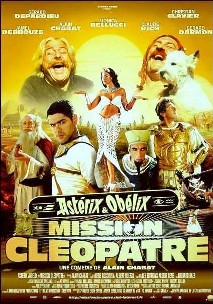
Behind the film
- Year
- 2002
- Director
- Alain Chabat
- Writers
- Alain Chabat
- Runtime
- 1h 47m
- Genres
- Comedy, Adventure
- Country
- France, Germany
- Cast
- Christian Clavier, Gérard Depardieu, Jamel Debbouze, Monica Bellucci, Alain Chabat, Claude Rich, Gérard Darmon, Édouard Baer
About the film
Contains story spoilers.
Alain Chabat’s live-action adventure takes the familiar Gaulish pair away from their village and into Cleopatra’s Egypt. The queen has heard Julius Caesar dismiss Egyptians as a people past their best, so she answers with a wager: her architects will build a magnificent palace in the desert in only three months. If they succeed, Caesar must admit that Egypt can still impress the world. Numérobis receives the assignment, but he knows the schedule is impossible without help. He travels to Gaul to find Getafix, the village druid, who agrees to come with Asterix and Obelix. The premise is simple enough to follow, and it gives every character a practical job inside the comedy.
Numérobis is a capable architect who has been handed a task designed to make him fail. His rival Amonbofis wants the commission and tries to turn the workers against him, pointing to their long hours and harsh treatment. Getafix answers the stoppage with a batch of magic potion, letting the crew move stone at a pace no ordinary labour force could match. When the work starts moving again, Amonbofis has stone shipments dumped in the Nile. The palace therefore remains a real construction project inside the farce: each delay costs time, and the contest cannot be won by a clever speech alone. Numérobis has to keep the crew, the supplies and the building moving while his rival keeps changing the problem.
Asterix, Obelix and Getafix are also targeted directly. Amonbofis’s men lure them into the Great Pyramid and leave them lost inside its passages. The three find their way out with help from Dogmatix, but the trap lets Amonbofis keep the palace project exposed while the deadline runs down. He then sends a poisoned cake to Cleopatra and frames the Gauls for trying to kill her. Getafix prepares an antidote; the friends escape custody and prove their innocence by eating the cake in front of the queen. Amonbofis’s sabotage keeps shifting from the worksite to personal danger, but Asterix’s quick thinking and Getafix’s knowledge repeatedly bring the group back to the palace challenge.
Cleopatra is not simply waiting for the Gauls to rescue her. She sets the contest in motion, expects the work to be done and will not let Caesar’s contempt define her kingdom. Caesar finally attacks the construction site with Roman siege engines, forcing the Gauls and the builders to defend the project they are trying to finish. Numérobis defeats Amonbofis in a potion-powered fight, and Cleopatra arrives to call Caesar out for breaking the terms of his own wager. The Romans are ordered to help complete the work, and the palace is finished before the deadline. Caesar then acknowledges Egypt’s achievement. The ending pays off the wager through a last change in power: the army that came to stop the building becomes part of the workforce.
The film adapts René Goscinny and Albert Uderzo’s comic world, but Chabat’s screenplay treats the ancient setting as an invitation to mix kinds of humour. Chabat has described Goscinny’s stories as layered, with adult meanings tucked into children’s adventures, and has spoken about the fun of imagining the ordinary routines of Gauls or Egyptians three thousand years ago. That everyday curiosity helps explain why the film can move from palace politics to a gag about a worker or a visitor without changing its world. It also leaves room for anachronism: modern speech, familiar habits and references sit alongside the sand, columns and Roman uniforms as part of the same comic language. The film’s rhythm depends on this layering. A scene can carry a physical joke, a play on language and a visual detail in the same moment, so the comedy is not restricted to the main plot or to one age group.
The ensemble helps keep those shifts lively. Christian Clavier plays Asterix, Gérard Depardieu is Obelix, Jamel Debbouze is Numérobis, and Claude Rich is Getafix. Chabat plays Caesar, with Gérard Darmon as Amonbofis and Édouard Baer as Otis, a worker on the site. The film moves among their different kinds of trouble: Obelix’s sheer strength can solve a physical obstacle, Asterix can see a trick coming, and Getafix’s potion can change what the workers are able to do. Cleopatra and Caesar bring the wager back into view whenever the comic detours threaten to pull too far from the deadline.
The palace project gives the film a visual structure as well as a deadline. Royal ceremonies and courtly rooms sit beside a dusty, unfinished worksite where labourers move blocks, argue over instructions and try to keep the building on schedule. The changing site makes progress visible: each new delay has a physical place to land, and the threat to the wager never disappears for long. Set decorator At Hoang and cinematographer Laurent Dailland are among the credited crew shaping that world, with Philippe Guillotel and Tanino Liberatore among the costume designers. Their work has to accommodate both the scale of an Egyptian palace and the close-up comic business of a crowded ensemble.