
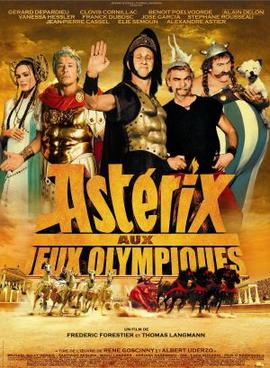
Behind the film
- Year
- 2008
- Director
- Frédéric Forestier, Thomas Langmann
- Writers
- Thierry Arbogast, Olivier Dazat, Thomas Langmann, Alexandre Charlot, Franck Magnier
- Runtime
- 2h 0m
- Genres
- Comedy, Adventure, Fantasy
- Production
- Pathé
- Country
- France, Italy, Germany, Spain, Belgium
- Cast
- Clovis Cornillac, Gérard Depardieu, Alain Delon, Benoît Poelvoorde, Vanessa Hessler, Jean-Pierre Cassel, Adriana Sklenaříková, Jamel Debbouze
About the film
Contains story spoilers.
In a small Gaulish village that still resists Roman rule, Lovesix is a poet in love with Princess Irina, daughter of the Greek king Samagas. Irina returns his affection, but her father has promised her to Brutus, Julius Caesar’s son. Brutus arrives with a statue of himself and Irina, a self-promoting engagement gift that makes the contest plain before Lovesix even enters the room. Disguised as a servant, Lovesix reveals himself and challenges Brutus to prove who deserves Irina by winning the Olympic Games. Irina agrees that she will marry the victor, turning a personal rivalry into a public sporting event and forcing her father to accept the terms.
Asterix and Obelix are drawn into the Games after meeting the Roman athlete Gluteus Maximus in the woods. The Gauls’ familiar strength comes from Getafix’s magic potion, and their village’s status as part of the Roman province of Gaul gives Asterix an argument for competing. They travel to Olympia with Getafix and the bard Cacofonix, bringing their village’s unruly comic energy into an arena governed by rules and ceremony. Brutus has a second ambition beyond Irina: he wants to remove Caesar and seize power. His contest with Lovesix therefore runs alongside a family conspiracy, making the Roman prince both a sports rival and a threat inside Caesar’s court.
The early events expose the trouble with relying on a potion in a competition meant to measure athletic skill. Brutus uses forbidden methods and bribery, while the Gauls’ own advantage is challenged when officials catch them using magic potion and disqualify them. Asterix has to find a path to victory without the shortcut that usually settles a Roman argument in a single blow. Brutus, meanwhile, proves a poor athlete even when he tries to tilt the results. The film turns the modern language of doping and fair play into an ancient comic predicament: everyone has an advantage they would rather keep, but only some are willing to call it cheating.
Asterix takes the issue to Caesar, asking whether Rome wants to be laughed at as a nation of cheats. Caesar orders the manipulation stopped, but Brutus finds another route. He kidnaps Getafix and tries to obtain a cauldron of potion for himself, hoping to replace sporting skill with the same superhuman force that has made the Gauls so difficult to defeat. His schemes keep threatening to escape the bounds of the Games. The Olympiad is now a stage for two competitions at once: Lovesix’s attempt to win Irina honestly and Brutus’s attempt to control both the result and his father’s throne.
The deciding contest is a chariot race, where the film makes room for a large-scale comic set piece and a parade of familiar sporting imagery. Brutus finishes first, but his blue tongue exposes his use of the doctored potion. Caesar declares the Gauls the winners, which allows Lovesix and Irina to marry. The celebration restores the romantic promise at the centre of the plot, but Brutus is left with a punishment that punctures his imperial pretensions: he is reduced to slavery aboard Caesar’s galley. His attempt to use the Games as a ladder to power ends with him literally serving the authority he hoped to replace.
This live-action adaptation takes its central sporting premise from René Goscinny and Albert Uderzo’s comic, while adding the romance between Lovesix and Irina and Brutus’s conspiracy against Caesar. Those additions give the film a wider ensemble plot than the comic’s simpler reason for entering the Games. The result shifts attention toward the Roman court and the rivalry between Caesar and his son, even as Asterix and Obelix remain the familiar point of entry. The contemporary sports cameos and anachronistic jokes make that adaptation choice explicit: French critic Ophélie Wiel singled out the Schumacher-Ferrari gag and the film’s invented sports references as examples of its broad, present-day comedy. Their presence connects the new court intrigue to the series’ basic joke: an occupied Gaul can still unsettle Roman confidence with a village-sized exception to imperial power.
Thomas Langmann wanted a cast that would travel across Europe, drawing lessons from the different fortunes of the earlier Asterix films in France, Germany and Italy. Michael “Bully” Herbig’s silent slave offered a way around the language barrier: gestures and expressions could carry the comedy without dialogue. The chariot race brought another international face into the arena, Michael Schumacher, after the filmmakers imagined a Ferrari in the ancient contest. His appearance makes the sporting anachronism part of the spectacle, placing a contemporary racing champion inside a Roman competition.
The film’s visual language aims to make a photographed landscape behave like a comic-book panel. Time Out noted Aline Bonetto’s recreation of the comics’ scenery and foregrounds, alongside computer effects that support rather than dominate the live-action performance. Moria likewise points to the magnifying-glass opening and the cartoon physics of Romans knocked from their armour as deliberate echoes of the printed stories. The adaptation’s particular balance is visible in its added romantic and political plots: they broaden the cast and create more room for European cameos, while the potion, athletic contest and boisterous Gaulish group keep the premise recognisably Asterix.