
Behind the film
- Year
- 1993
- Director
- Emir Kusturica
- Writers
- Emir Kusturica, David Atkins
- Genres
- Comedy drama, Adventure, Drama, Fantasy
- Production
- StudioCanal
- Country
- France, United States
- Cast
- Johnny Depp, Jerry Lewis, Faye Dunaway, Vincent Gallo, Lili Taylor, Paulina Porizkova, Michael J. Pollard, Emir Kusturica
About the film
Contains story spoilers, including the ending.
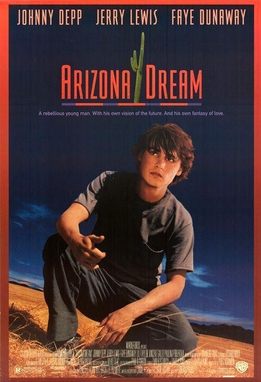
Arizona Dream follows Axel from New York to an Arizona car dealership, with his uncle Leo hoping to turn a family visit into a permanent arrangement. The younger man is drawn towards fish, distant ice and imagined journeys, while Leo wants him to learn the business and find a life nearby. Emir Kusturica's 1993 film brings Johnny Depp, Jerry Lewis, Faye Dunaway, Lili Taylor and Vincent Gallo into this world, with music by Goran Bregovic. Axel's encounter with Elaine, who dreams of flying, redirects his attention from selling cars to building something with no secure prospect of leaving the ground.
Paul brings Axel to Arizona for Leo's wedding, but the visit becomes entangled with Elaine and her stepdaughter Grace. Axel falls for Elaine and works on her flying machine. Grace interferes with the construction, and he rebuilds what she damages. When Leo and Paul try to bring him back to the dealership, Elaine resists their intrusion. Completing the machine does not deliver the escape she wants: its test ends in a tree. Paul has an ambition of his own, expressed through a talent-show performance of Cary Grant's crop-duster scene from North by Northwest. The judges give him a dismal score, while news that Leo is seriously ill pulls Axel out of the evening's performance and towards an ambulance. Cars, improvised aircraft and an imitation of a movie chase offer different forms of movement around a group whose plans keep stalling. The family business cannot hold Axel, but the life he finds away from it brings demands he has not anticipated.
A later reunion at Elaine's house leads to her birthday celebration and the gift of an aeroplane. A storm interrupts the party. Grace releases her turtles, then gives Axel a globe while they wrap presents. He tells her that he no longer loves Elaine and promises that they will go to Alaska. The promise cannot prevent the tragedy that follows. Grace dies by suicide despite Axel and Elaine's attempt to reach her, and lightning destroys the plane. The film eventually returns Axel to Leo's deserted Cadillac showroom, where he sleeps on a car near a cat and her new litter. His dream takes him back to the Arctic landscape from the opening, now with Leo beside him. They catch a halibut, which flies towards the sunrise. The last journey happens in sleep after the household's losses. The dream reunites Axel with his uncle without reversing the events that have brought him back to the empty dealership.
Kusturica discussed the fish imagery in his interview with M. Bouineau after the film's release. He associated the fish with loneliness and recalled feeling displaced when he first reached America, as though he were outside his natural element. His explanation gives the image a personal connection without turning it into a fixed answer to every scene. He also described combining selected pieces of realism with irrational material. The relationship between Depp and Dunaway was part of that effort: he wanted its feeling to exceed what the characters could state directly. Asked about recurring ceremonies and celebrations, he connected weddings, funerals and birthdays to the risks his characters encounter in life. These gatherings offer the story occasions to move between ordinary social behaviour and the strange events that break into it. The characters' dreams remain close to the activities and objects of their daily lives.
In his conversation with Philippe Elhem for 24 images, Kusturica called Arizona Dream an English-language film rather than an American film. Working in the United States had not changed the vision he wanted to pursue. He described mixing genres around his own interest in dreams and wanted the film to contain the despair he had encountered in New York, alongside its capacity to amuse. His account also makes the ensemble an active part of that approach. He wanted the actors to put their energy together without treating some characters as stars and others as support. The separate wishes of Axel, Leo, Elaine, Grace and Paul could therefore pull the story in competing directions. Kusturica regarded Paul as a tragic figure of alienation, even where the aspiring performer might appear to be providing comic relief.
Bouineau also asked about the recurring collision of comedy and tragedy. Kusturica said that attempts to make comedy repeatedly led him towards tragic material. For him, the mixed tone belonged to the life being brought into the film, alongside the rain, animals and celebrations that recur in his work. He told Elhem that a narrative could appear to head in one direction before deliberately taking another. His approach asked audiences to follow changes in feeling and association instead of expecting every episode to complete an orderly plan. That freedom extends from the cast's competing ambitions to the movement between a family gathering, a failed performance and a dream.